


The Chianan Canal Miracle
In 1920s southern Taiwan, while the gunfire of the "indigenous pacification policy" still echoed faintly through the depths of the Central Mountain Range and the literati of Taipei's Dadaocheng still cried out for liberty and equality, a vast yet lifeless wasteland stretched across the horizon of southern Taiwan. That was the Chianan Plain — fully 150,000 hectares of it.
In that era, this was no golden granary of rolling rice waves but a wasteland of weeds and cracked earth, "fields that depend on the sky" that had drained the tears of countless farmers. Without any proper irrigation system, the plain was held hostage year-round by extreme drought, by floods triggered by torrential rain, and by severe salinization seeping in from the coast. In winter, a furious northeast monsoon swept the surface, lifting clouds of yellow dust; salt crystals bloomed white on the dried mud like a thick layer of snow, allowing nothing to grow. Farmers here could only stand barefoot on earth as hard as iron beneath a burning sun, looking helplessly to the heavens, living in hunger and cold and depending entirely on the sky for survival.
The fate of this land turned completely in 1920. That year, a thirty-four-year-old Japanese civil engineer with curly hair, a firm gaze, and burning passion arrived in Guantian, Tainan, with his surveying instruments. His name was Yoichi Hatta.
A graduate of Tokyo Imperial University, Hatta was a brilliant engineering prodigy. Standing on the undulating hills of Guantian, gazing at the lifeless white expanse before him, he ignited an almost insane vision: on this wasteland that the Qing Empire had been unable to tame in two centuries of rule, he would build the largest super-hydraulic engineering work in all of Asia at the time, a miracle even by the standards of world hydraulic history — the Wushantou Reservoir and the Chianan Canal.
The scale of the project was suffocating. Hatta planned a massive dam across the Guantian Creek standing fifty-six meters high and more than a thousand meters long. To draw the abundant waters of the Zengwen River beyond Guantian into the reservoir, he boldly decided to cut a diversion tunnel more than three thousand meters long straight through the belly of the Wushan Mountain. At the same time, he would lay a labyrinth of channels with a total length of sixteen thousand kilometers — enough to wrap half the globe — to carry clean water to every corner of the Chianan Plain.
This was no detached design drawn up at an office desk. It was a decade-long pilgrimage of blood and tears.
Construction formally began in 1920. Hatta moved his entire family — his wife Toyoki and their young children — into the worker dormitories at the Wushantou construction site. He shared every hardship with thousands of Han Taiwanese laborers, indigenous youths, and Japanese technicians. In an age without modern excavators or advanced ventilation, the cutting of the mountain and the building of the dam were done entirely by hand, by laborers with pickaxes, iron shovels, and dynamite, hacking inch by inch through hard rock and clinging mud.
The most brutal and moving battlefield of the entire project was the excavation of the Wushan Mountain diversion tunnel. Sunless and lightless, with subterranean temperatures soaring past forty degrees Celsius, the air there hung thick with toxic gases and volatile natural gas ready to ignite. The fires of the 1895 Yiwei War had long died out, yet in this pitch-black tunnel another battle against fate was only just beginning.
In the early winter of 1922, a thunderous gas explosion erupted deep within the tunnel. Fire instantly consumed the shaft, mudslides surged in, and more than fifty Taiwanese and Japanese laborers lost their lives in an instant. As the charred bodies were carried out one by one, lamentations shook the entire Wushantou site, and countless laborers, in terror, packed their belongings and fled into the night. The project ground to a complete and despairing halt.
At this critical moment — hearts shaken, even the Government-General preparing to abandon the bottomless project — Yoichi Hatta revealed a moral spine that transcended nationality and class. Choking back grief at the loss of his comrades, he stood himself in the construction yard and cried out to all the laborers: "On this site there are no Japanese and no Taiwanese! There are only brothers sweating together, struggling together for this land!" He then funded a "Martyrs' Monument" by the reservoir, carving into a single stone the names of every Taiwanese and Japanese laborer killed or felled by illness — without distinction of rank or nationality. He personally visited the family of every fallen Taiwanese worker, delivering compensation and pledging to care for their well-being for the rest of their lives.
Hatta's sincerity and selflessness completely won the hearts of the Taiwanese laborers. They wiped away their tears, pic…
Hatta's sincerity and selflessness completely won the hearts of the Taiwanese laborers. They wiped away their tears, picked up their iron shovels again, and walked back into the black hole that could collapse at any moment.
To meet the project's harshest challenges, Hatta produced a series of miracles in world hydraulic history. Rejecting the concrete-dam techniques then in vogue in Europe and America, he adapted to local conditions and adopted the radically forward-looking "Semi-hydraulic Fill" method. Mixing silt, clay, and gravel, he used water's buoyancy and natural gravity to allow the dam body to compact itself naturally — building a "living reservoir" fused with the natural landscape. To this day, despite decades of powerful earthquakes and storms, the Wushantou Reservoir remains intact.
The climax of history arrived on 10 April 1930 (Showa 5).
On that day, after ten full years of labor, more than fifty million yen of astronomical investment, and the sacrifice of one hundred and thirty-four lives, the Chianan Canal was formally completed and the water was at last turned on.
Yoichi Hatta and his countless mud-caked, emaciated Taiwanese laborers stood silently before the great outlet of the Wushantou Reservoir. As the floodgate rose to the heavy scrape of its steel cables, a clear and torrential current — like a long ribbon of white silk, like a water dragon that had slept for a thousand years — burst out roaring, surging through the lattice of channels toward the parched Chianan Plain.
In distant fields, thousands of Taiwanese farmers at work heard the rush of water from afar. When the cool clear water flowed into their cracked rice paddies and washed away the white salt crust on the soil, every farmer, every woman, every child — heedless of the mud on their bodies — rushed wildly into the channels. They scooped the water with their hands and drank in great mouthfuls, splashed it on their faces, looked at the rising green of their fields, and burst into cheering and weeping that rang up to the sky.
That night, all of southern Taiwan blazed with lights. Farmers held operatic celebrations at temple gates as if it were the new year.
Through the sweat of Hatta and his laborers, the Chianan Plain rewrote its fate overnight. The dry, drought-stricken "fields of the sky" became a golden granary of three-year crop rotations and annual abundance. Rice and sugarcane yields in Taiwan multiplied many times over, finally uprooting the existential cancer of chronic water shortage that had plagued southern Taiwan for two centuries of Qing rule and that had so often sparked ethnic feuds.
Tragically, the engineering master who had given his life to the soil of Taiwan met his end in the Pacific War. In 1942, Hatta was ordered to the Philippines for a hydraulic survey of cotton cultivation. The merchant ship "Taiyo Maru" carrying him was torpedoed by an American submarine near the Goto Islands. Hatta perished at the age of fifty-six. His wife Toyoki, refusing after Japan's defeat in 1945 to leave the land that had bound her so deeply to her husband, walked one rain-lashed night to the outlet of the Wushantou Reservoir and threw herself into the water, following him in death.
Yoichi Hatta's story is the most border-transcending and the most constructive chapter of Taiwan's Japanese era. While imperial politicians were busy plundering and imperial armies were busy killing across the battlefields of East Asia, Hatta poured ten years of his youth, his exquisite technical genius, and his immense love for his workers into carving from the earth a wellspring of life that still pulses to this day.
Today, when you drive past Guantian, Tainan, and see the still waters of the Wushantou Reservoir resting like a single emerald coral among the mountains, in the shade of the trees beside the reservoir you can still find Yoichi Hatta's bronze statue. He is not arrayed in dignified imperial uniform or a Western suit; instead he wears working clothes, his curly hair still on his head, one hand running through that hair, sitting cross-legged on the ground in deep concentration, gazing quietly at the plain of abundance that he and his pioneers irrigated with their blood and sweat. That tenderness toward the land has become, in Taiwan's historical memory, the most indelible legend in the long annals of this island.
The water came, but not every year. The Chianan canal could not supply a hundred and fifty thousand hectares, and the answer designed into it was the three-year rotation: the irrigated area was cut into three blocks, each of which took its turn at paddy rice once in three years and grew cane and dry crops the other two. What to plant was not the farmer's decision; the irrigation association allotted it by roster, and breaches were fined. For people who had lived by the sky for generations this was still a change: once water reached the saline ground it began to grow things, and yields steadied. The price appeared on a different sheet of paper. The water rate was levied by area whether or not your block had its turn that year, and in the two cane years the purchase price was set by the sugar company. In the farmers' movement of the late 1920s the demands around Chianan were usually the same two: relief on the water rate and adjustment of the rotation. Which gave the old saying its second half — in a water year you thank Mr Hatta, and in a dry year you pay the rate all the same.
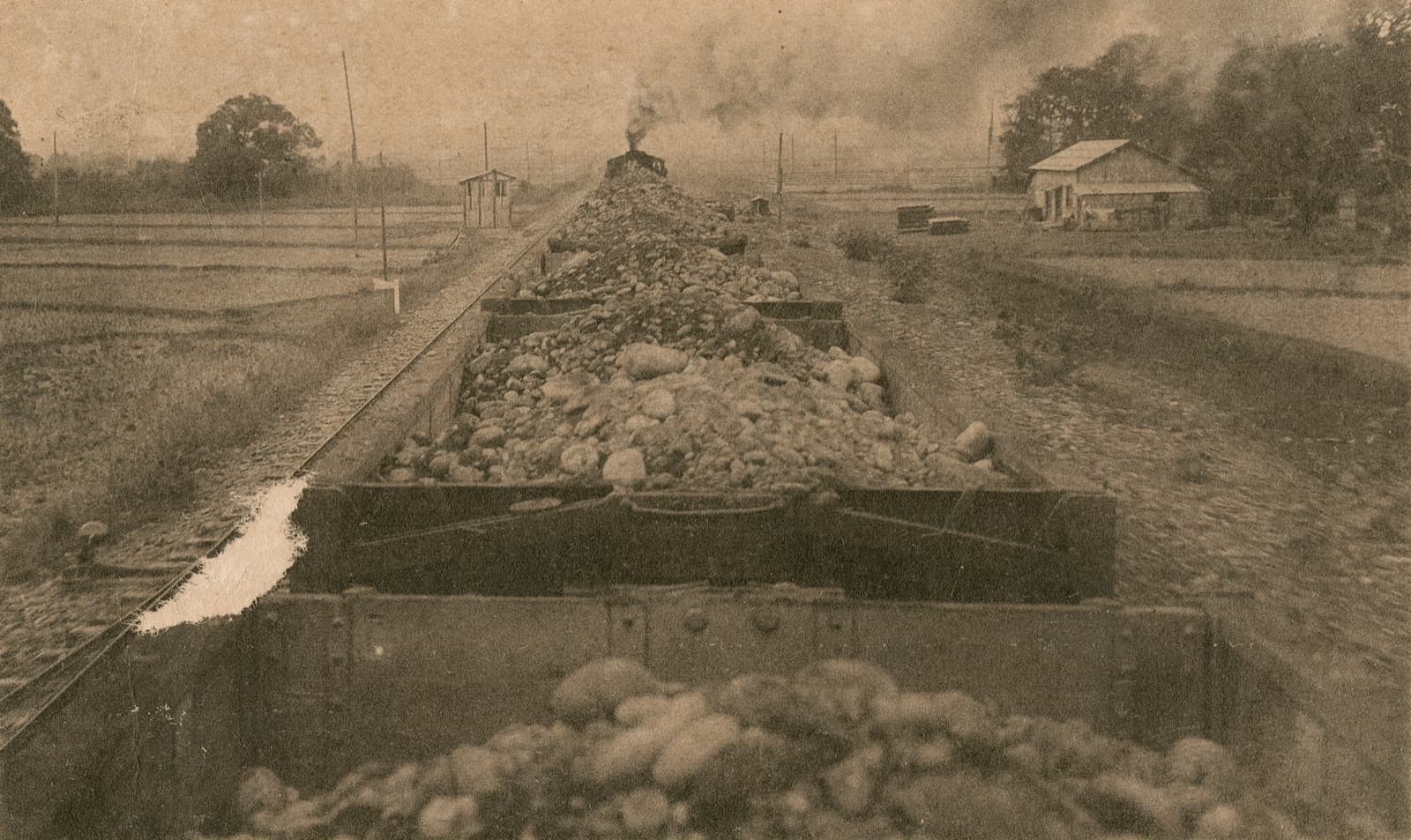
A train hauling gravel to the Wushantou dam site. Hatta Yoichi chose semi-hydraulic fill, sluicing earth and rock into place — a method without precedent in East Asia at the time.
Taiwan Cultural Memory Bank
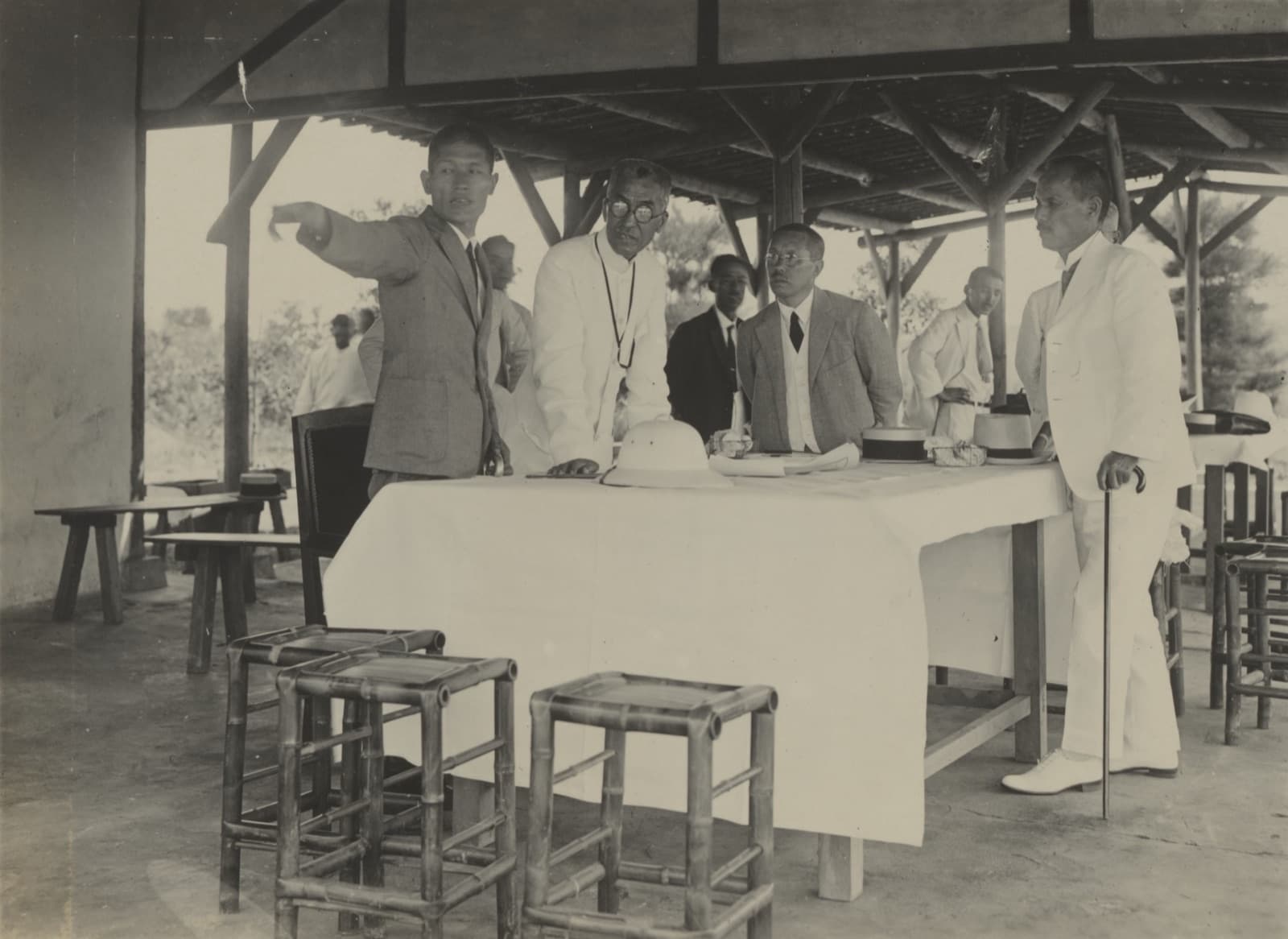
Governor-General Ishizuka Eizo receiving a briefing at Wushantou, 1929. The canal watered 150,000 hectares — at the price of a three-year rotation that took the choice of crop out of the farmers' hands.
National Center of Photography and Images
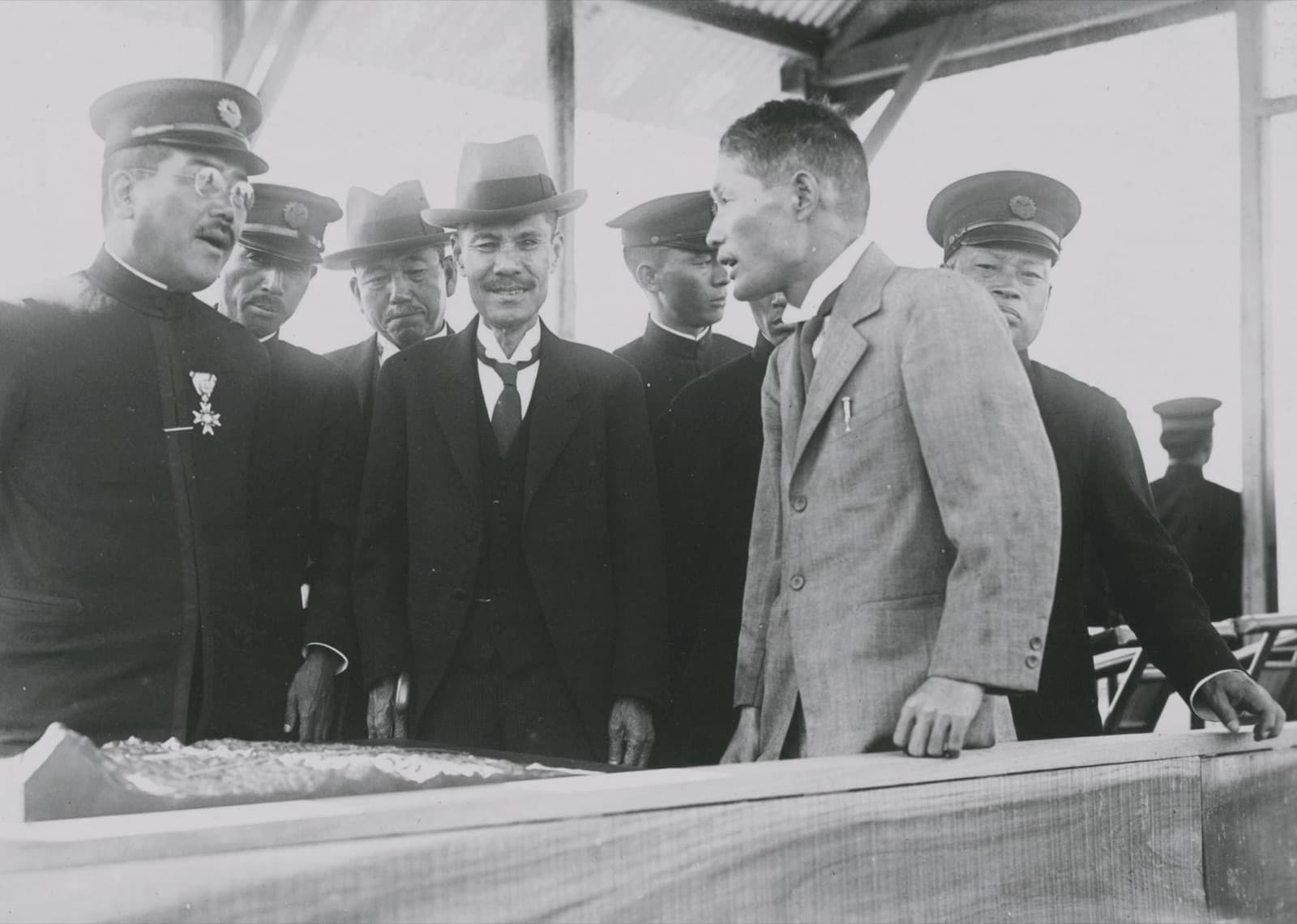
Officials inspecting the Chianan canal works. Ten years in the building, it was opened in 1930 as the largest irrigation system in East Asia.
Public domain; photographer unknown
Isle of Time