


Taiwan Parliament Petition
In the early 1920s, a group of Taiwanese students living in Tokyo began, under the lamplight of a foreign city, to rethink their own destiny and that of their island. Japan was then in the high tide of Taisho democracy; the vocabulary of parliamentary politics, liberty, and human rights circulated through the streets and campuses of the imperial capital. Taiwan itself, however, remained bound by a colonial system in which the Governor-General held legislative, executive, and judicial power in a single hand. It was within this gap that these young men formed the New People's Society in 1920 — a core group to gather like-minded comrades and search for a way forward, and the seed of a political movement that would last more than a decade.
Out of the Society's debates a clear line of thought gradually emerged. Rather than talk idly of outright independence, or submit to complete assimilation, they would seek political rights for Taiwanese within Japan's own constitutional framework. Their concrete aim was to demand an elected parliament for Taiwan, one holding the power to legislate and to approve the colony's budget. It was a shrewd and cautious middle path — acknowledging the reality of the colonial framework while prying open, within that framework, a space of self-rule for the island's people. Another current of opinion on the island called instead for assimilation, for Taiwanese to be granted the same treatment as Japanese in the home islands. But the petitioners understood that complete assimilation would in the end erase Taiwan's own face, and that only self-rule centered on a parliament could allow Taiwanese to take part, as subjects in their own right, in the political decisions that governed their lives. This insistence on subjecthood gave the movement, beneath its moderate surface, a far-reaching and clear-eyed political ambition.
The movement's acknowledged leader was Lin Hsien-tang, the gentleman of Wufeng. Born of a distinguished family and long esteemed, he became, through his measured and steady bearing, the figure around whom the various factions gathered. Beside him, Chiang Wei-shui labored with fierce energy to organize and connect, while Tsai Pei-huo advanced the cause through his pen and his gift for organization. The three men complemented one another, forming the campaign's most important driving force, and behind them stood countless doctors, lawyers, teachers, landlords, and young students.
In 1921 the first Petition for the Establishment of a Taiwan Parliament, carrying 178 signatures, was formally submitted…
In 1921 the first Petition for the Establishment of a Taiwan Parliament, carrying 178 signatures, was formally submitted to the Imperial Diet. Over the following fourteen years the petitioners crossed the sea to Tokyo fifteen times in all, again and again placing the Taiwanese demand at the center of imperial politics. The number of signatories climbed with each round, repeatedly gathering thousands of names, far surpassing the original scale — a sign that this was no longer the lonely cry of a small elite but a steadily spreading island consensus.
Each petition journey to Tokyo was itself a public event. The delegations' departures and returns, the speeches and gatherings along the way, resounded across the island through newspapers and word of mouth. Crowds seeing the petitioners off at the wharf, cheers before the railway stations — these became concrete scenes in which the island's people expressed a shared identity. For Taiwanese long excluded from politics, these actions were like open lessons in civic life, teaching people to understand their own condition in the language of rights, representation, and the rule of law. To sign a petition was no longer merely to write one's name, but to make a public political declaration; to join a farewell rally was to acknowledge oneself a part of this island's fate. In this back-and-forth, round after round, the long-dormant political consciousness of an entire generation was slowly awakened.
Yet the colonial authorities never granted the parliament. Faced with this steady, peaceful pressure, the Governor-General's Office alternated between conciliation and suppression, but yielded not an inch. As the 1930s arrived, militarism rose within Japan, the pace of outward expansion quickened, and the political space on the island tightened accordingly. Squeezed between mounting pressure and the gathering shadow of war, the movement was quietly wound down at last in 1934.
The Taiwan Parliament Petition Movement never won a true parliament, yet it was the longest and most sustained peaceful campaign of the entire colonial era. Across those fourteen years, in the gentlest and most tenacious of ways, it proved that Taiwanese could express a collective will with discipline and strategy. The seeds it sowed — of rights, of representation, of the imagination of self-rule — sank deep into the island's soil, becoming the spiritual bedrock to which every later Taiwanese political and social movement would return, and from which it would draw nourishment.
In 1907 he met Liang Qichao at an inn in Nara and asked what the Taiwanese ought to do. Liang's answer was that China would be in no position to help Taiwan for thirty years, and that the Taiwanese should do as the Irish had done with the English: secure political rights first. That conversation set his course for the next three decades — not independence, not assimilation either, but a parliament of Taiwan's own inside the constitutional frame of the empire. The first petition went in on January 1921 with one hundred and seventy-eight signatures, his name at the head. It was repeated each year, fifteen times in all by 1934, the largest gathering more than two thousand signatures. He travelled to Tokyo every year to see members, hold briefings, write submissions, and the money of the Lin family of Wufeng went in year after year. All fifteen petitions were shelved by the imperial Diet. In a speech in Shanghai in 1936 he used the words returning to the motherland; back in Taiwan he was struck in public by a Japanese ruffian in Taichung Park and afterwards resigned his offices. He left for Japan in 1949 and never returned.
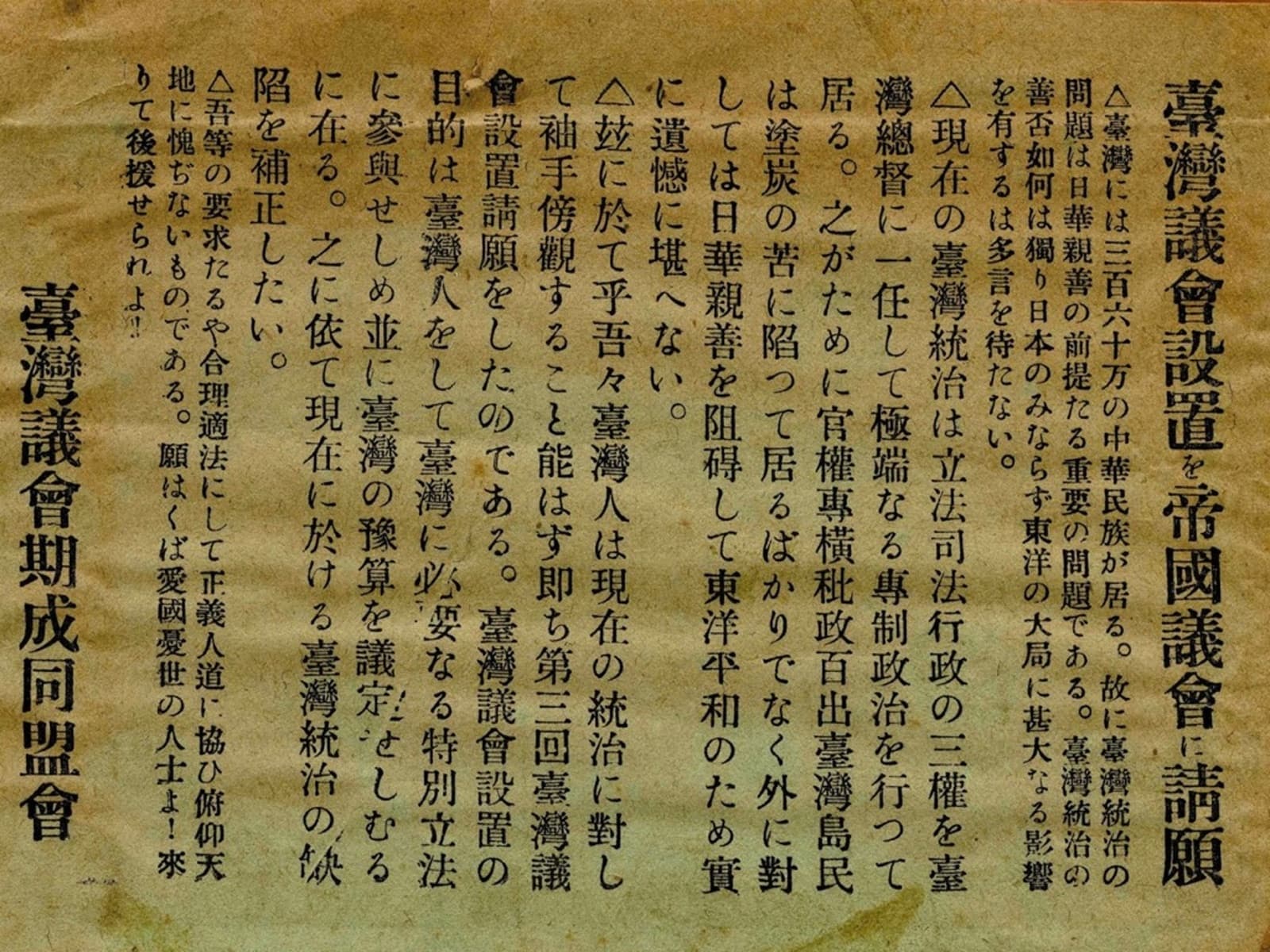
A petition handbill from the League for the Establishment of a Taiwanese Parliament. It argued that islanders should have a say in legislation and budgets — not independence, but representation inside the empire.
League for the Establishment of a Taiwanese Parliament
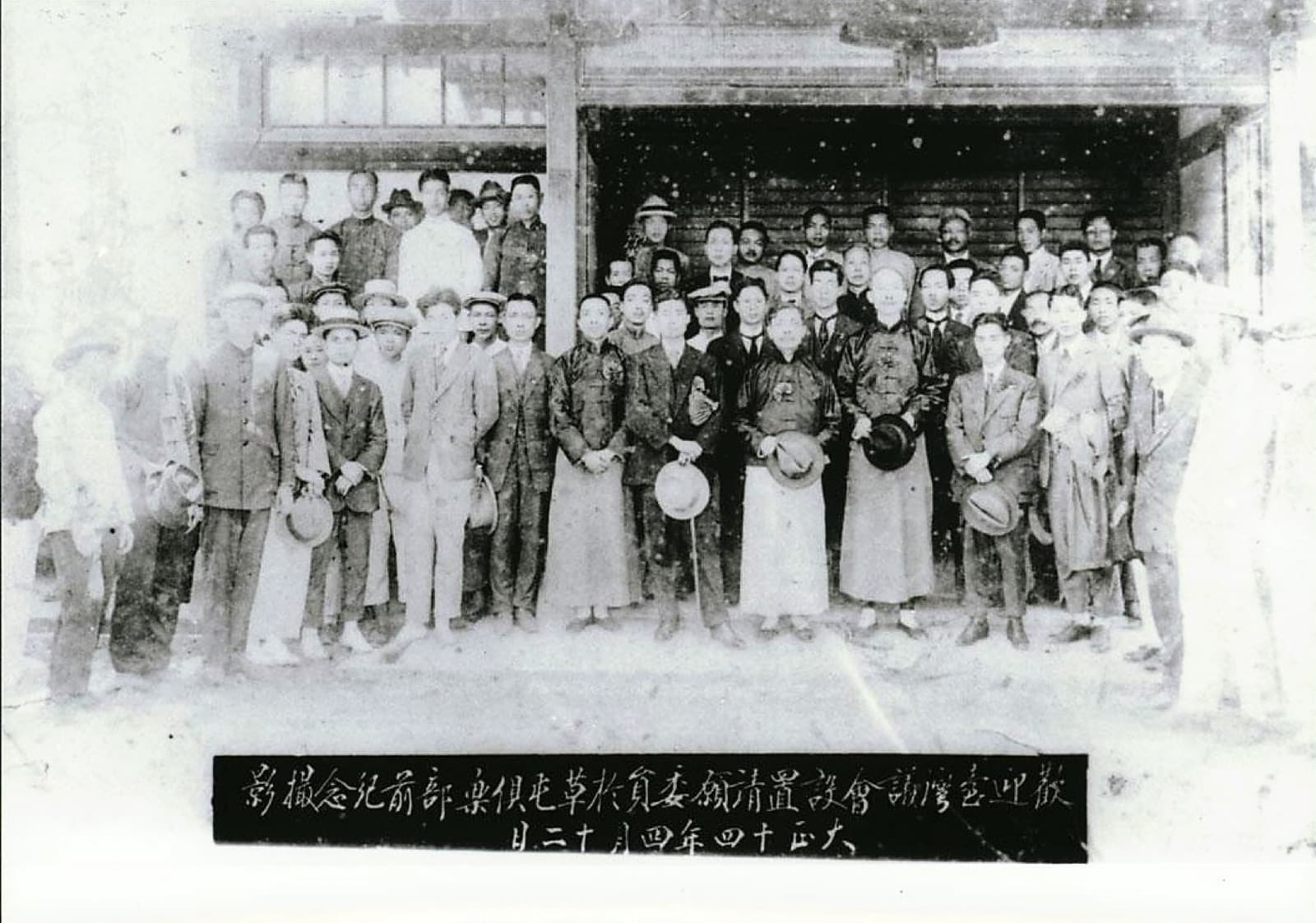
Petitioners photographed before departure, 1925. Between 1921 and 1934 the movement submitted fifteen petitions to the Imperial Diet. Not one was adopted.
Academia Sinica Digital Archives
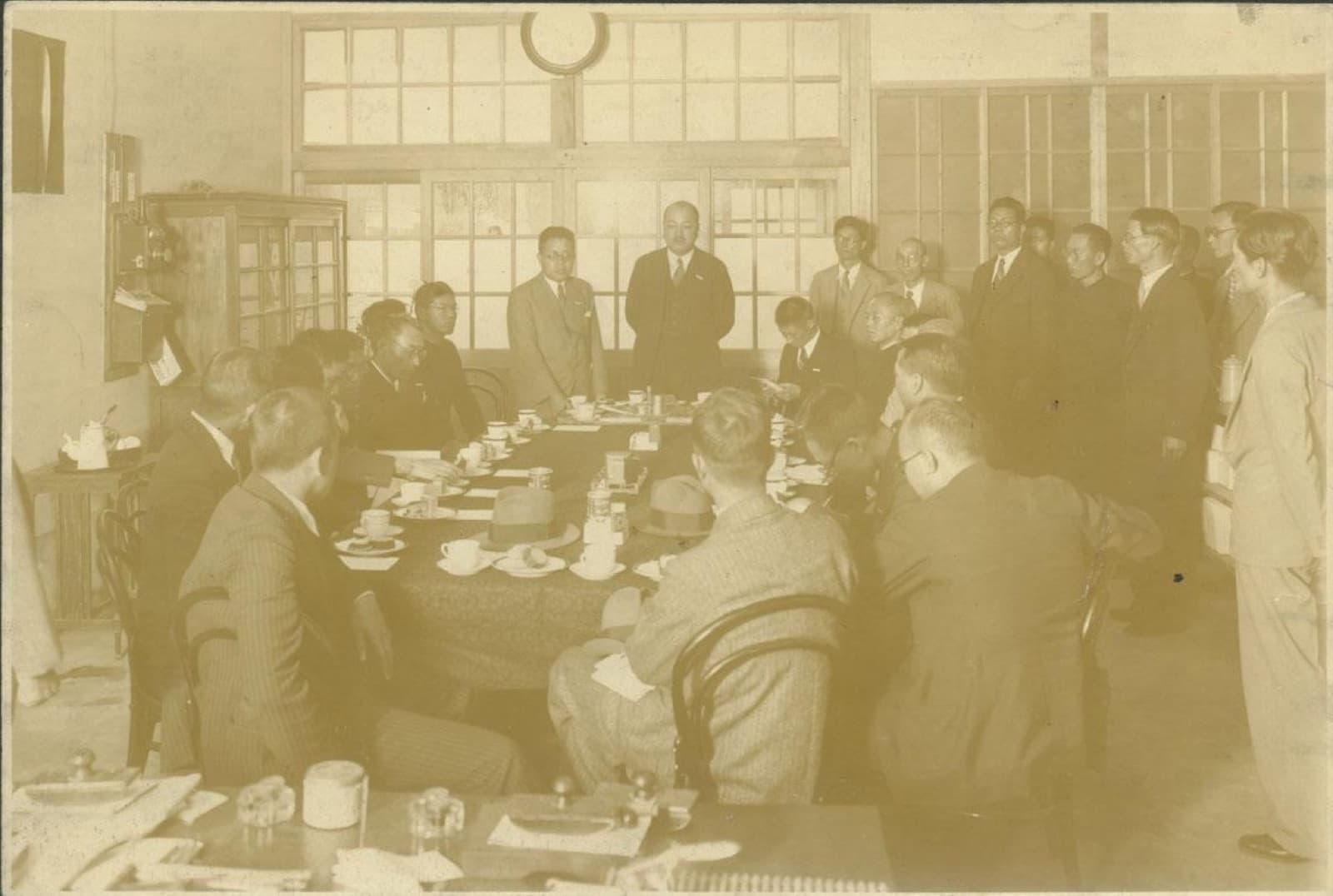
Iap Ing-tsing and others in session, 1924. This generation of newly educated intellectuals moved the struggle from rifles in the hills to paper outside the chamber.
Academia Sinica Digital Archives
Isle of Time