


The Erhlin Incident
Under Japanese colonial rule, Taiwan's sugar industry was built into one of the empire's most important economic pillars — yet that sweet wealth rested on the sweat and humiliation of the cane farmers. Through the system of designated "raw-material collection zones," the Government-General carved every stretch of cane field into the territory of a single assigned sugar company, so that the cane a farmer grew could be sold only to the one mill within his zone. As a result, when the cane would be harvested and weighed, how it would be graded, and what price each hundred catties would fetch were all decided by the company alone. The farmers had no room to bargain and no way to check whether the scales — held entirely in the company's hands — were honest. Day after day of toil brought them suppressed prices and weights that had plainly been tampered with. Small wonder that a bitter, wry saying passed from mouth to mouth: "the smartest man in the world can't beat the sugar company's scales." That single refrain captured an entire generation of growers' resignation and resentment toward this structural exploitation.
As the 1920s arrived, stirred by currents of thought sweeping the world and by the awakening of intellectuals, that silent resignation began to loosen. In Erhlin, in Changhua, a man who was both a physician and a social activist stepped forward — Li Ying-chang. While healing the sick, he also walked out among the field ridges to teach the farmers of his district what rights and fairness meant. Under his rallying call, in the summer of 1925 the cane farmers of Erhlin gathered together and formed the first cane growers' union in Taiwan's history. The union's demands were not radical, but they struck at the heart of the matter: the farmers asked that prices be agreed before the cane was harvested, that they be allowed to send representatives to witness the weighing, and that they have a say in and knowledge of the grading standards. For farmers who had long been at the company's mercy, this was the first collective voice they had ever raised — an attempt to wrest back some measure of their fate from beneath those opaque scales.
The union's adversary was the powerful Lin Pen-yuan Sugar Company, which had no intention of giving ground. When the cane-harvesting season came that October, the company disregarded the farmers' calls to agree prices and negotiate first, and simply sent its men into the fields to seize the harvest. In that moment, the grievances accumulated over years found their outlet.
On 22 October 1925, the farmers of the Erhlin area came face to face with the police who had been sent to guard the harv…
On 22 October 1925, the farmers of the Erhlin area came face to face with the police who had been sent to guard the harvest, and the taut situation escalated at last into physical conflict. To the colonial authorities, that farmers should dare to stand collectively against both company and police was a provocation that could not be tolerated. In the aftermath, the authorities launched mass arrests: scores of participants were detained and imprisoned, among them the union's core leaders, and dozens more were formally prosecuted and brought before the colonial courts. Li Ying-chang and many of the farmers' leaders thus paid the price in prison and in trial.
The Erhlin Incident was the first large-scale, organised farmers' protest since the beginning of Japanese rule over Taiwan. Unlike the scattered armed resistance of the past, it was a modern social movement built around a union and framed as a struggle for economic rights. Although the protest was outwardly suppressed under the authorities' crackdown — its leaders behind bars and the union's activities set back for a time — the flame it had lit reached far beyond the bounds of this small sugar town.
The example set by the Erhlin cane growers' union let farmers across the island, suffering the same exploitation, see the power of solidarity. Inspired by it, in less than a year an organisation emerged that crossed regional lines and linked farmers throughout Taiwan: in 1926, Chien Chi, Chao Kang and others drove the founding of the Taiwan Farmers' Union, gathering a struggle once confined to a single town into a tide of rural protest that swept the whole island. From a quarrel over the scales in one corner of Erhlin to farmers across Taiwan rising for their land, their tenancy, and their dignity, the thread of resistance was drawn taut and continuous.
Looking back, the meaning of the Erhlin Incident has long since outgrown the cane and the scales themselves. It made Taiwan's farmers realise for the first time that, in the face of structural injustice, only by organising and raising a collective voice could they hope to move a balance that had always tilted toward the company. Those nameless farmers who were detained and prosecuted wrote, with their imprisonment and their sacrifice, a crucial opening chapter to the sweeping social movements of the colonial era.
The rules of the trade were the company's. The raw material zone system assigned every cane field to a designated sugar company, and the cane in that field could be sold to no one else; the date of harvest, the place of weighing, the grading and the price were all set by the company, and the farmers never laid a hand on the scale. The saying put it plainly: the greatest fool under heaven is the man who grows cane for the company's scale. In June 1925 Dr Li Ying-chang, together with Liu Sung-fu and Chan Yi-hou, founded the Erlin cane farmers' union, the first peasant union in Taiwan. The three things they asked for were not extreme: the purchase price announced before the harvest, farmers present at the weighing, and freedom to buy fertilizer where they chose. The Lin Pen Yuan Sugar Company did not reply, and in October sent its men into the fields on the date it had fixed. On 22 October the farmers gathered at the field edge to stop the cutting and clashed with the police who arrived. Nobody died that day. Over the following two months more than four hundred people were reported for prosecution.
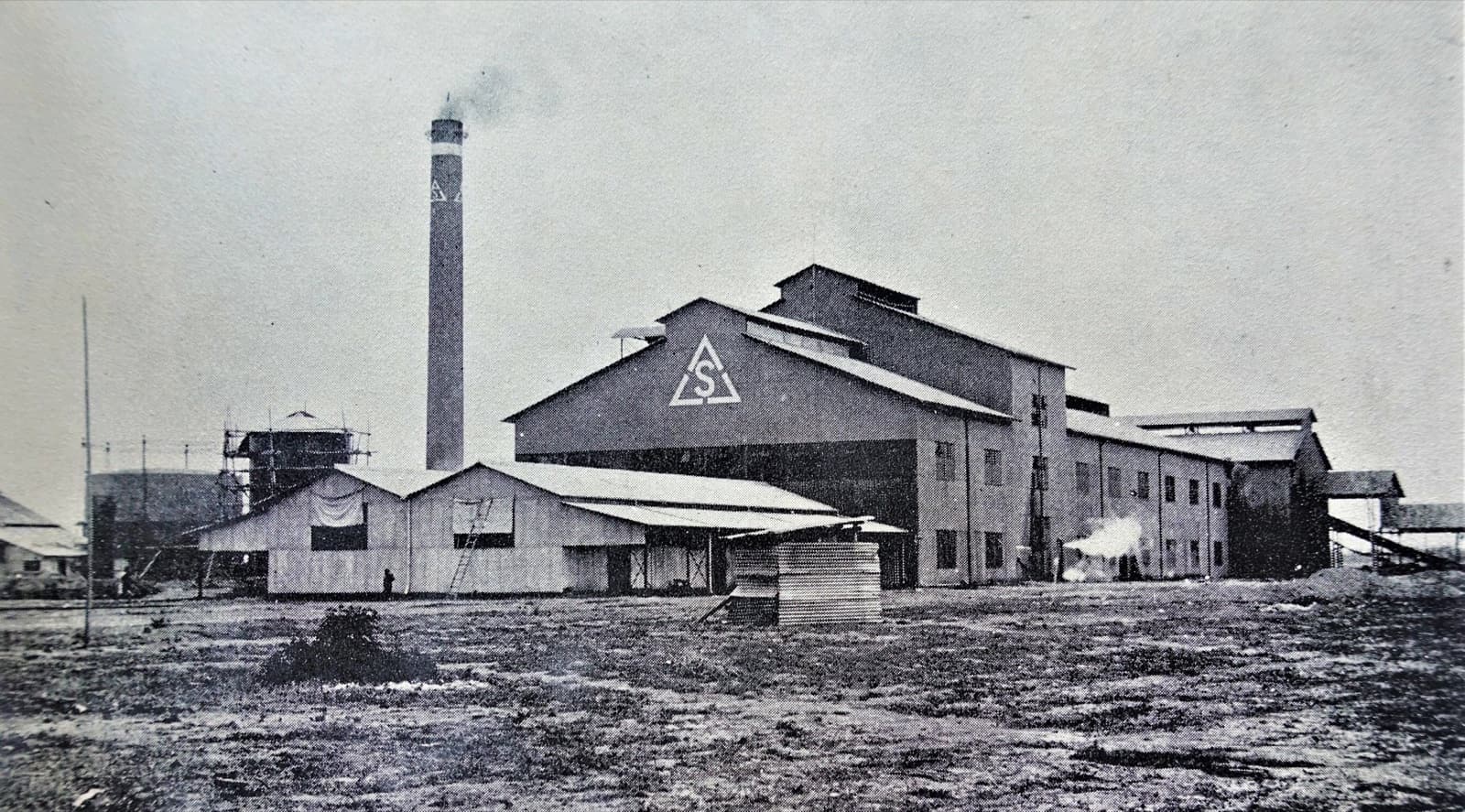
The Lin Pen-yuan sugar company's mill. The Government-General drew raw-material zones: cane growers inside a zone could sell only to the one designated company, at the price that company set.
Public domain; photographer unknown
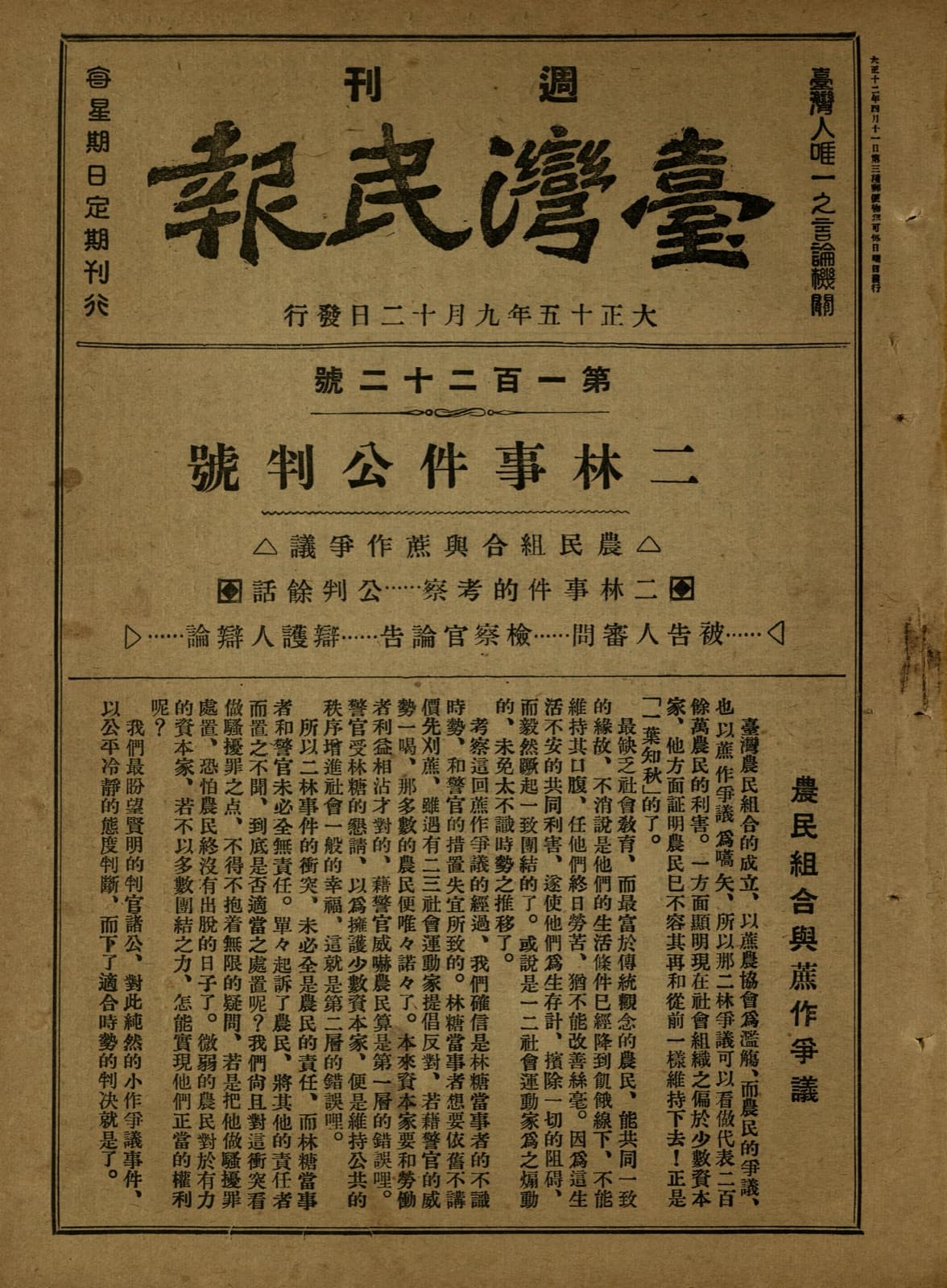
*The Taiwan Minpao* no. 122, the Erhlin trial issue, 12 September 1926. More than ninety growers were arrested after the clash with the sugar company; this issue gave the trial its front page.
National Museum of Taiwan History
Isle of Time