


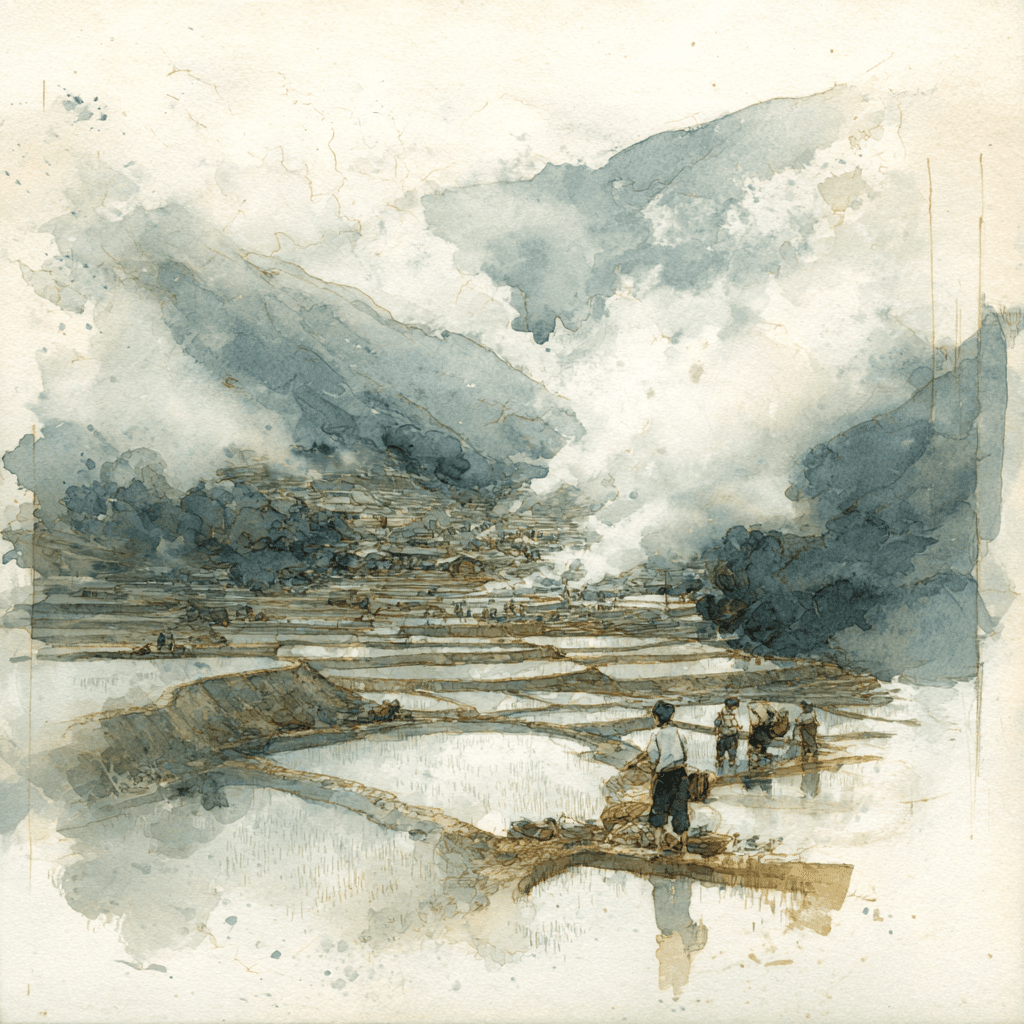
In 1912 Iso Eikichi, twenty-six years old, reported for work at the Government-General's agricultural experiment station. The island grew native indica rice, long, slender and not very sticky, which Japanese diners did not care for. Rice seed brought from Japan did poorly on Taiwan's lowlands: the heat made it head too early, and the harvest was poor. What the Government-General wanted was a rice that could be grown in Taiwan and sold in Japan.
Another man had arrived two years before him. Suenaga Megumu came to Taiwan in 1910, worked first as a technician in Chiayi, and in October 1915 was transferred to the Taichu agricultural experiment station. In 1917 he found a way to keep rice seedlings from ageing, which changed how rice was transplanted. In 1921 he and Iso published their young seedling theory: seedlings should go into the paddy while they are still tender.
Trials needed ground that was cool and cut off from the lowland paddies. Iso climbed Qixing Mountain and chose Zhuzihu, at the foot of the Datun range. In 1923 he set up an office for Horai rice foundation seed there. Seed bred on the mountain was sent down to the fields below. After the war money ran short and the station there was closed. Farmers turned to vegetables and later to calla lilies, and Zhuzihu became the flower-viewing spot it is today.
On 5 May 1926, at the nineteenth convention of the Greater Japan Rice Association, held at the Taipei Railway Hotel, Governor-General Izawa Takio gave this Japanese-type rice grown in Taiwan a name: Horai rice, the rice of Penglai. Later Suenaga crossed the Kameji and Shinriki varieties and selected the disease-resistant Taichu No. 65. From 1936 it gradually replaced the earlier Nakamura strain and became the ancestor of most Taiwanese rice that followed.
Horai rice was shorter and plumper than native rice, oval, large-grained and sticky, cooking up the way Japanese diners knew. The trouble was that it sold too well. It needed heavy fertiliser, but it fetched a good price in Japan, and farmers planted more every year. The Chianan Canal, built between 1920 and 1930, turned land in the south that had only grown dry crops and sugarcane into ground that could grow rice. As paddy spread south it competed with the sugar companies for land. The companies introduced a formula that tied the price they paid for cane to the price of rice, hoping to win farmers back, with limited success. Later writers called it the rice and sugar conflict.
By 1934 Horai rice shipped to Japan reached 750,000 tons, and it covered sixty percent of all cultivated land. Native rice retreated to the plot a farm family kept for itself. After the war the share rose to ninety-eight percent.
Suenaga died in Taiwan on 24 December 1939, aged fifty-three. Two years later the Taichu experiment station put up a bronze statue of him. Iso was kept on after 1945, teaching in the agronomy department of National Taiwan University, and retired to Japan on 28 June 1957. The government of Taiwan sent him 1,200 kilograms of Horai rice every year until his death in 1972.
In 2019 researchers at Academia Sinica analysed the genes of Horai rice and found that this rice, taken for a Japanese variety, also carried the blood of the upland rice grown by Taiwan's indigenous peoples.
In the Government-General's accounts, rice was one of the most useful things the colony could send home. Japan did not grow enough of its own, and when the price rose there was trouble. Taiwan harvested twice a year and lacked only a variety that Japanese people would eat. The agricultural experiment station, the foundation seed fields at Zhuzihu and the prefectural experiment stations were all set up for that one goal.
On 5 May 1926 Izawa Takio named it at the Railway Hotel, using the name of a legendary island of immortals in the eastern sea. After that the numbers followed the plan: 750,000 tons shipped to Japan in 1934, and sixty percent of the island's farmland under the crop. That cane fields were squeezed by paddy and the sugar companies ran short of cane was a problem for another bureau.
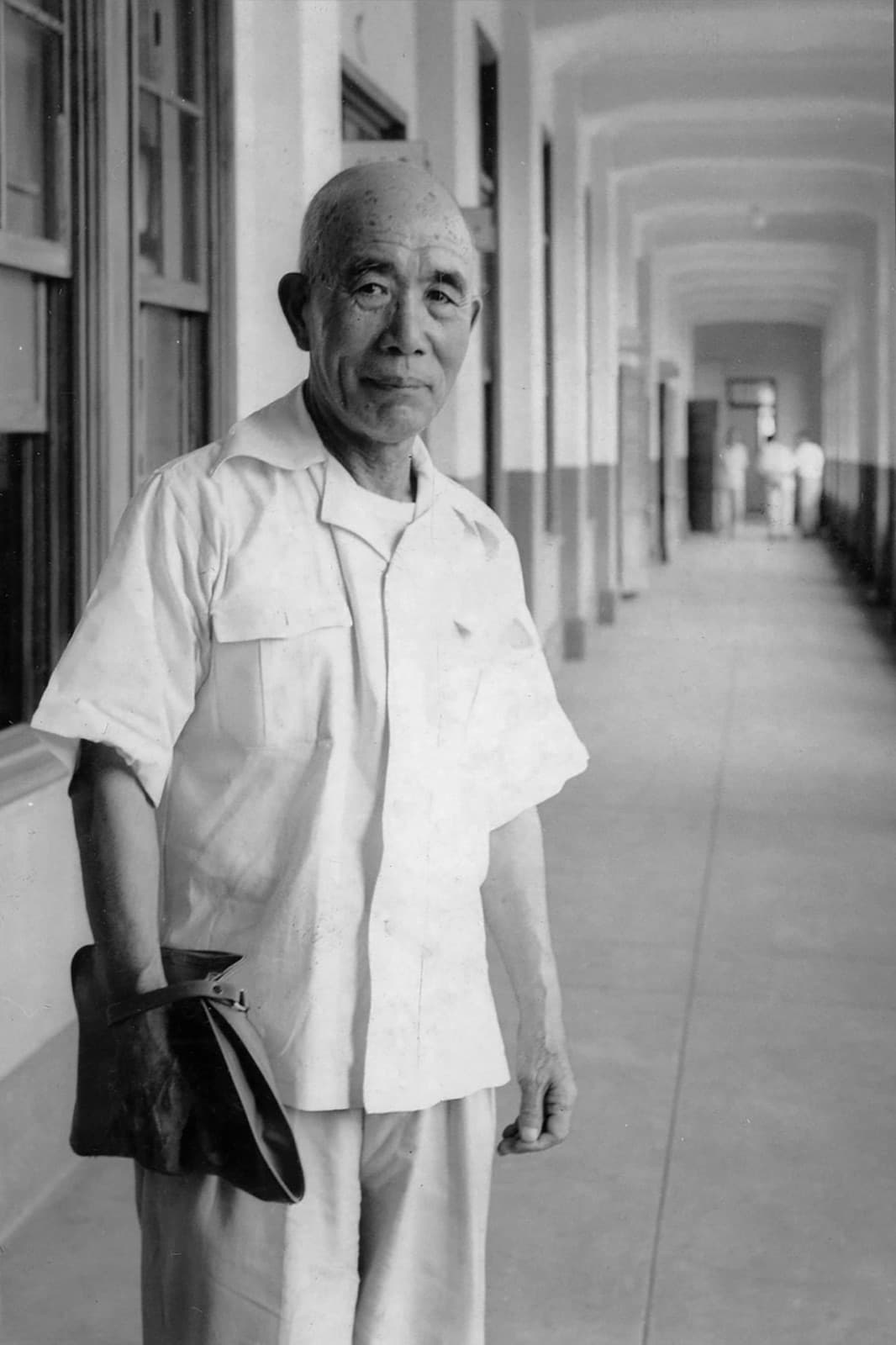
Iso Eikichi. He spent forty-five years in Taiwan, stayed on after the war to teach agronomy at National Taiwan University, and returned to Japan only in 1957. Date of photograph unknown.
Public domain, photographer unknown
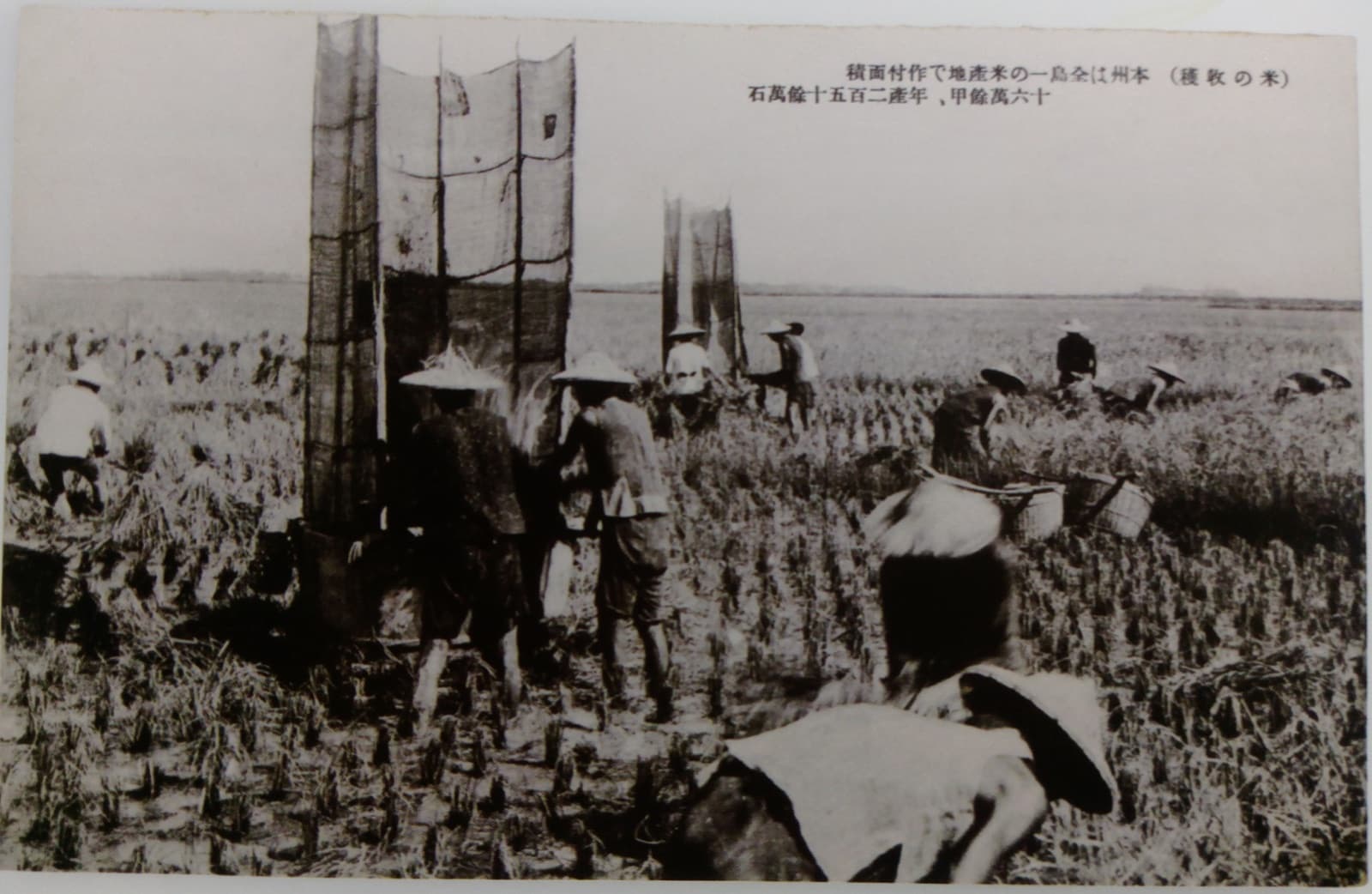
Rice harvest in Taichu Prefecture, from a postcard of the Japanese era. Horai rice later replaced native rice in fields like these.
Wang Chih-cheng and Chang Liang-tse, Taichung Postcards: Images and Travels of the Japanese Era