

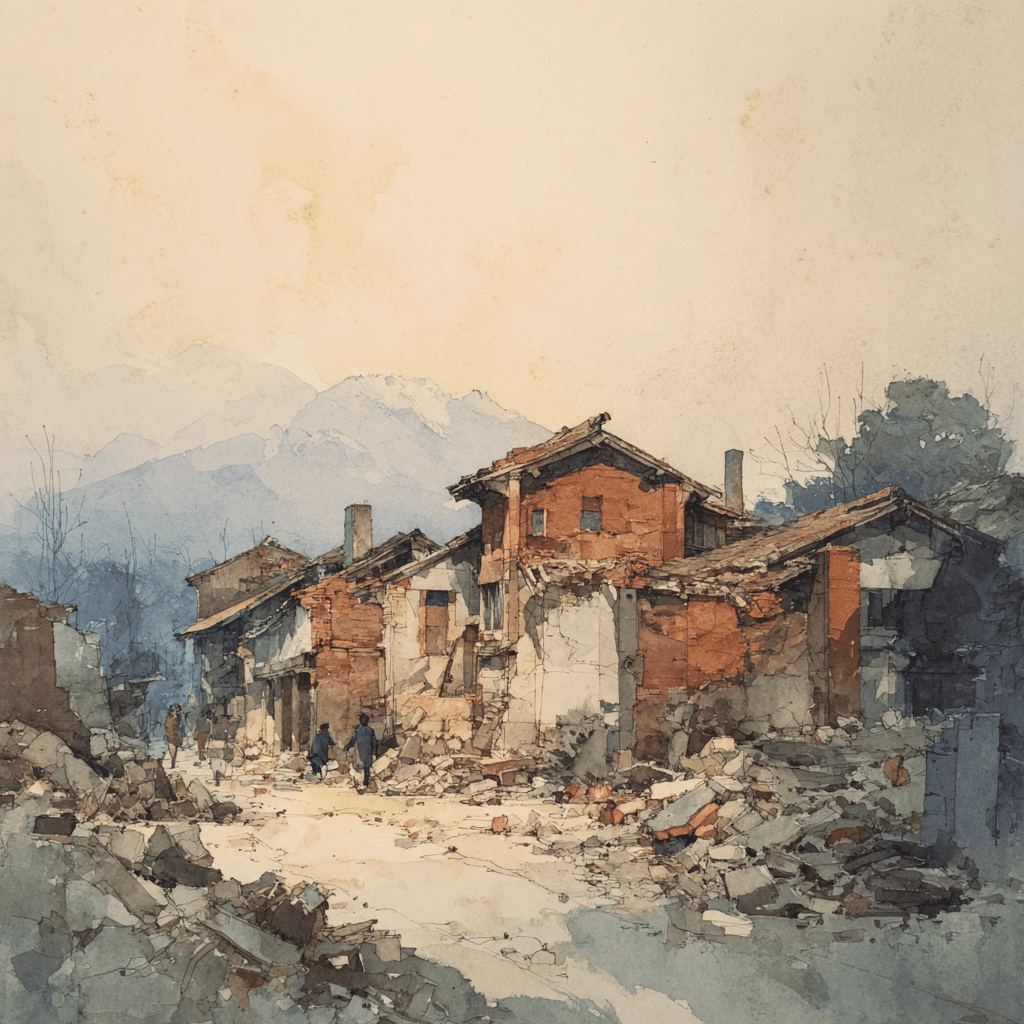
The Guandaoshan Earthquake
At two minutes past six on the morning of 21 April 1935 the centre and north of the island were shaken awake. The epicentre lay near Guandaoshan in Dahu district of Hsinchu prefecture, the magnitude was 7.1, and the focus was only a few kilometres down. At that hour most people were still indoors — lighting the stove, dressing, about to leave for the fields.
Three thousand two hundred and seventy-six died, more than twelve thousand were injured, and close to eighteen thousand houses came down entirely. It is the deadliest earthquake in twentieth-century Taiwan. Sixty-four years later the Chichi earthquake of 1999 killed somewhat over two thousand four hundred.
The worst of it was not at the epicentre. Miaoli and Dahu districts in Hsinchu prefecture suffered badly, but the greatest toll at any one place was at Dunzijiao in Fengyuan district of Taichung prefecture — Houli today. The ground there is flat, the settlement close-packed, the houses mostly adobe; a whole row went over together, and fewer were pulled out than stayed buried. The event is also called the Dunzijiao earthquake, one place name covering over the name of the epicentre.
What collapsed most completely was adobe. The walls were bricks of earth and rice straw dried in the sun, they carried t…
What collapsed most completely was adobe. The walls were bricks of earth and rice straw dried in the sun, they carried the load themselves without a frame of posts, and the roofs above them were heavy tile. One lateral shove, the wall crumbled, and the roof lost its support and came down frame and all. Brick shophouses held a little longer. Timber-framed Japanese quarters swayed and stayed up. Along a single street the difference between injury and death was often what the wall was made of.
Three months later, on 17 July, it came again, the epicentre shifted to the mouth of the Houlong river, and what had not yet been repaired was shaken down a second time. The red brick arches of the Yutengping bridge had broken in the first shock. The broken span is still standing, and tourists photograph it.
The Government-General set up a reconstruction committee for the stricken districts, released funds, distributed the relief subscriptions and rebuilt the townships. Rebuilding did not mean putting things back. The street blocks of Qingshui, Fengyuan, Houli and Shengang were drawn again, roads were widened, fire lanes were left open, and adobe gave way to brick and braced timber, paid for out of government funds and island-wide subscriptions. It was the first time an earthquake had redrawn Taiwanese townships on that scale.
The rewriting had a price. When blocks are redrawn, whose land is cut and whose household is moved to the back row are not decided in the village. The committee left orderly streets and a stock of houses that would stand up to shaking. It also left a number of people shifted to a different position on their own ground.
Six in the morning is the least fortunate hour in the day. An hour later most people would have been out in the fields. An hour earlier, those still lying down would at least not have had in their hands whatever they had just picked up. That morning people were lighting stoves and getting dressed. An adobe house does not fall the way a brick house does. It does not crack, it dissolves. The wall turns back into earth and buries the household on the floor of its own home. The men digging were the neighbours and the tools were hoes. They dug from first light until dark, and most of what they brought out was no longer breathing. The tallies afterwards said this village had lost the most. The village did not require a tally.
Isle of Time