


The Koshien Dream
In 1930s Taiwan, while the wastelands of the south, irrigated by Hatta Yoichi's Chianan Canal, broke into endless waves of golden rice, another miracle — a storm of sweat, tears, and black-earth youth — exploded onto the red-clay baseball diamond of Chiayi. It was a colonial era of rigid class lines and high ethnic walls. On the baseball map of the Empire of Japan, Taiwanese teams had long been regarded as "second-tier ragtag outfits," and no one ever believed that boys from this southern island could one day step onto Japanese baseball's supreme sanctum — Koshien.
Taiwan's baseball world at the time was split by an invisible but stark line. Teams of Japanese were known for "defense and tactics." Han Chinese teams (Hokkien and Hakka) were known for "hitting." And the physically gifted indigenous Taiwanese teams — chiefly Amis and Seediq players — had unmatched "speed and explosiveness." In daily life these three ethnic groups were full of estrangement; on the diamond, they played their own games and refused to yield to one another.
But this seemingly unbreakable prejudice met in 1929 a man who would shatter all the rules. He was a stern-faced, eagle-eyed legendary Japanese coach named Kondo Hyotaro. Invited to become head coach of the baseball team at the "Chiayi Agriculture and Forestry Institute" (KANO for short, from the Japanese reading), Kondo on his first day looked at the sun-darkened, threadbare boys assembled before him and made a decision then considered pure fantasy. He would break the ethnic barriers and weld Japanese, Han, and indigenous players into one unprecedented "cocktail" team.
Kondo's training was, in the most literal sense, an iron-blooded discipline. On Chiayi's red clay scorched by sun, Kondo gripped his wooden bat and tirelessly hammered out drive after drive. He howled at the boys who rolled in mud and dust. He ordered them every dawn to run laps through the streets of Chiayi while shouting at the top of their lungs a slogan that every townsperson found laughable at the time: "Koshien! Koshien!"
Against townspeople's mockery and their own bodies' limits, these boys from different peoples — through year upon year of tears and sweat — fell into a strange chemistry. The indigenous players set aside their wariness of the Han; the Han players took on Japanese discipline. They shared the same bowl of white rice in the dorm and clapped one another on shoulders raw with bruises. Kondo Hyotaro watched these boys' eyes harden into the gaze of wolves and smiled faintly, because he knew the team had earned the iron-blooded creed that would burn through an era: "Do not think of winning. Think of not losing."
The climax of history thundered into 1931 in the height of summer.
This once-unknown "ragtag outfit" that had not won a single match seized the all-Taiwan selection tournament in a stunning upset, claiming the single ticket that would take a team from Taiwan to Osaka. When the four English letters KANO appeared on the giant scoreboard at Koshien Stadium in Japan, tens of thousands of arrogant Japanese spectators and reporters cast doubtful and disdainful glances. They sneered that this was a "wild children's team" from a barbaric southern island.
But when the umpire shouted the start of the game, the cocktail team unleashed a fearsome force that left Japan breathless. The indigenous power hitter Hirano Yasuro (Amis, Han name Luo Baonong) swung his bat and sent a baseball flying into the Koshien night sky. The shortstop Uematsu Koichi (Tsou) launched himself across the black clay in a flying dive to glove a sure base hit. And the core of the team, the ace pitcher Wu Mingjie (Hakka), used his astonishingly fast and ferocious fastball to shut down inning after inning the lineups of Japan's traditional baseball powers.
KANO cut through opponent after opponent and, like a dark horse, miraculously slashed its way into the final championshi…
KANO cut through opponent after opponent and, like a dark horse, miraculously slashed its way into the final championship game.
But fate delivered its cruelest blow at the moment of greatest glory. After several consecutive complete-game performances at the highest intensity, the skin of ace pitcher Wu Mingjie's pitching fingers split open from prolonged friction against the baseball's seams. Blood streamed from his fingers mixed with sand. On the diamond in the final against Japan's Chukyo Commercial School, every pitch he threw came with searing pain. His velocity crashed, his control collapsed, and he gave up walk after walk.
The Japanese crowd in the stands began to jeer. In the dugout, Kondo Hyotaro's face turned iron-gray; he was preparing to relieve his exhausted ace. But at that very moment, the indigenous and Han teammates on the field rushed forward together and surrounded Wu Mingjie, his face streaked with tears and blood.
"Mingjie, throw it. Let them swing!" His teammates wiped the dripping blood from his hands with the black earth and pounded on his chest in frenzy: "We are behind you! We will get every ball! Because we are KANO!"
In that moment, they crossed ancestral lines, crossed ethnic groups, crossed the great gulf between colonizer and colonized. Wu Mingjie clenched his teeth, his eyes blazing with one last savage fury. He climbed back onto the mound, willed himself through his broken knuckles, and with the last of his strength hurled that blood-soaked baseball at home plate again and again. Behind him, his teammates ran like madmen across the black earth of Koshien, dove, and threw their bodies in front of every batted ball.
Though KANO finally took only second place — undone by the gap in strength and by injury — the moment the final out was recorded and the game ended, the entire Koshien stadium fell into a deathly silence. Then, slowly, tens of thousands of once-arrogant Japanese spectators rose to their feet. They did not cheer for the champions. Instead they poured wave upon wave of applause and tears toward these Taiwanese boys who knelt on the mound, weeping as they scooped Koshien's black earth into their hands to take home as a keepsake.
A famous Japanese writer and editor — pen trembling in his hand — set down on that day's newspaper a verdict that has echoed through Asian baseball history ever since: "KANO under heaven!"
KANO's battle on the black earth was the most impassioned and most warm-hearted final curtain of Taiwan's Japanese era. The sweat and blood they spilled on Koshien melted clean away the colony's towering ethnic walls. By their actions they proved to everyone that on this island — whether you were Han, indigenous, or Japanese — if you held one shared goal and stood shoulder to shoulder on the same red clay, you could create miracles that moved the world.
That "never give up" spirit of KANO drove itself deep into the genes of the Taiwanese people, becoming, for the decades that followed and for modern Taiwan to this day, the most rebellious and most resilient spiritual origin of every appearance on baseball's international stages.
The team had Japanese, Han Chinese and indigenous players, which in the Taiwan of 1931 was not usual. Positions were assigned by a simple rule: whoever ran fastest went to the outfield, whoever had the arm went deep in the infield, and there was no other rule. The pitcher Wu Ming-chieh was Hakka from Miaoli; among the catchers and outfielders were Amis and Puyuma players; the cleanup hitter was a Japanese boy named Mayama Uichi. They practised on the red clay ground at Chiayi until dark, and for several years they lost their friendlies against the Taipei schools. In the summer of 1931 they went through to the final of the seventeenth national middle school championship — the first Taiwanese side ever to reach a final at Koshien. They lost it to Chukyo Commercial, one to four. Wu Ming-chieh's finger split open during the game and the blood soaked into the dirt beside the rubber; he finished the innings. On the day they came home to Chiayi, the road from the station to the school was lined with people. Some of them later became teachers and clerks at farmers' associations. Mayama Uichi took back his own name after the war and became principal of the Taitung agricultural school.
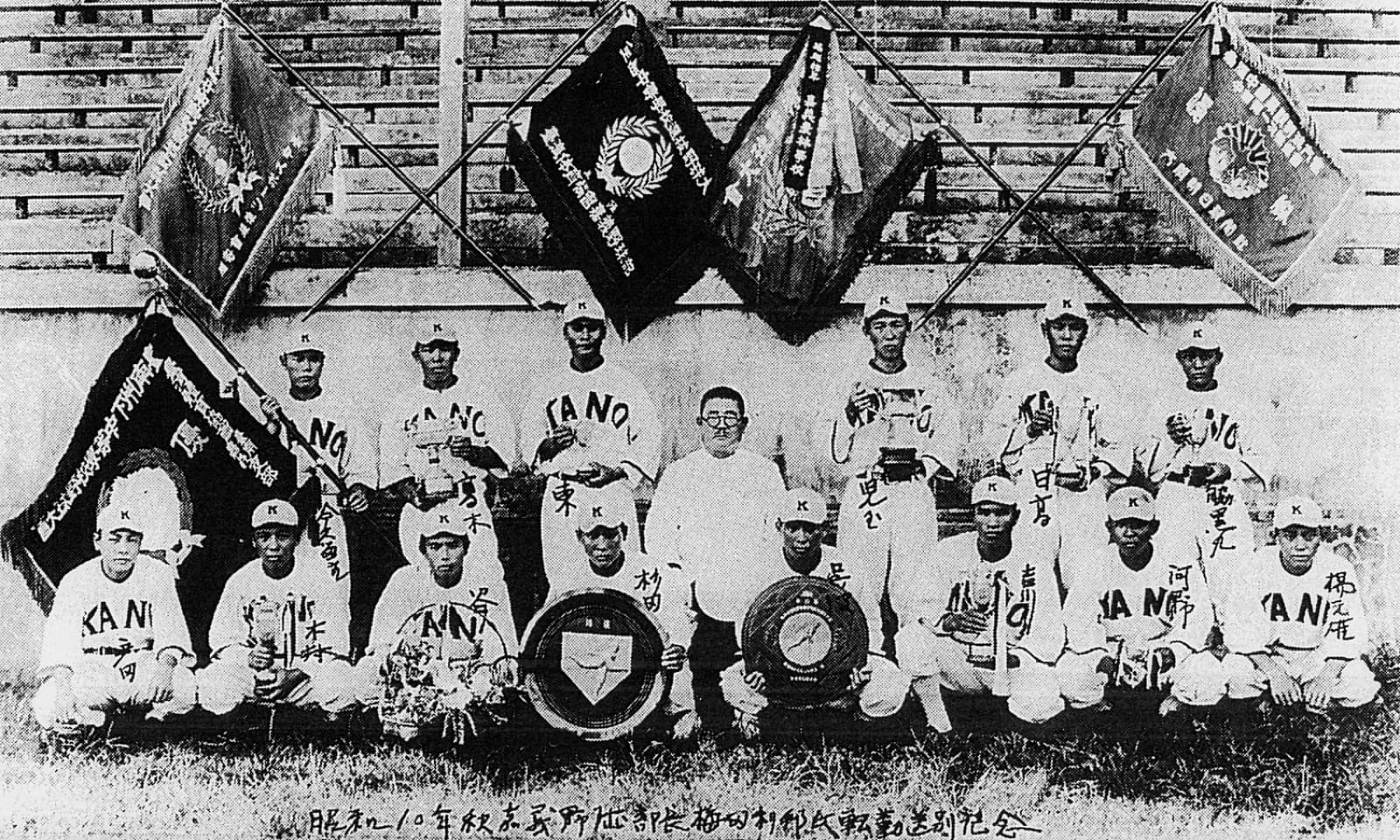
The Chiayi Agriculture and Forestry baseball team, 1935. Japanese, Han and indigenous players shared the roster; in 1931 they reached the Koshien final and finished second.
*One Hundred Years of Baseball in Ehime*, Ehime Shimbun
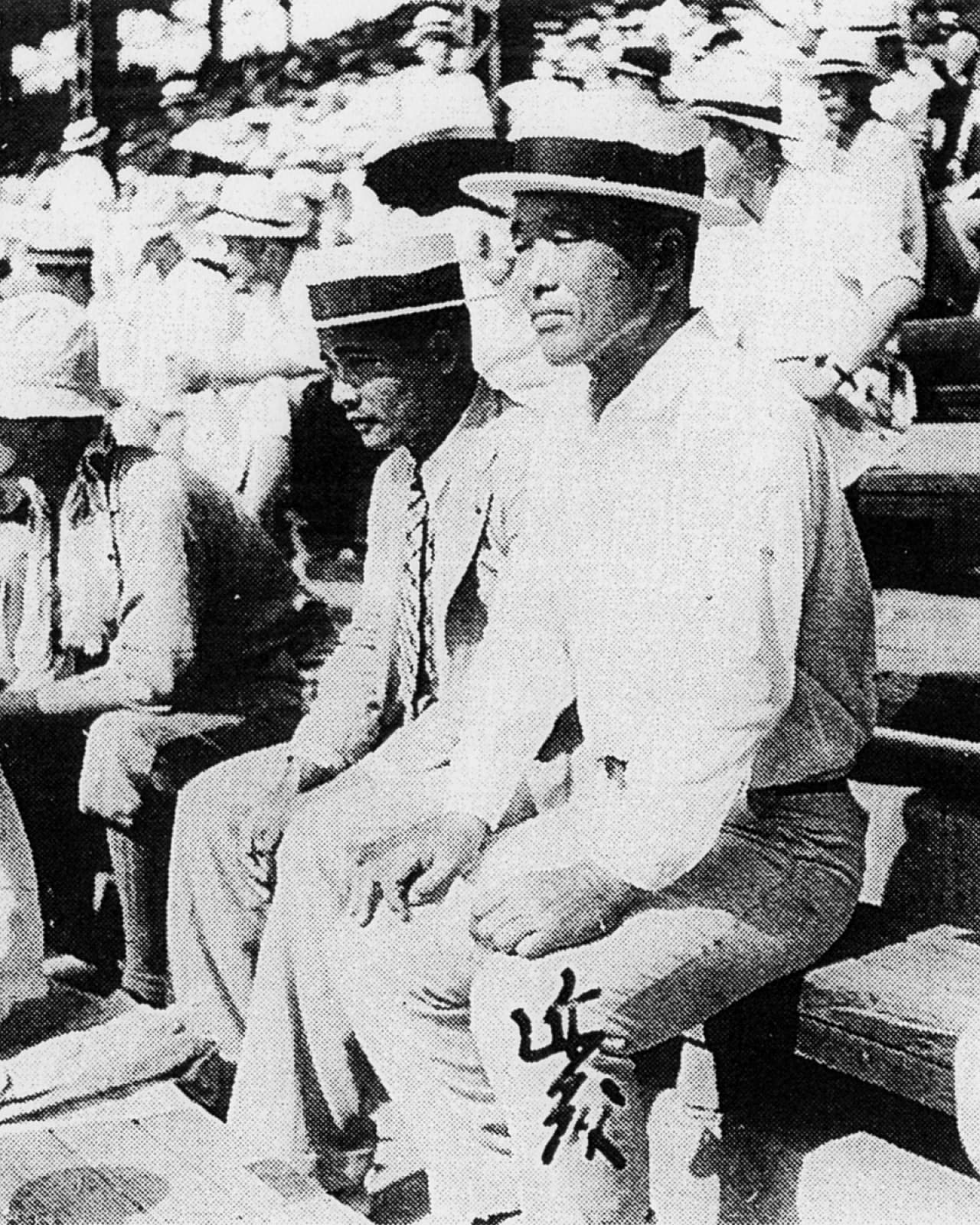
Kondo Hyotaro in the stands. He came from Ehime to teach in Chiayi and drilled an unfancied side all the way to Koshien, insisting that on the field only play counted, not ancestry.
*One Hundred Years of Baseball in Ehime*, Ehime Shimbun
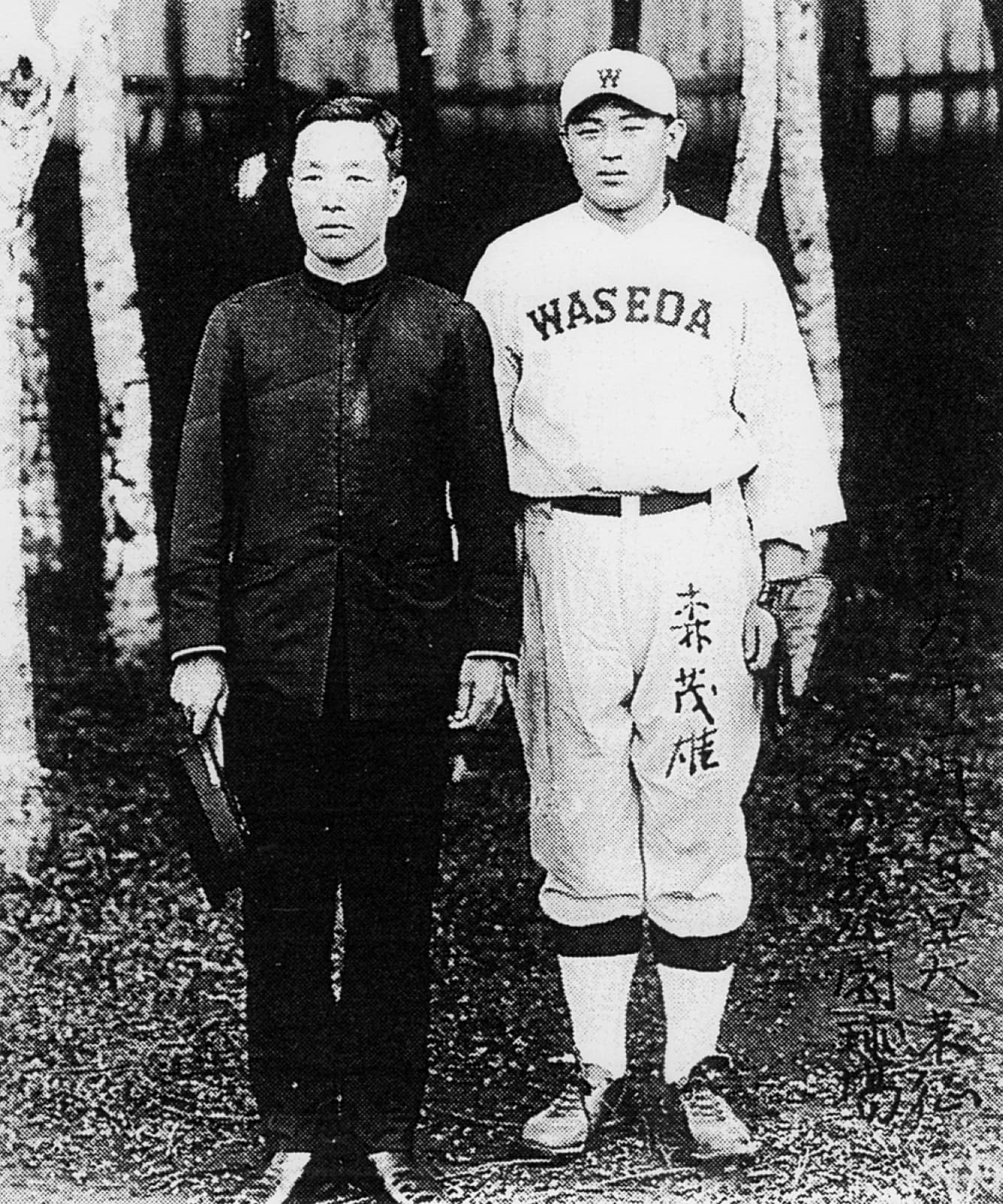
Kondo Hyotaro with Mori Shigeo, 1931. Mori came out of Waseda; both men were formed at Matsuyama Commercial in Ehime, and that is where Kano's style of play came from.
*One Hundred Years of Baseball in Ehime*, Ehime Shimbun
Isle of Time