


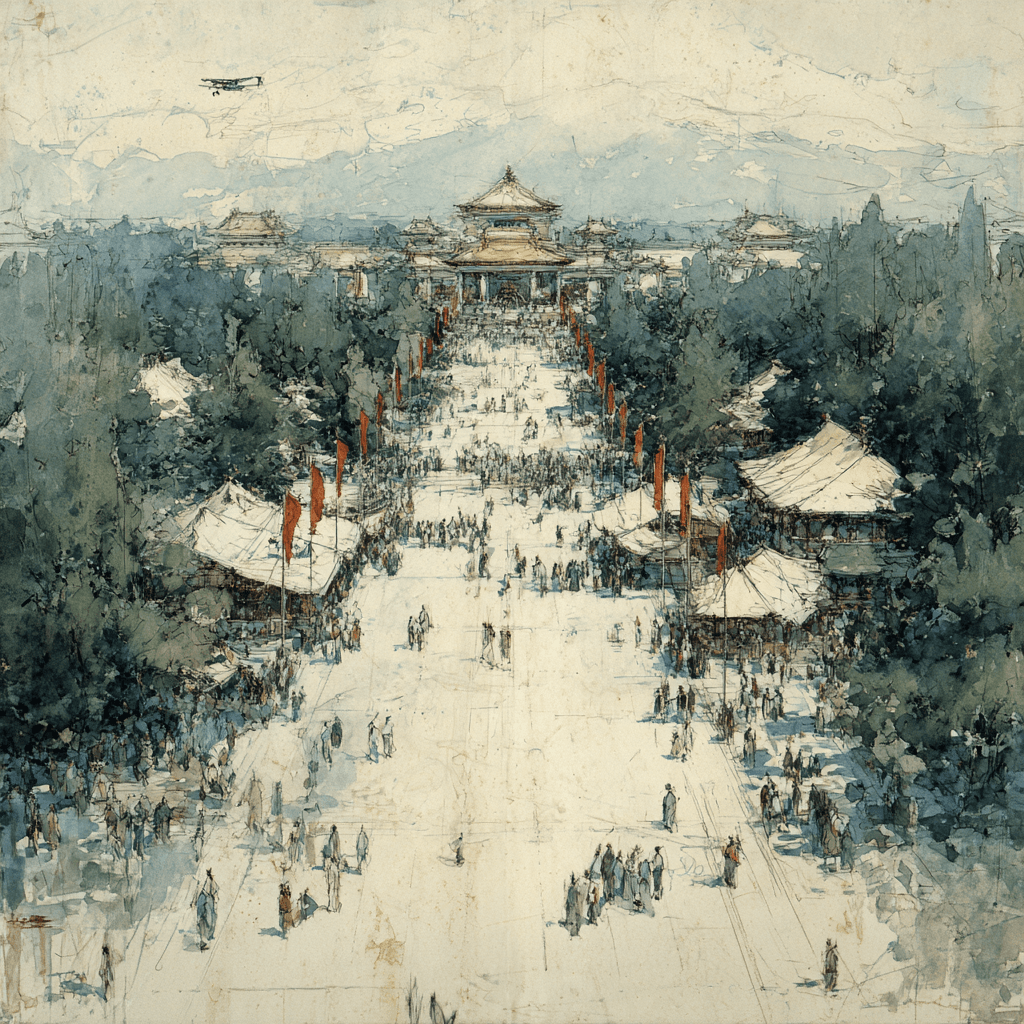
At half past nine on the morning of 10 October 1935, the Taiwan Exposition to commemorate forty years of rule opened in Taipei. The rule in question was Japan's, which had begun in 1895. Forty years had passed, and the Government-General wanted to lay out all the results at once. The exposition ran until 28 November, fifty days in all. It was the first island-wide exposition on this scale ever held in Taiwan.
The exposition used a city that had already been remade. When the Qing walls of Taipei came down, the line of them was rebuilt as the three-lane boulevards known today as Zhongshan South Road, Aiguo West Road, Zhonghua Road and Zhongxiao West Road. The first venue lay around the Public Hall, where Zhongshan Hall and Zhonghua Road are today. The second was in New Park, today's 228 Peace Memorial Park. Dadaocheng had a separate South Seas Pavilion, and the hot spring district of Kusayama in Beitou had a branch pavilion as well. Four venues and thirty-eight pavilions in all cost 1,119,407 yen.
The first venue displayed industry. The Industry Pavilion showed the Chianan Canal, the Transport Pavilion and the Promotion of Industry Pavilion showed textiles, soda and soap, and there were pavilions on forest products, iron, sugar and mining, pavilions for the prefectures of Japan, and a Manchuria Pavilion. Among the themes at the second venue were baojia supervision, household registration and the monopoly system, and beside them stood city pavilions for Tokyo, Osaka, Kyoto and Nara, along with a reception hall, a children's pavilion, a theatre, a cinema and a music hall.
The prefectures set up pavilions at home as well. Taichu Prefecture's Mountain Pavilion showed photographs of its great peaks, Sun Moon Lake and Musha, along with local products. Tainan took history as its theme and displayed documents and old stone tablets from every period. Karenko's local pavilion set out regional records, produce and handicrafts. Shinchiku, Kagi, Takao and Taito all had exhibits too.
To bring people to Taipei, the Government-General brought locomotives over from Japan and added special trains between regions, and extra sailings were laid on to Keelung from Europe, Kobe and Hong Kong. Over the fifty days the Taipei venues counted 2,738,895 visits. Taiwan's population at the time was about 5.2 million.
It was not the first such show in Taipei. When the trunk railway opened in 1908, the Government-General ran a travelling "train exposition" in ten carriages that fifteen thousand people came to see. At the Industrial Promotion Fair of 1916, the sixty-metre central tower of the new Government-General building was opened to climbers: five sen from the first floor to the fourth, another ten sen from the fourth to the top, bringing in as much as 150 yen a day.
On 21 April that same year, a major earthquake had struck Shinchiku and Taichu prefectures. The exposition opened on its scheduled date.
On 22 November, while the exposition was still running, Taiwan held its first government-run election, choosing half the members of the city councils and the town and village councils. The other half were still appointed. To vote, a man had to be at least twenty-five, independent, and paying at least five yen a year in tax. The island had 950,427 men aged twenty-five or over, and only 186,627 of them qualified, about one in five. Turnout was 92 percent for the city councils and 97 percent for the town and village councils.
What the Government-General wanted to exhibit was forty years of governing itself. The themes at the second venue said it outright: baojia supervision, household registration, the monopoly system. These were what the Government-General believed had turned Taiwan from disorder into order, and now they were made into an exhibition that people bought tickets to see. The Chianan Canal, sugar, iron and mining at the first venue told the other half of the same story: what the island could produce.
The arrangement of pavilions showed a direction too. The first venue had a Manchuria Pavilion, Dadaocheng had a South Seas Pavilion, and Japan's great cities each had one of their own. Taiwan was placed in the middle of a map that ran north to Manchuria and south to the South Seas. Fifty days, more than 2.73 million visits, more than 1.11 million yen: all of these went into the official report afterwards.
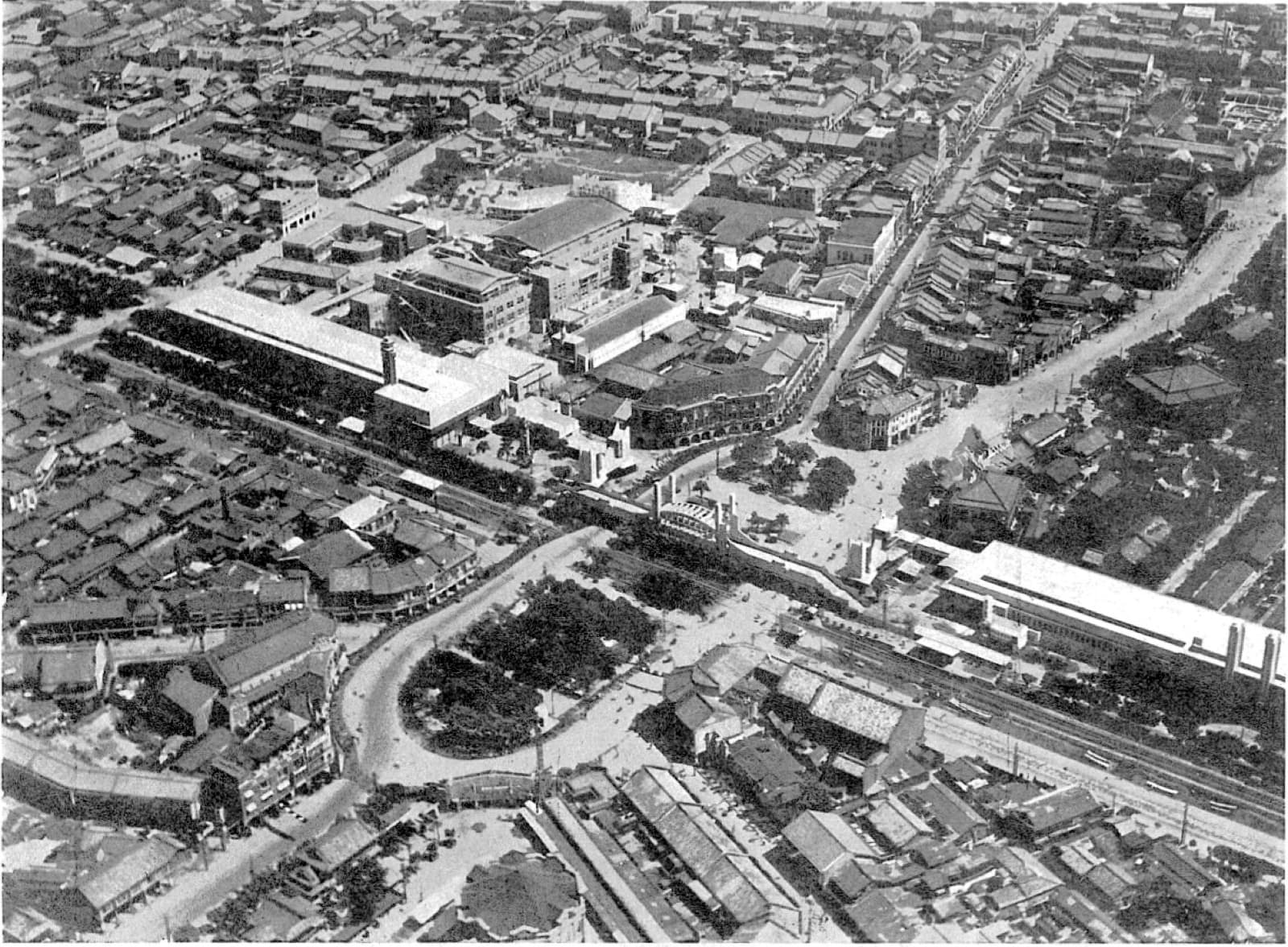
Aerial view of the first venue of the 1935 Taiwan Exposition, from the Journal of the Taiwan Architectural Association. The Public Hall area is at the centre, and the long buildings on the right line the boulevards laid where the city wall had stood.
Taiwan Architectural Association, Journal, vol. 7 nos. 5–6
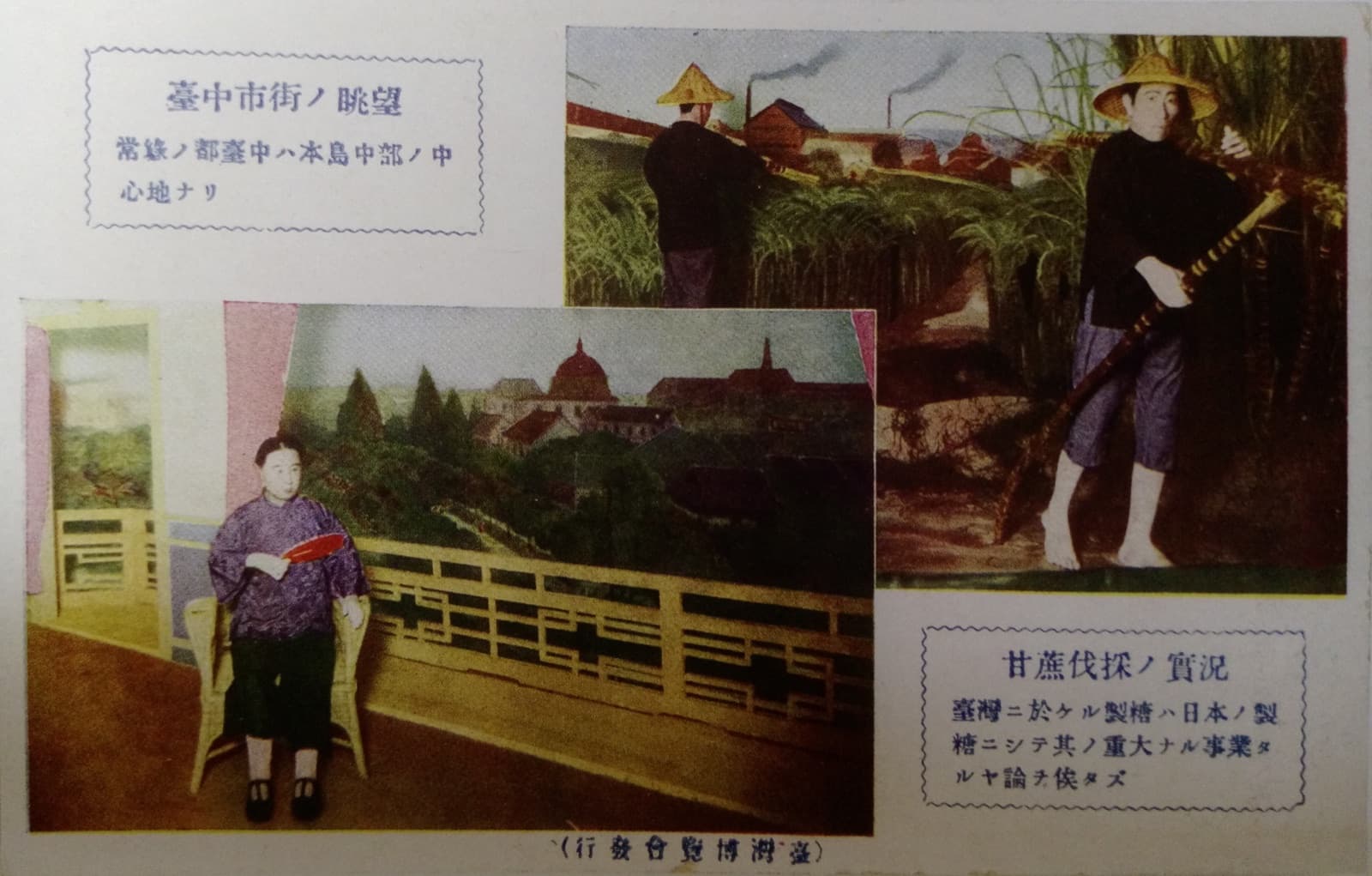
A souvenir postcard from the exposition. The diorama at upper right shows sugarcane being cut, and at lower left is a view of 'the streets of Taipei' from a pavilion. The exposition turned the island's industries into scenery people bought tickets to see.
Wang Chih-cheng and Chang Liang-tse, Taichung Postcards: Images and Travels of the Japanese Era