


The Taiwanese People's Party
In the early 1920s, driven by the newspaper Taiwan Minpao and by lecture meetings held across the island, Taiwanese society experienced an unprecedented awakening. Islanders who had once known only taxes and corvée began to speak openly of assemblies, local self-government, and basic civil rights. At the forefront of this current stood a generation of newly educated intellectuals, physicians, and young landowners, gathered beneath the banner of the Taiwan Cultural Association, founded in 1921 with cultural enlightenment as its mission. Through reading rooms, summer schools, and touring lectures, the sparks of awakening were scattered into towns and villages across the island.
Yet there was more than one road to awakening. By the mid-1920s, as socialist and labour-movement ideas circulating across the world reached the island, fissures opened within the Cultural Association. Those who favoured moderate reform and the pursuit of legal political space drifted ever further from the leftist youth, who inclined toward class struggle and placed workers and farmers at the centre. In 1927 that rift could no longer be bridged; the Cultural Association that had once led the island's awakening split apart, its leadership passing to the left, and the moderates were forced to seek another path.
Out of that rupture, on 10 July 1927, Chiang Wei-shui and his allies gathered in Taichung and founded the Taiwanese People's Party. It was the first legally sanctioned political party ever organised by Taiwanese, and under the severe apparatus of colonial rule the mere granting of permission to associate was itself a hard-won breakthrough — a milestone in the island's political history. From that point, Taiwanese political demands were no longer scattered petitions but a lasting force with a clear platform, standing organs, and an organisational backbone.
At its founding the party raised the banner of local self-government and civil liberties, demanding wider political participation for Taiwanese, the reform of an unjust colonial system, and room for speech, assembly, and association. But under Chiang's leadership its centre of gravity leaned increasingly toward the plight of workers and farmers. He believed that unless the lives of the labouring masses could be improved, self-government and civil rights would remain the empty talk of a propertied few. This orientation gradually carried the party from a purely political association toward a mass party bound tightly to social movements.
In 1928 the party helped establish the Taiwan General Federation of Labour, linking scattered unions and labour groups i…
In 1928 the party helped establish the Taiwan General Federation of Labour, linking scattered unions and labour groups into a single body and throwing its weight behind strikes and rural disputes. This was an important step in the organisation of the Taiwanese labour movement, and it sank the party's roots deep into grassroots society. Its members moved among factories, cane fields, and wharves, carrying the language of politics into the daily lives of ordinary working people; labour disputes and peasant protests now had an organisation to lean on — something the colonial authorities watched with growing wariness.
The party did not shrink from embarrassing the colonial regime. Its most celebrated action concerned the Governor-General's opium licensing policy: when the authorities reopened licences for opium smoking, public opinion was outraged, and the party cabled international bodies to lodge a protest, carrying Taiwan's grievances to eyes beyond the island. This appeal to the international arena, an open challenge to the colonial order, displayed the maturity and nerve of the Taiwanese political movement and let observers at home and abroad glimpse the contradictions of colonial rule — but it also sharply raised the tension between the party and the Governor-General's Office.
That combativeness sealed its fate. As the party's line grew sharper and drew ever closer to workers and farmers, and its ties to the labour movement deepened, the colonial authorities at last ceased to tolerate it. On 18 February 1931, in the very midst of a party gathering, the authorities declared the Taiwanese People's Party an illegal organisation and ordered it dissolved on the spot. The first legal party Taiwanese had built with such care came to an abrupt end, less than four years after its founding, and with it closed the island's brief experiment in legal party politics.
The heavy blow of the ban, compounded by years of tireless labour for the movement, had long eroded Chiang Wei-shui's health. Only months after the party's dissolution, the physician later honoured as a leader of the Taiwanese national movement died of typhoid fever, leaving countless ideals unfinished. Yet in its short life the People's Party had already proved one thing: that Taiwanese could build and run a modern political organisation of their own, and could fuse political, social, and labour movements into a single force. That lesson outlived the decree of prohibition, and it became one of the wellsprings from which later Taiwanese would draw in their continuing pursuit of self-government and democracy.
After the Cultural Association split in 1927, what he wanted was a party that could be registered lawfully. The platform was submitted three times before it passed: the first, which spoke of realizing government based on the people, was refused; the second, which spoke of establishing it, was refused as well; the third removed the word national altogether, and on 10 July 1927 the Taiwanese People's Party was founded in Taichung, the first Taiwanese party ever permitted. The price of that permission was written into the text, and he knew it. His centre of gravity moved quickly to workers. The Taiwan Federation of Labour was founded in February 1928 with sixty-five affiliated unions and more than ten thousand members, its inaugural banner reading that compatriots must unite, and that in unity there is strength. For the next three years the party's work was strikes, disputes and petitions: Asano Cement in Kaohsiung, the printers of Taipei, the machinists of Changhua. In 1930 he cabled the League of Nations about the new opium licences, and with that the administration's patience ran out. On 18 February 1931 police dissolved the party on the floor of its fourth congress. He died of typhoid that 5 August, and about five thousand people walked in the public funeral held for him in Taipei.
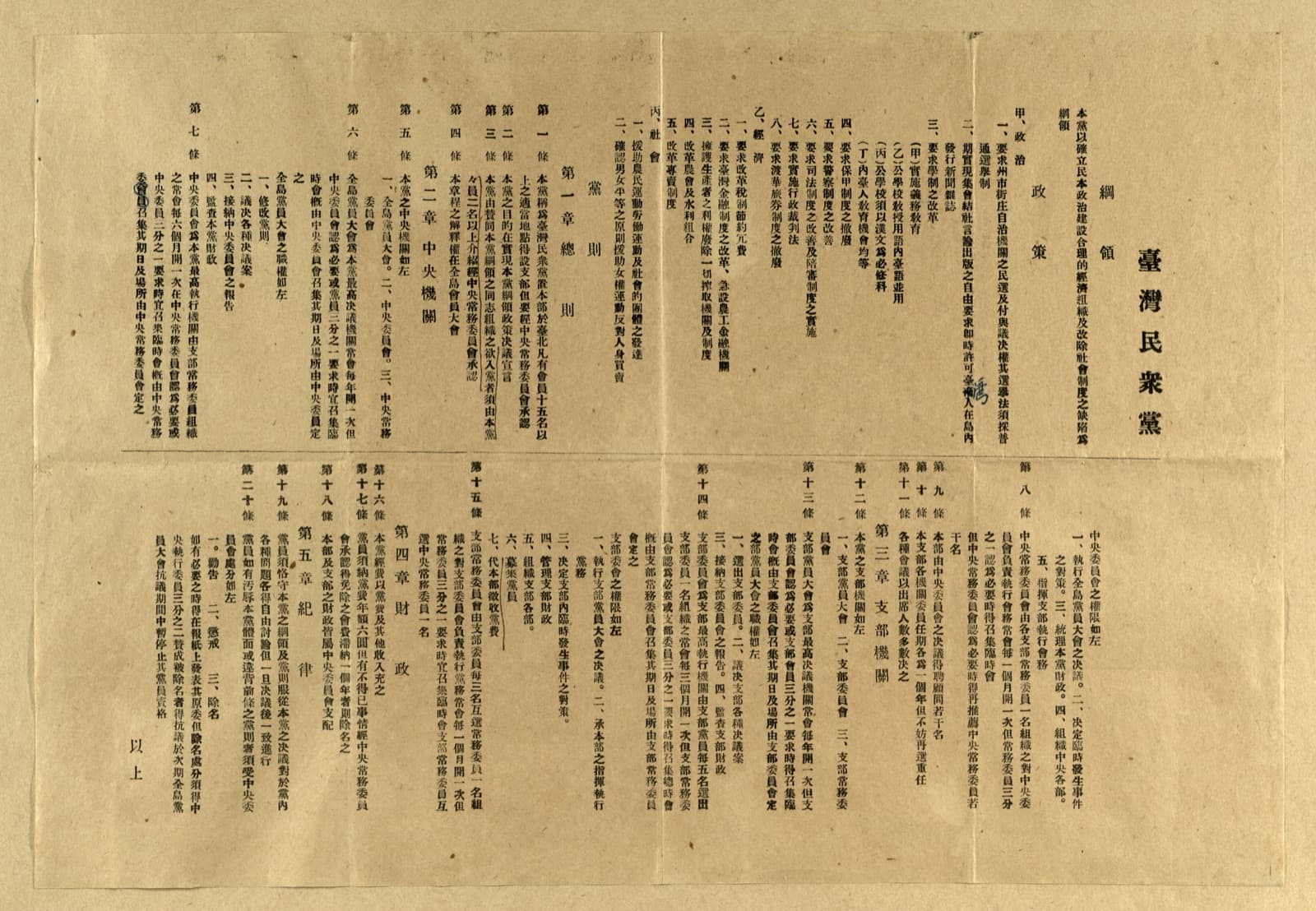
The platform of the Taiwanese People's Party, July 1927. It was the first political party the colonial government allowed Taiwanese to form; four years later it was dissolved.
Archives of the Institute of Taiwan History, Academia Sinica
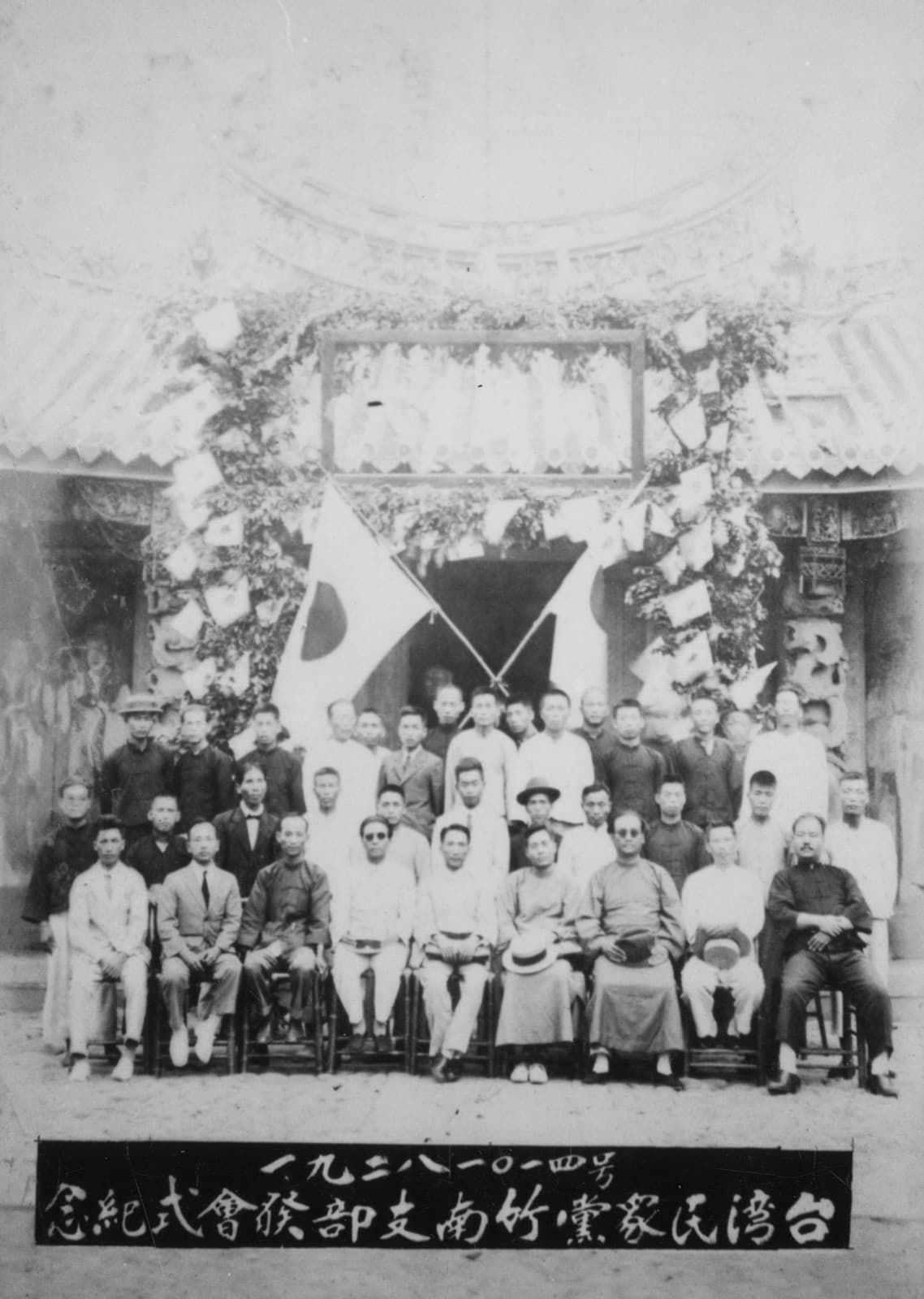
The founding of the Taiwanese People's Party's Chunan branch, 1928. Branches carried the party's political vocabulary out into the smaller market towns.
Archives of the Institute of Taiwan History, Academia Sinica
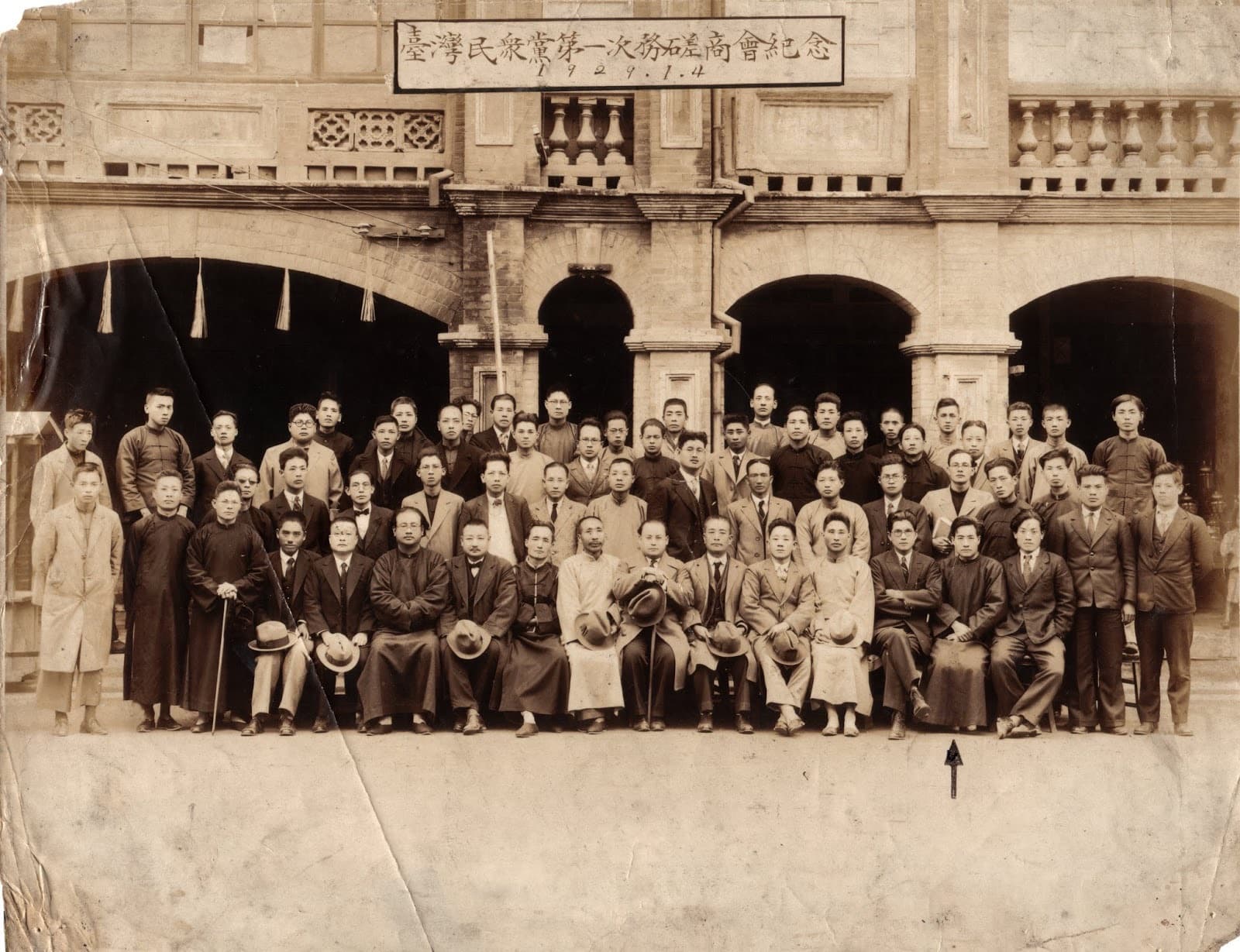
A general meeting of Taiwanese People's Party members, January 1929. The party was by then leaning towards labour and farmer organising — the reason the Government-General gave when it banned the party two years later.
Public domain; photographer unknown
Isle of Time