


Sovereignty of the Mountains
The encounter between Taiwan's indigenous peoples and Qing Chinese expansion did not have a single form or a single outcome. It was not simply a story of conquest followed by resistance followed by defeat, though all three were certainly present. It was a more complicated set of negotiations, adaptations, and confrontations spread across more than two centuries, involving dozens of distinct peoples facing a colonial pressure that arrived with different intensities in different places and at different times.
Zhi Muliu was a Saisiyat chief whose career fell in the early eighteenth century, when the frontier between Han settlement and indigenous territory was still being established and both sides were still testing what was possible. Zhi Muliu pursued a strategy of selective engagement — trading with Han merchants for goods the Saisiyat wanted, resisting by force when settlement pushed too close to vital resources, and maintaining enough ambiguity in his commitments to avoid being bound by any agreement that would have foreclosed future options. His flexibility gave the Saisiyat a degree of autonomy that lasted longer than it might have under more rigidly confrontational leadership.
Arokus was a leader in the Mudan community, the Paiwan village at the center of the 1874 incident that changed the traje…
Arokus was a leader in the Mudan community, the Paiwan village at the center of the 1874 incident that changed the trajectory of Taiwanese history. When Ryukyuan sailors shipwrecked on the southern coast in 1871 were killed following indigenous customary law, the incident became the pretext for Japan's first military expedition to Taiwan. Arokus fought in the Japanese engagement and was killed. His resistance made the incident internationally significant, forced the Qing court to confront its claims about eastern Taiwan, and triggered the 'opening the mountains' program that would reshape the island's geography and demographics.
Pan Shengqing chose the path of integration. A man of mixed Kavalan and Pingpu descent who obtained official appointments within the Qing administrative system, he became one of the very few indigenous people in the Qing era to hold formal bureaucratic authority. The price of this strategy was visible: integration required adopting the cultural markers of Han Chinese respectability and accepting the premises of a system that classified his own people as backward. Whether his career achieved net benefit for the communities he represented is a question that cannot be answered simply — it illustrates, at minimum, the impossible trade-offs that indigenous survival in Qing Taiwan required.
He lived when the boundary was still forming, and there was room to move. Saisiyat country lay in what is now the hill district of Hsinchu and Miaoli, abutting the Chinese clearings, and his method was neither refusal nor submission: fight when the hunting ground was entered, trade when ironware and salt were needed, negotiate when the government offered terms, and go on holding his own land afterwards. Such flexibility was workable in the eighteenth century, because the other side's strength was not yet overwhelming. The court later gave him the title of interpreter, and in his hands the post ran both ways — representing his people to the yamen and the yamen to his people. What ended that room was not his death but camphor. From the nineteenth century the trees became an international commodity, and capital advanced together with the guard line, leaving less and less that could be negotiated. By his great-grandsons' time Saisiyat territory had been cut into pieces by the line. It was men from these hills who struck in the Peipu affair of 1907.
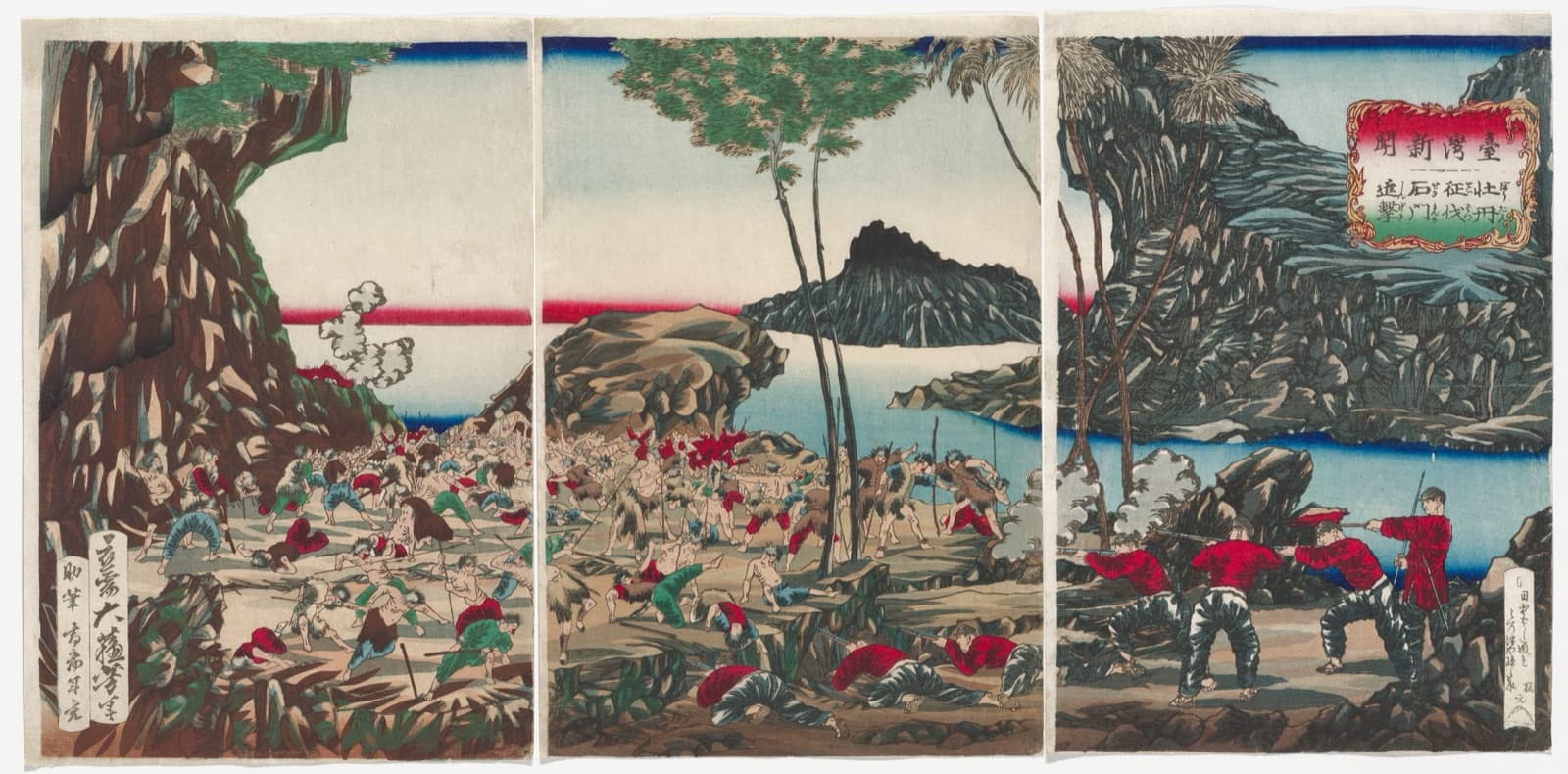
The fight at Shimen, drawn by Tsukioka Yoshitoshi in 1874. Japan sent troops on the pretext of the Mudan killing of shipwrecked Ryukyuans; the Mudan chief Aruqu and his son died in this engagement.
By Tsukioka Yoshitoshi; Minneapolis Institute of Art
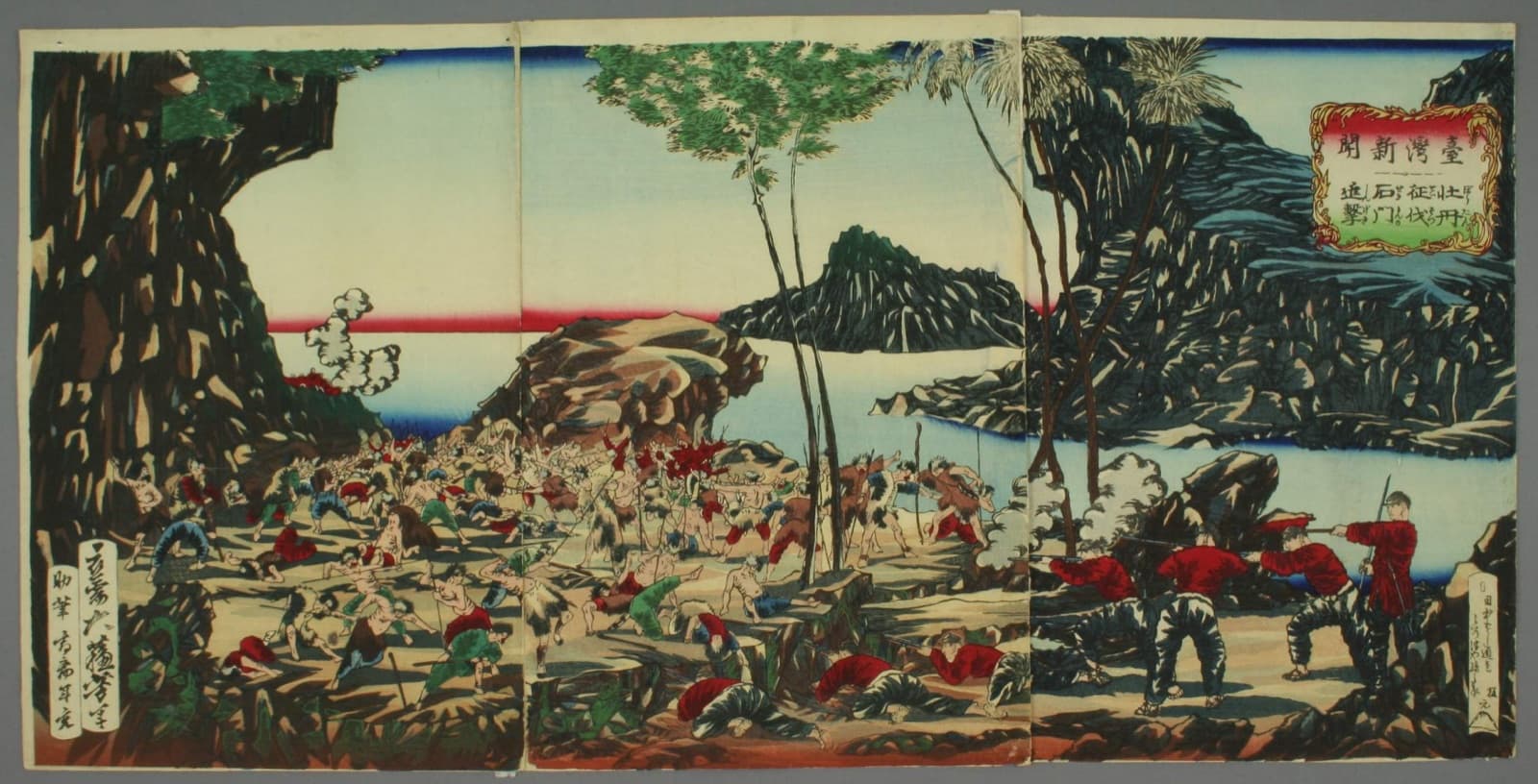
Another of Yoshitoshi's prints of the expedition. The Qing settled for five hundred thousand taels, and the agreement called Japan's action a righteous move to protect its own people — the sentence that began to loosen Ryukyu's standing.
By Tsukioka Yoshitoshi; Waseda University Library
Isle of Time