


The Aboriginal Frontier
Throughout the Qing period, the relationship between Han settlers and Taiwan's indigenous peoples was defined by an official boundary — the 'savage boundary' (番界) — a line of earthen mounds, ditches, and guard posts stretching across the island's western foothills. East of this line lay the territories of indigenous communities whom the Qing classified as 'raw savages' (生番), largely beyond imperial control; to the west spread the Han-settled plains, where 'cooked savages' (熟番) — indigenous groups that had adopted Han customs and paid taxes — occupied an increasingly precarious middle ground.
This frontier was never stable. Generation after generation, Han settlers pushed eastward in search of arable land and t…
This frontier was never stable. Generation after generation, Han settlers pushed eastward in search of arable land and the island's lucrative camphor forests, encroaching on indigenous hunting grounds and provoking violent confrontations. The Qing authorities alternated between enforcing the boundary to maintain order and quietly tolerating its violation to collect land taxes from newly cleared fields. For plains-dwelling indigenous peoples, the result was a slow dispossession: their communal lands were absorbed through lease agreements, intermarriage, and outright seizure, gradually eroding their cultural and economic autonomy.
The Mudan Incident of 1874 — when Japan launched a punitive expedition into southern Taiwan after Paiwan warriors killed shipwrecked Ryukyuan sailors — exposed the consequences of Qing neglect. Japan's intervention demonstrated that territories the Qing claimed but did not effectively govern could become pretexts for foreign aggression. The crisis prompted Shen Baozhen's 'open the mountains, pacify the savages' (開山撫番) campaign, a belated and often brutal effort to extend roads, military posts, and administrative control into the island's mountainous interior.
To them the line was not a boundary but a mark the Chinese had drawn for themselves. The extent of a hunting ground was settled by streams, ridges and agreements handed down over generations, and had nothing to do with an earth bank and a ditch. What they felt was pressure. Every decade or two the villages west of the line moved forward a stage — scattered clearers first, then guard huts and guardsmen, then the camphor sheds. Where the trees were cut, the deer stopped coming. There were several ways to answer. Larger settlements made the other side pay through raids and by burning the sheds; smaller ones moved deeper into the mountains. Some chose trade, exchanging deerskin, rattan and camphor for ironware, salt and cloth, and turning the guardsmen into neighbours with a commercial interest. None of it could last, because what the other side wanted was not goods but ground. By the later nineteenth century the line stood at the foot of the Central Range, and after the opening of the mountains in 1875 the idea of a beyond was abolished altogether.
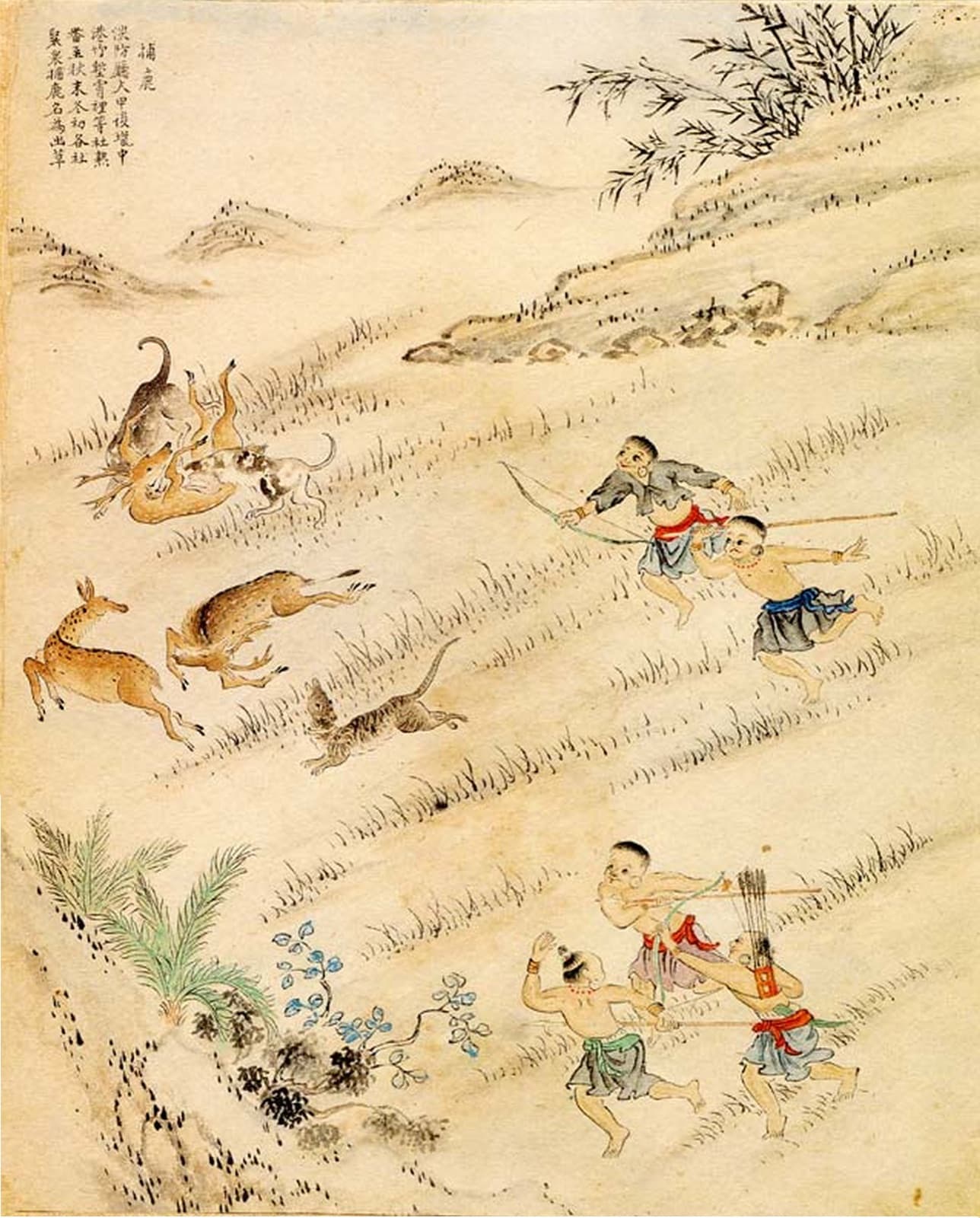
A deer hunt from *Images of Barbarian Customs*. Deerskin had been the island's chief export since the Dutch period; as the herds retreated, Han fields followed.
*Images of Barbarian Customs*, Qianlong era
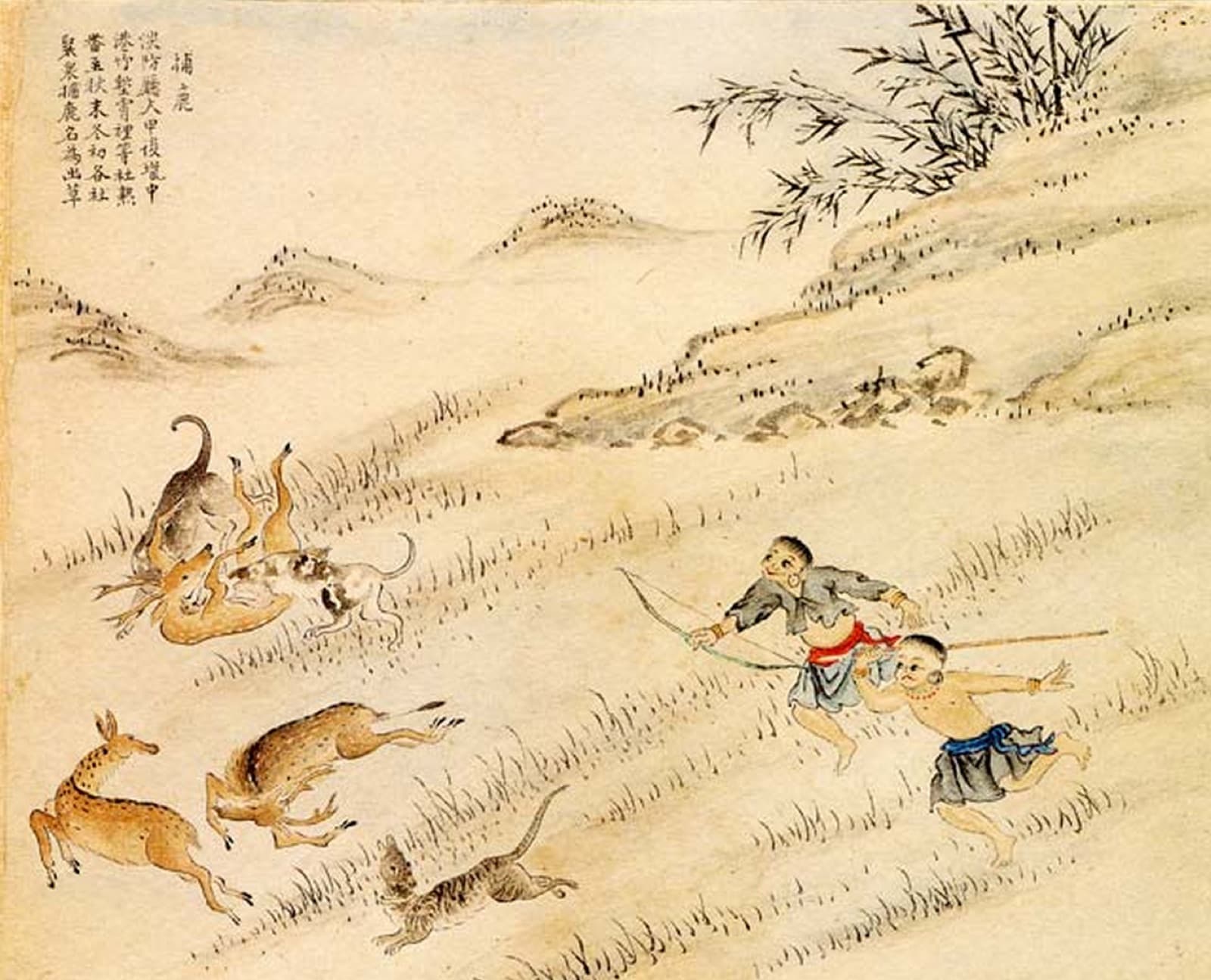
Another deer hunt from the same album. The plates were painted for an imperial inspector's report, and they show the “acculturated” villages — those already paying tax and serving corvée.
*Images of Barbarian Customs*, Qianlong era
Isle of Time