


Koxinga's Kingdom
In May 1661, following the successful landing of Zheng Koxinga’s twenty-five thousand elite troops at the Luermen channels, this emerald island—governed by the Dutch for thirty-eight years—witnessed the dawn of its very first Han Chinese regime. At this historical crossroads, though Fort Zeelandia remained locked in a fierce defense under the Dutch Governor, Frederick Coyett, the Prince of Yanping could not wait to commence his grand nation-building project upon the coastal plains. He decreed that the captured Fort Provintia in Chikan be transformed into the "Chengtian Prefecture," serving as the supreme imperial capital of the Ming Dynasty’s overseas orthodoxy, while establishing Tianxing and Wannian counties to the north and south. In a grand proclamation, Koxinga formally christened the island "Dongdu" (The Eastern Capital of the Ming). This was never meant to be a mere temporary refuge; it was a sovereign kingdom carved out of the wilderness by a desperate warlord whose mainland dreams had fractured, a final, sacred sanctuary for a fallen empire.
This newly born island kingdom was immediately confronted with a lethal, terrifying challenge that threatened its survival: an acute, total shortage of grain. Sustaining over twenty thousand soldiers accustomed to mainland diets, alongside thousands of Han civilian refugees who had crossed the dangerous strait, required an astronomical volume of food. To prevent his grand army from disintegrating into mutiny and starvation before Fort Zeelandia could be taken, Koxinga stood inside his temporary palace at Chengtian and authorized the Tuntian (military settlement) system—a strategy that permanently reshaped the geography of Taiwan. He decreed a policy of turning soldiers into farmers, keeping only a core vanguard to maintain the siege while dispersing the remaining military divisions across the northern and southern plains. Officers and foot soldiers dropped their iron spears to seize wooden plows, clearing the wild, overgrown frontier to turn native hunting grounds into fertile fields. Modern Taiwanese city names like Xinying, Liuying, and Zuoying stand today as historical ironclad proof of where Koxinga's grand army once pitched their agricultural camps.
Yet, behind the grand blueprints drawn by the Prince, dark, turbulent currents were swirling across the humid island rea…
Yet, behind the grand blueprints drawn by the Prince, dark, turbulent currents were swirling across the humid island realm. The aggressive expansion of the military settlements and the forced confiscation of lands inevitably violated the ancestral hunting territories of the indigenous tribes. Across the plains, native clans began launching bloody, localized retaliations against the encroaching Han military camps. Concurrently, across the strait, the Qing court reacted to Koxinga's capture of Taiwan with absolute fury, ruthlessly upgrading the "Great Clearance" policy into a total maritime blockade designed to starve the island kingdom into submission. Trapped between a domestic grain crisis and racial friction on the frontier, and assaulted by the strict economic embargo from abroad, Koxinga sat in his temporary hall, working through the night to review grim dispatches detailing failed harvests and the rapid death of his soldiers to tropical fevers.
By early 1662, after nine grueling months of siege, the Dutch finally signed the instrument of surrender, officially bringing Fort Zeelandia into the domain of the Zheng Kingdom. This was the absolute zenith of Koxinga’s career; he had comprehensively driven out the Western colonizers to become the undisputed "King of Taiwan." Moving his supreme command into the massive brick fortress, he renamed it "Anping." Standing atop this citadel, which had taken a Western superpower decades to construct, the Prince watched the crimson banners of the Ming Dynasty whip in the sea breeze, yet his heart harbored none of the joy of a founding monarch. The exhausting decades of maritime warfare, the mental torment of the grain crisis, and the shattering news that the Qing had executed his father Zheng Zhilong and desecrated his ancestral tombs were beginning to erode his sanity. This island kingdom, whose foundations had been laid with such immense blood and sweat, was about to enter a dark, terrifying tempest driven by the fading mind of its king.

The Koxinga Shrine in Tainan, originally built in 1663 as a family ancestral hall and later elevated to an official state shrine — the oldest continuously venerated memorial to the founder of the Kingdom of Tungning.
Tainan City Cultural Affairs Bureau

A reconstructed map of the tuntian military-colony allotments across the southwestern plains under Koxinga's administration, marking regimental garrisons whose names — Zuozhen, Xinying, Youwu — endure in the landscape today.
Academia Historica, Republic of China (Taiwan)
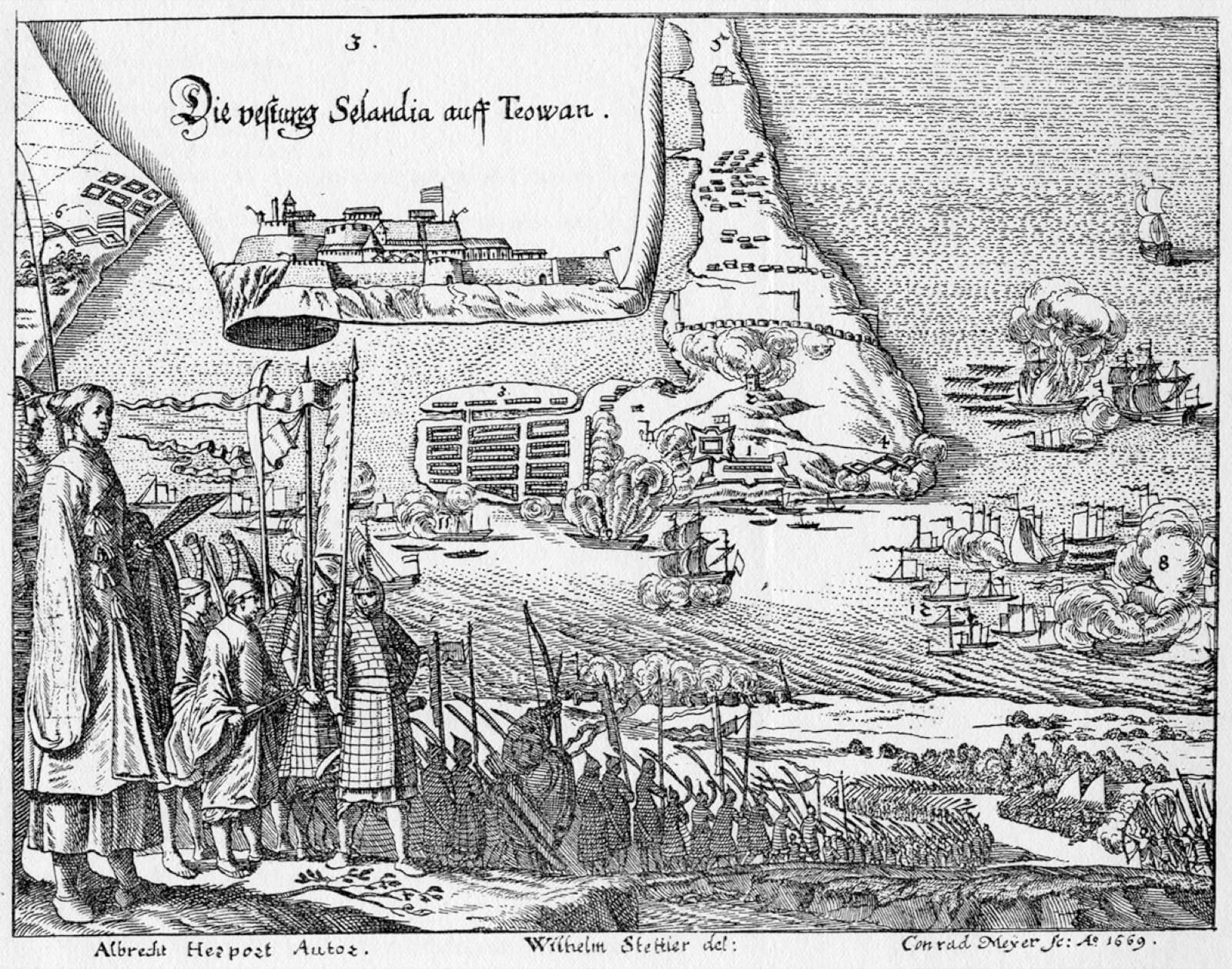
Fort Zeelandia and the bay of Tayouan, from the travel account of Albrecht Herport, a Swiss mercenary who was inside the fort through the nine-month siege of 1661. Few images of the castle come from an eyewitness.
Albrecht Herport, *Ostindianische Reißbeschreibung*, 1669
Isle of Time