


A King Imprisoned by Wrath
In the early days of 1662, the air over Anping was thick with the acrid stench of gunpowder and the heavy, salty tang of the sea breeze. This massive brick fortress, once known to the Dutch as "Zeelandia," now flew the vibrant crimson banners of the Ming Dynasty’s Prince of Yanping.
After a grueling nine-month siege, the thirty-nine-year-old warlord Koxinga (Zheng Chenggong) had finally forced the Dutch Governor, Frederick Coyett, to sign the instrument of surrender. Standing atop this fortress, which had taken the Dutch East India Company thirty years to build, Koxinga watched the enemy’s merchant ships carry the remnants of their defeated garrison away from Anping Harbor. To the outside world, this was the absolute zenith of his career—he had carved out a sovereign sanctuary for the Han people across the sea with his bare hands, rising from the son of a pirate king to become a legendary founding hero.
Yet, when we step into the final one hundred and twenty days of this great man’s life, we find not the grand triumph of a founding monarch, but a harrowing psychological tragedy woven from profound rage, paranoia, betrayal, and madness. During these final months, Fort Zeelandia was not a cornerstone for a new empire, but a psychological cage that slowly consumed its master. Koxinga’s descent into madness did not ignite from nothing; fate dealt him a succession of devastating blows across those short months.
Just as the echoes of victory over the Dutch began to fade, the first catastrophic news arrived from across the strait. To permanently sever Koxinga’s supply lines, the Qing court had enforced the ruthless "Great Clearance" policy, forcing coastal residents to move miles inland and banning all maritime activity. Worse still, the Qing took bloody vengeance on his family.
A secret dispatch from Beijing revealed that his father, Zheng Zhilong—the legendary maritime tycoon who had surrendered to the Qing—had been publicly executed, and his brothers slaughtered. To shatter the Zheng family’s imperial ambitions, Qing troops had even desecrated the ancestral tombs in Fujian, scattering the bones of his mother and ancestors into the wind. In a Confucian society that viewed filial piety as the ultimate virtue, the execution of his father and the desecration of his ancestral tombs were weights too heavy to bear.
Koxinga collapsed to the floor of his bedchamber, coughing up blood. His anti-Qing crusade had always been torn by the agonizing conflict of choosing loyalty over filial piety; now, his father was dead because of him, and his ancestors disgraced. Deep guilt and rage warped his mind, twisting into a profound, suffocating paranoia toward everyone around him.
If the cruelty of the Qing court was a devastating external blow, the betrayal from his home base in Xiamen was a fatal blade plunged directly into his chest. While he was still reeling from the loss of his father, a messenger arrived from Xiamen carrying a letter from his eldest son and heir, Zheng Jing, announcing the birth of a newborn grandson. However, a subsequent secret report unmasked a scandalous truth: the infant was not born to Zheng Jing’s legitimate wife, but was the product of an illicit affair between the prince and his younger brother’s wet nurse, Zhaoniang.
The wife’s grandfather, a high-ranking official named Tang Xianyue, wrote a scathing letter to Koxinga across the sea, demanding justice for his granddaughter's public humiliation: "If you cannot rule your own house with righteousness, how can you rule a nation? You hold massive armies abroad while your heir commits incest at home.
How can you command the respect of the people?" This letter ignited the volcanic wrath pent up inside Koxinga's chest. For a man who defined his entire rebellion on the orthodox moral laws of Confucianism—a warlord who executed his own generals for the slightest moral failure—this was an intolerable stain. In the grand council hall of Fort Zeelandia, a psychologically shattered Koxinga flipped the tables, drew his sword, and issued a terrifying, desperate decree: he ordered his cousin, Zheng Tai, to sail to Xiamen and immediately execute his heir Zheng Jing, his own wife Lady Dong, the wet nurse, and the newborn infant to wash away the family shame in blood.
Koxinga could never have anticipated that this manic command would push him into absolute isolation. In Xiamen, the veteran generals stared at the decree in shock. Executing a nursemaid was easy, but executing the Prince's wife and heir would destroy the very foundations of the regime. Declaring that the King had gone mad in Taiwan, the generals chose collective mutiny; they killed the nursemaid but placed Lady Dong and Zheng Jing under armed protection. When news of this insubordination reached Taiwan, Koxinga realized he was utterly alone.
Fort Zeelandia had become a true prison. To the north lay the iron blockade of the Qing Empire; to the west, his own gen…
Fort Zeelandia had become a true prison. To the north lay the iron blockade of the Qing Empire; to the west, his own generals in Xiamen refused his commands; beneath his feet, the newly conquered island simmered with native unrest. Koxinga locked himself in the highest tower of the fortress, refusing to see any officials.
Witnesses described the late-stage warlord pacing frantically along the corridors, his eyes bloodshot and predatory. He began issuing death sentences daily—executing officials for minor agricultural delays and soldiers for trivial infractions. In his final four months, more of his own men died from his paranoid fury than had fallen during the entire nine-month war against the Dutch. He began to hallucinate in the sweltering heat of the tropical nights, claiming he could hear his executed father calling to him from across the waves, or seeing the ghosts of his slain generals demanding his life.
By early May 1662, Koxinga's body finally collapsed under the relentless burning of his mind.
He contracted a severe tropical fever that ravaged his immune system, but he refused to take to his bed. Instead, he sat upright in a wooden chair like a wounded wolf, his hand clenched tight around the hilt of his royal sword. On May 8, when General Ma Xin entered the chamber, he witnessed one of the most tragic sights in history. The grand commander who had once terrified the Dutch East India Company and broken the sleep of Qing emperors was disheveled, his robes torn. His fingernails were caked with dried blood—in his final paroxysms of anxiety and mental torment, he had used his own hands to claw his face and forehead into a bloodied, unrecognizable ruin.
Staring out the window at the vast waves of Anping Harbor, he knew the strait he had crossed so many times had become an impassable gulf, and his dream of reclaiming China had vanished. Summoning his absolute last reserves of strength, Koxinga stood up, pressed the imperial codes of the Ming Dynasty’s founding emperor to his face, and unleashed a final, thunderous roar that shook the stone walls of the fortress: "How can I face my emperors in the world below? Oh Heaven! Oh Heaven! Why have you driven me to such an extreme?"
With those final words, he sprayed a fountain of blood across the pages, and his tall, imposing frame crashed heavily onto the wooden floors of Fort Zeelandia.
He was only thirty-nine years old.
Koxinga’s death bears the profound weight of a Shakespearean tragedy. He was an undisputed hero, but he was also a fragile human being driven to madness by the shifting tides of an era, a pathological moral perfectionism, and an unquenchable thirst for vengeance. His rage was born from the unstoppable collapse of the dynasty he loved; his madness, from the unraveling of his own family.
Today, when we stand beneath the weathered brick walls of Fort Zeelandia in Tainan, enjoying the warm southern sun, it is hard to fathom the sheer agony of the soul that was once imprisoned here. Koxinga died in a tempest of fury and madness, but the island he left behind did not vanish with him. Instead, from the moment he fell, this former pirate outpost was permanently injected with Han civilization, classical education, and an uncompromising spirit of rebellion.
The King died in madness, but the true history of Taiwan was born in that blood-stained hall of Fort Zeelandia.
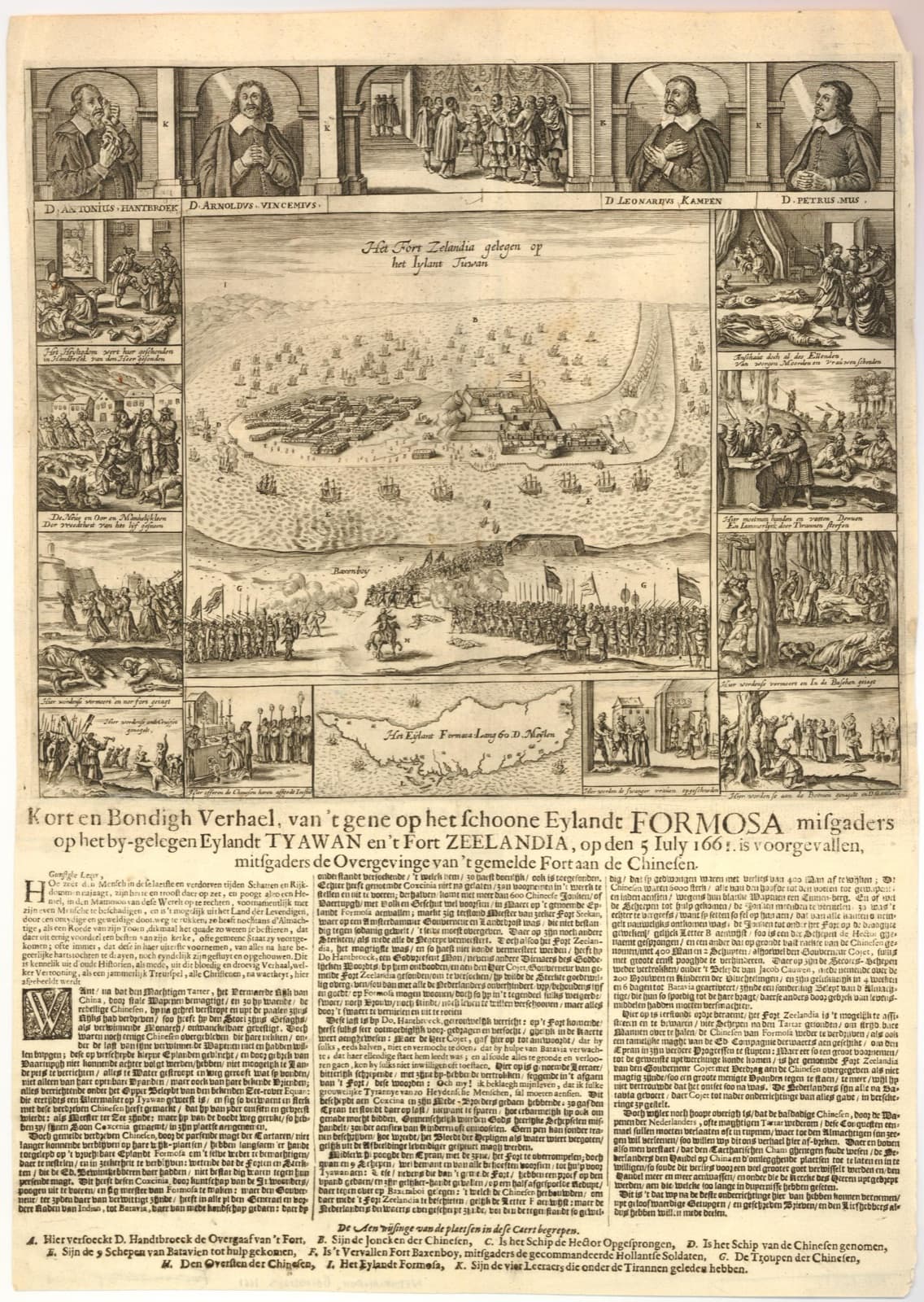
A Dutch news broadsheet of 1662 reporting the loss of Formosa and Fort Zeelandia. Vignettes along the top and bottom narrate the siege; the centre is a bird's-eye view of the bay of Tayouan.
British Museum
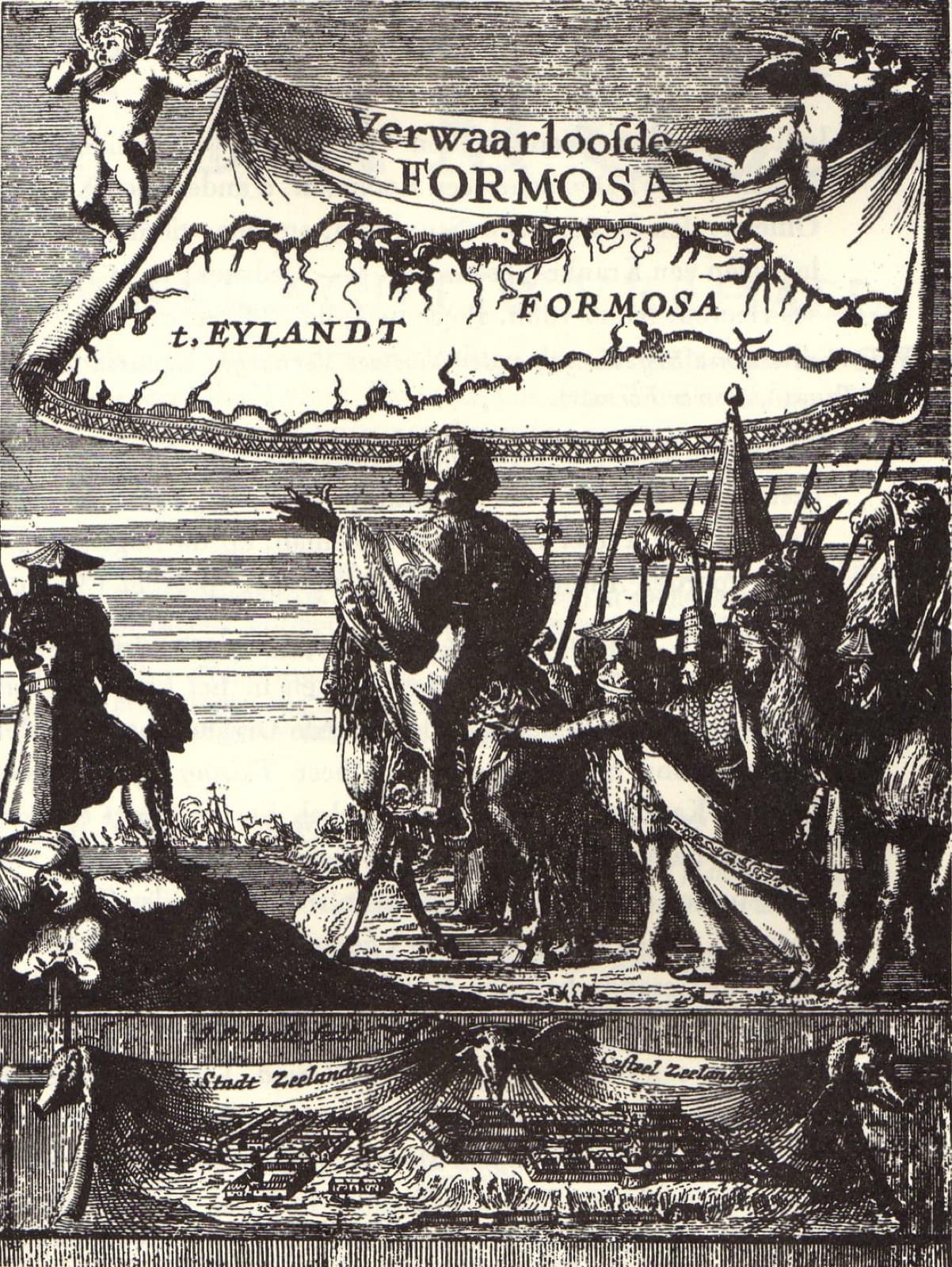
The title page of *'t Verwaerloosde Formosa*, 1675. Frederick Coyett, the last Dutch governor, was exiled after the surrender and wrote this book in his own defence, accusing his superiors in Batavia of abandoning him.
*'t Verwaerloosde Formosa*, 1675
Isle of Time