


Before 1949, Taiwan's tenant farmers handed fifty to seventy percent of their harvest to the landlord as rent. On 14 April 1949 the Taiwan Provincial Government issued its regulations on the leasing of private farmland: rent could be no more than 37.5 percent of the main crop's annual yield. Rents above that had to come down, and those below it could not be raised. This was the 37.5 percent rent reduction. It was pushed through by the provincial chairman, Chen Cheng, with the backing of Chiang Monlin.
That year 296,043 tenant households signed new leases, 44.5 percent of all farm households. The land under those leases came to 256,557 hectares, 31.4 percent of all farmland. The grain tenants now kept soon went back into the fields: between 1948 and 1951 farm output rose by more than forty-seven percent.
Landlords' income dropped sharply, and some tried to take their fields back to farm themselves or to switch to a tenant who would pay more. Around Hsinchu, one landlord-tenant dispute followed another. On 7 June 1951 the Farmland 37.5 Percent Rent Reduction Act came into force, and the regulations became law.
The same year the government began selling public farmland to the farmers working it, much of it land that had belonged to Japanese sugar companies. The sale of public land ran in nine phases until 1976, releasing 138,957 hectares to 286,287 farm households.
Then came private land. The Executive Yuan approved the draft act in November 1952, and on 26 January 1953 the President promulgated the Land-to-the-Tiller Act. A landlord could keep three chia of medium-grade paddy, about 2.9 hectares, or six chia of dry field, about 5.8 hectares, and anything more was bought up by the government and passed on to the tenants farming it. The price was two and a half times the annual yield of the main crop, and tenants paid it off over ten years. Landlords were compensated seventy percent in land bonds redeemable in kind and thirty percent in shares of four state enterprises: Taiwan Cement, Taiwan Pulp and Paper, Taiwan Agriculture and Forestry, and Taiwan Industry and Mining.
This round took 139,249 hectares and created 194,823 new owner-farmer households. Afterwards more than eighty percent of the farming population farmed their own land. Between 1949 and 1960 rice productivity rose by about half, and farm families' net income tripled.
Lin Hsien-tang of the Wufeng Lin family, who had led the petition movement for a Taiwan parliament under Japanese rule, did not wait for that day. In September 1949 he went to Japan, saying it was for medical treatment, and he never came back. The land policy had struck at the family's estates, and what followed the February 28 Incident had left him disheartened. In Japan he wrote a couplet: a foreign land will do for a short stay, but who will tend the flowers of the old garden? In 1955 Tsai Pei-huo was sent to Tokyo to persuade him to return, and he answered with the classical line: do not enter a state in danger, do not live in a state in disorder. He died in Suginami, Tokyo, on 8 September 1956, and his body was brought back to Taiwan for burial.
Rent reduction was the cheapest route to stability the provincial government could find in 1949. The government did not have to spend anything. It only had to write down a ceiling on rent, and the extra harvest left in tenants' hands was stability. The 296,043 households that signed new leases were close to half of all farm households. And the landlords who held that land were mostly Taiwanese, while the government's leaders owned no land on this island.
Land-to-the-tiller followed the same logic. The price was set at two and a half times the annual yield, paid by tenants over ten years. Landlords received seventy percent in land bonds and thirty percent in shares of the four state enterprises, and again the government put up no cash. The act was promulgated on 26 January 1953, and 139,249 hectares were taken. The countryside settled down, and landlords' money was steered towards industry.
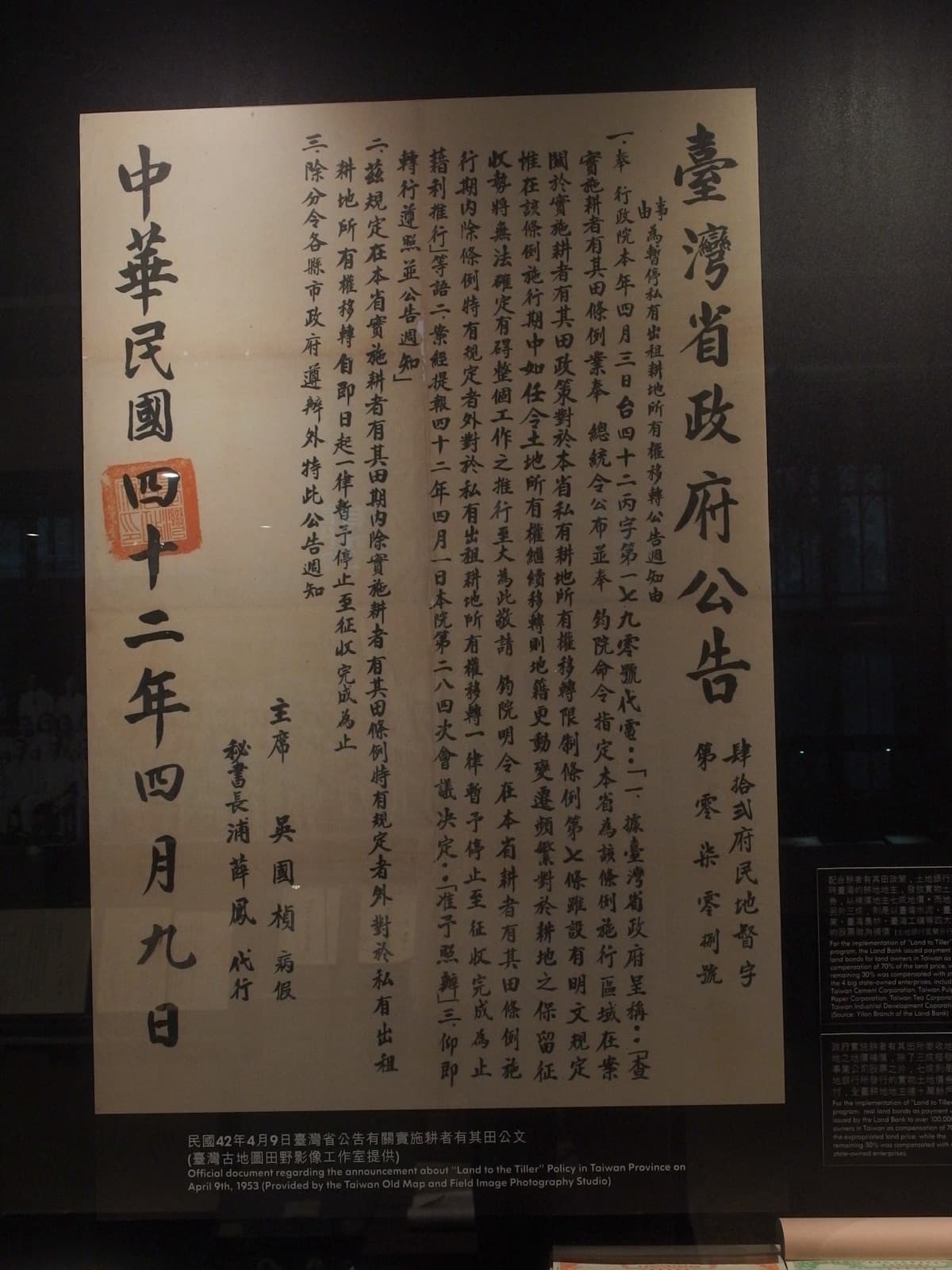
Taiwan Provincial Government proclamation of 9 April 1953, signed by the provincial chairman K. C. Wu, announcing the regulations for carrying out land-to-the-tiller. Photographed from the original on display.
HuKi001 / CC BY-SA 4.0 via Wikimedia Commons
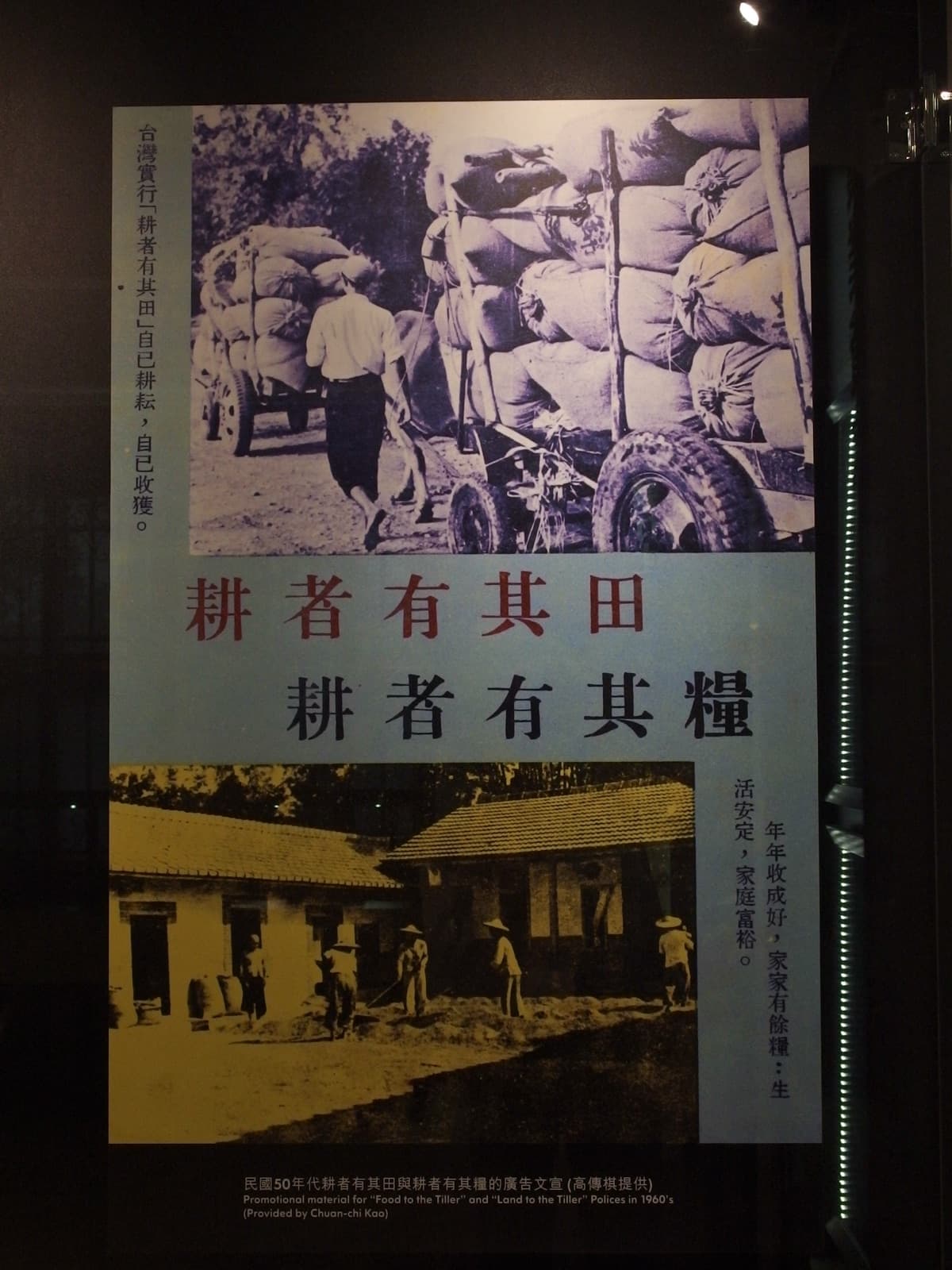
A 1960s propaganda poster: 'Land to the tiller, grain to the tiller.' The upper half shows an ox cart piled with sacks of rice, the lower half a farmyard threshing floor.
HuKi001 / CC BY-SA 4.0 via Wikimedia Commons