


Opening of Treaty Ports
Following the Second Opium War, the Treaty of Tianjin (1858) and the Convention of Peking (1860) compelled the Qing to open Taiwan's ports to international trade — a turning point that would transform the island from an imperial backwater into a node of global commerce. Tamsui, Keelung, Anping, and Takao (present-day Kaohsiung) were designated as treaty ports, and by the 1860s foreign merchants, missionaries, and consular officials had established a permanent presence on Taiwan's shores.
The economic impact was swift and profound. Taiwan's tea — cultivated in the misty hills north of Taipei — became a priz…
The economic impact was swift and profound. Taiwan's tea — cultivated in the misty hills north of Taipei — became a prized export to the United States and Europe, rivaling the famous teas of Fujian. Camphor, essential for celluloid manufacturing and pharmaceutical production, made Taiwan one of the world's leading suppliers. Sugar continued its centuries-old role as a staple export to Japan and China. British trading houses such as Jardine, Matheson & Co. and Dent & Co. established operations, while John Dodd's pioneering direct export of Formosa Oolong to New York in 1869 opened an entirely new market. Alongside commerce, Presbyterian missionaries — notably George Leslie Mackay in the north and Thomas Barclay in the south — introduced modern hospitals, schools, and romanized writing systems for local languages.
This volume traces how the forced opening of Taiwan's ports drew the island into global networks of trade, religion, and diplomacy, fundamentally altering its economy, society, and relationship with the outside world in the decades before Japanese colonization.
He came from Xiamen, arrived at Tamsui in 1866 and worked as compradore for the British firm Dodd and Company. A compradore stood between two sets of books: the foreign house understood prices and sailing dates but not local credit, dialect or obligation, and he did, so goods, money and men all passed through him. His first large piece of work was buying tea for John Dodd — seedlings had been brought from Anxi around 1865, loans were advanced to growers in the northern hills, and the crop bought for cash at harvest. In 1869 Dodd shipped more than two thousand piculs of oolong from Tamsui directly to New York under the label Formosa, and it sold better than expected. For the twenty years that followed, tea was Taiwan's largest export by value, and the tea houses of Dadaocheng grew from a handful to over a hundred. Li Chunsheng went on to trade tea on his own account, to handle foreign affairs, and to invest in property and shipping, becoming one of the wealthiest Chinese in northern Taiwan and among the earliest to be baptized. The books he wrote in old age deal with religion and philosophy and rarely with business. One line in them reads that trade is not for goods but for the meeting of minds.
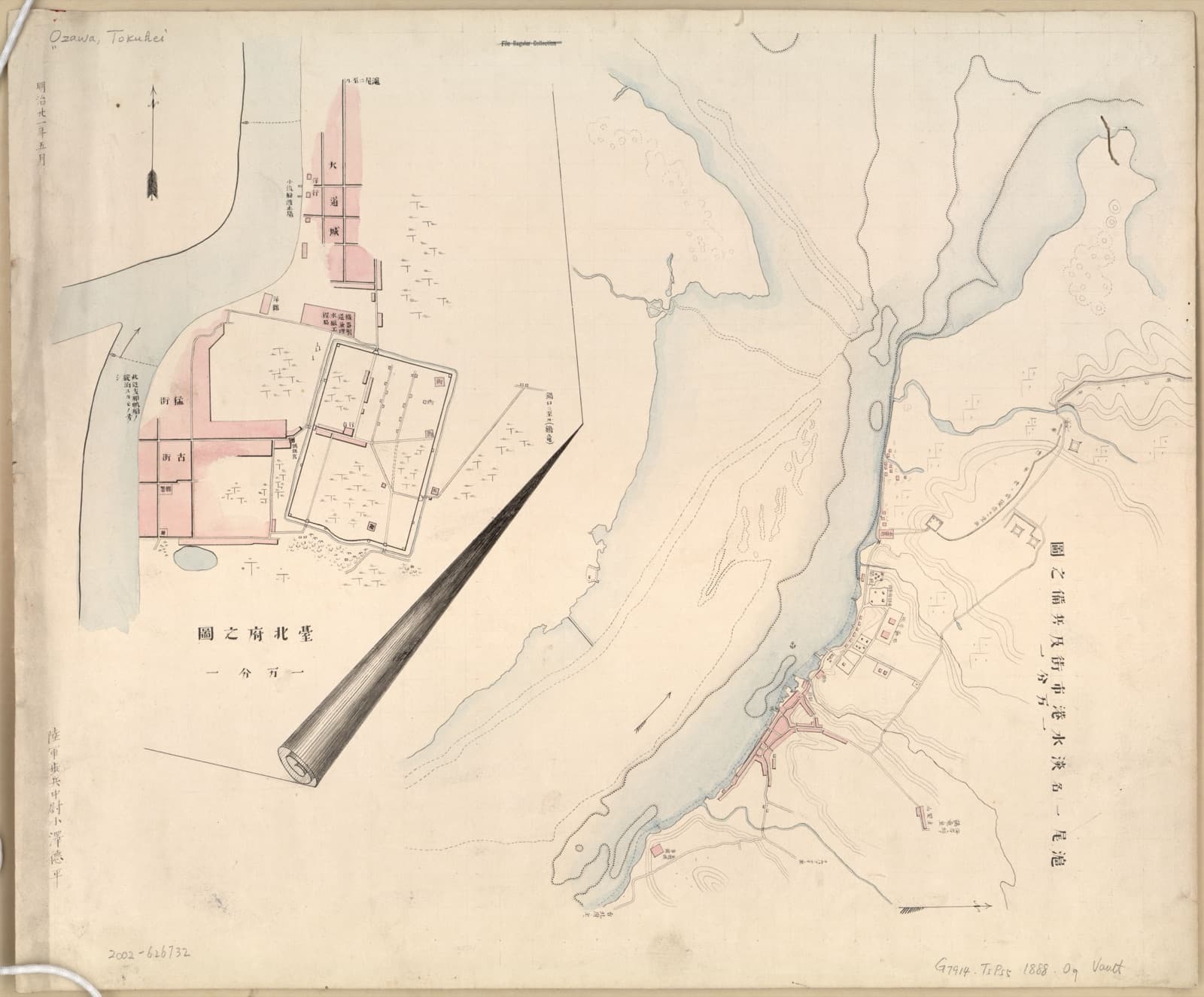
Tamsui harbour and the Taipei prefecture, drawn by Ozawa Tokuhei in 1888. Tamsui opened under the Treaty of Tianjin in 1860, with Keelung, Anping and Takow following; tea, sugar and camphor left through these four.
Drawn by Ozawa Tokuhei; Library of Congress
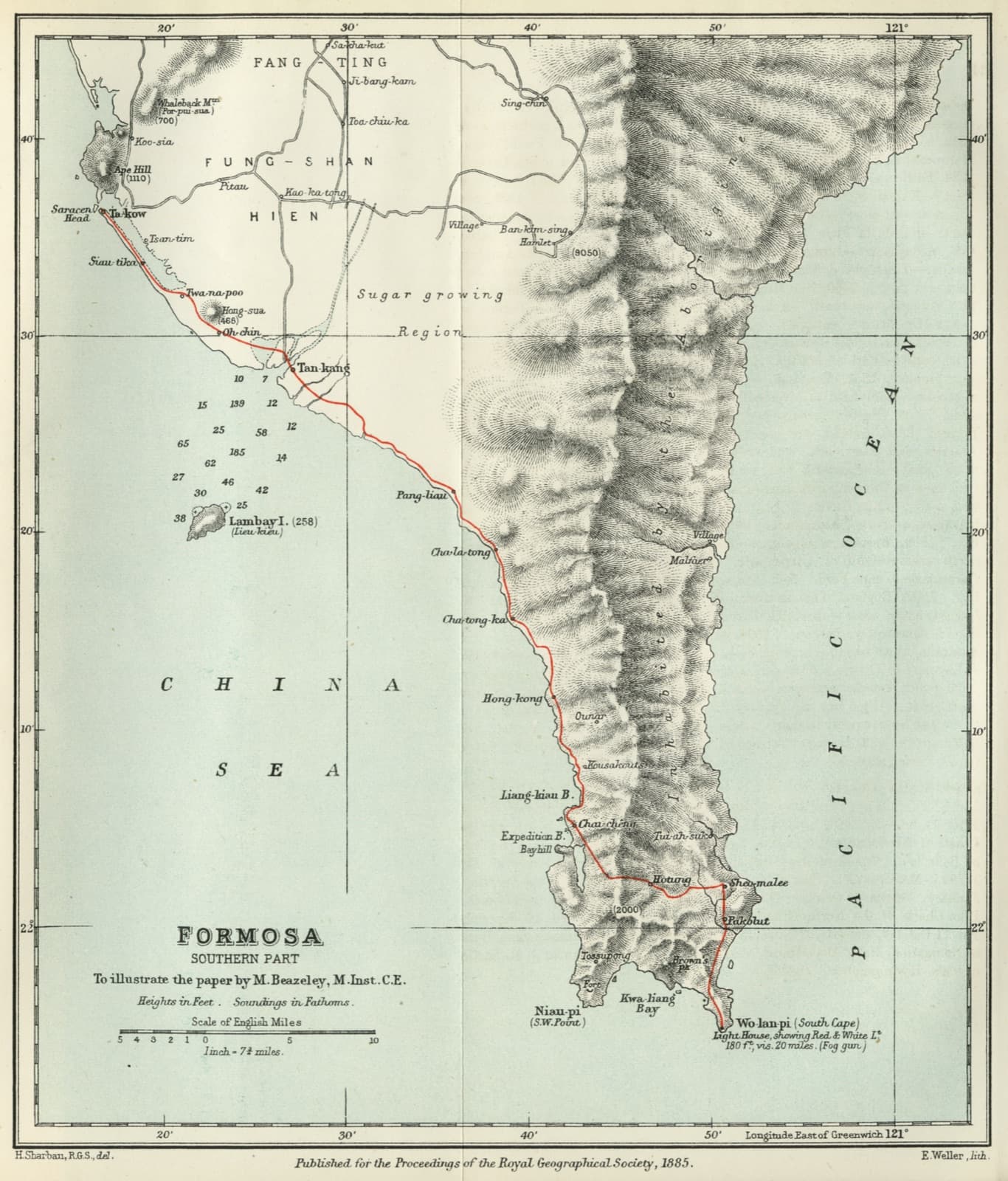
A map of southern Formosa published by the Royal Geographical Society in 1885, appended to Beazeley's account of an overland journey made in 1875. After the ports opened, foreign survey moved inland alongside foreign trade.
*Proceedings of the Royal Geographical Society*, 1885
Isle of Time