


The Opium War
In early twentieth-century Taiwan, while "the Greatest Thief Under Heaven," Liao Tianding, leapt across rooftops in the dark and challenged the Government-General with raw force, another struggle — bloodless, yet even more breathtaking — was quietly opening in laboratories and hospital wards, waged by a scholarly young man in gold-rimmed glasses. The enemy of this war was not the proud Japanese police, but a white demon that had gnawed at Taiwan's social structure since two centuries of Qing rule had begun, leaving over a hundred thousand families ruined: opium.
The soul of this opium war was Du Cong-ming, born in 1893 in Sanzhi, New Taipei. He would become Taiwan's first doctor of medicine — a medical giant who combined brilliance with deep human compassion. The Government-General faced a uniquely difficult mess in Taiwan: more than a hundred thousand registered opium users were officially recorded on the island. These addicts had drowned for years in opium smoke, losing all productivity and becoming the heaviest burden on the lowest rungs of society.
At first the Japanese government had no answer. A harsh outright ban could trigger mass riots from over a hundred thousand addicts and dealers in agonizing withdrawal; passive tolerance, as in the early Qing years, would leave Taiwan's economy and society barred from modernity forever. With the Government-General caught between these poles, even considering mass internment, Du Cong-ming stepped forward, founded the "Renewal Hospital" (Gengsheng-yuan) in Taipei, and formally declared war on opium.
Du Cong-ming was a true scientist and a compassionate physician. In an age that treated drug users as criminals or social refuse, he issued a historically foresighted diagnosis. He declared openly: "Opium smokers are not criminals; they are patients. And since they are patients, we should heal them with science and medicine."
The climax of this war erupted inside the isolation wards of the Renewal Hospital.
There Du faced patients whose addictions to powerful morphine and opium reached deep into the bone. When these men were brought into the Renewal Hospital and cut off from their drugs, the wards became a living hell. Crushing withdrawal sent patients writhing on the floor, beating their heads against walls in hysterics, even biting their own skin in frenzy. The wails went on through the night.
Japanese officials and the police watched in horror, many demanding handcuffs and whips to subdue the frenzied addicts. …
Japanese officials and the police watched in horror, many demanding handcuffs and whips to subdue the frenzied addicts. Du calmly placed himself across the ward's door. He knew that forced "cold turkey" complete withdrawal would simply kill them. Drawing on his deep knowledge of pharmacology, he devised what would become his world-famous "Gradual Withdrawal Method" — a reduction-based detoxification protocol.
Du Cong-ming worked sleeplessly in his laboratory, extracting compounds from plants and precisely formulating replacement medications that could ease the agony without producing strong new addiction. In nights lit by flickering flame, Du personally led his nurses and orderlies into the ward thick with sweat and cries. Half-kneeling beside beds stained with mud and waste, he gently soothed the delirious patients and injected the medications into their veins with his own hand.
A miracle followed. Patients who minutes earlier had thrashed like beasts saw their fever and convulsions subside within minutes of injection and at last fell into deep sleep. Du Cong-ming monitored the data with rigorous scientific discipline, reducing dosage drop by drop, day by day, paired with psychological counseling and nutritional therapy. Within a few short weeks of treatment, the gaunt, hollow-eyed addicts miraculously regained their wits and walked back through the wooden doors of the Renewal Hospital — restored as upright men in society.
The results of this opium war were stunning. Within a few years, the Renewal Hospital cured tens of thousands of severe addicts across Taiwan completely of their opium and morphine dependence. Through precise injections and selfless love, Du pulled this group of "wandering ghosts abandoned by their age" back from the brink of death and madness. It was not merely a medical victory; it was a pivotal miracle in which science rescued the demographic structure of Taiwanese society.
After Japan's defeat in 1945, Du Cong-ming carried his love of this land forward. He took over the College of Medicine at National Taiwan University, and later in life moved south to Kaohsiung, where he founded Taiwan's first private medical college — Kaohsiung Medical College, today Kaohsiung Medical University — training generation after generation of frontline physicians serving the island.
Du Cong-ming's story was the most rational and most humanitarian chapter of Taiwan's Japanese era. While Liao Tianding cut sparks of rebellion through the night with his dagger, Du, in Taipei's laboratories and wards, with a stethoscope and limitless compassion, completed a far larger, far deeper "redemption of souls."
He did more than excise the white tumor from the body of his society — with the modern scientific spirit, he laid the firmest, most unshakable century-long foundation for Taiwan's public health and modern medicine.
The licence was a card with a photograph and a number, carried on the person, and the paste could only be bought at outlets designated by the monopoly bureau. Around 1900 some one hundred and sixty-nine thousand smokers were on the register, about six per cent of the population; most were men past middle age, among them merchants, village heads and local notables. The policy was called gradual prohibition — issue no new licences, and as this generation died away opium would disappear of itself. The other side of gradual prohibition was that a licensed man was recognized by the state as a patient and fixed as a customer. The bureau set the price of the paste and raised it year by year, and those who could not stop went on buying. Every village had its stories of fields sold off plot by plot. In 1929 the administration announced it would accept new applications, reasoning that with so many unlicensed smokers being caught it was better to bring them under supervision than leave them underground, and more than twenty thousand applications appeared. To a man who had held a licence for thirty years the meaning was plain: this generation was not finished yet.
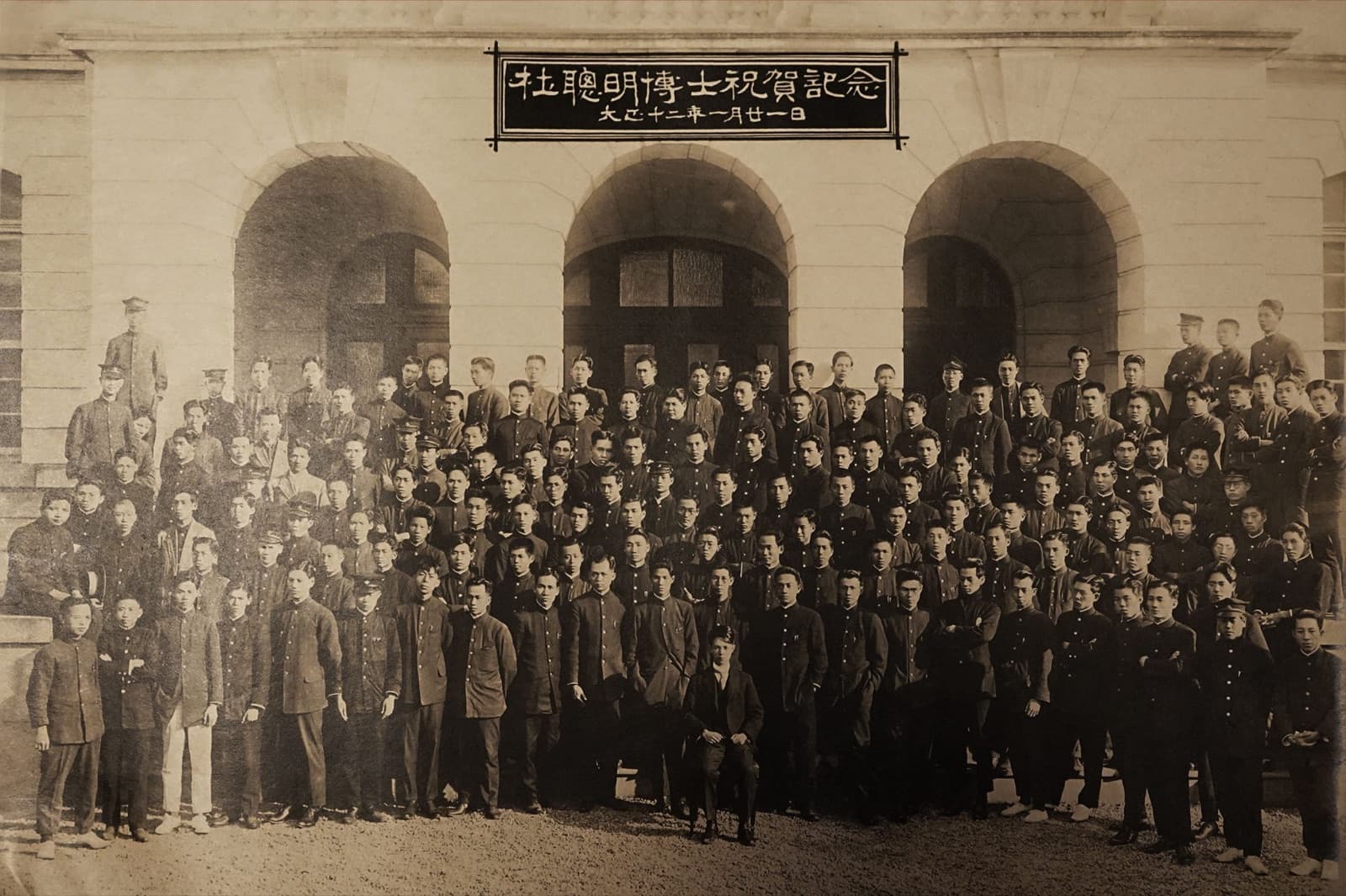
Taipei, 1922: a crowd gathers to celebrate Tu Tsung-ming, the first Taiwanese to earn a doctorate. He went on to run the gradual-withdrawal treatment for opium addicts, working alongside a monopoly that profited from them.
Public domain; photographer unknown
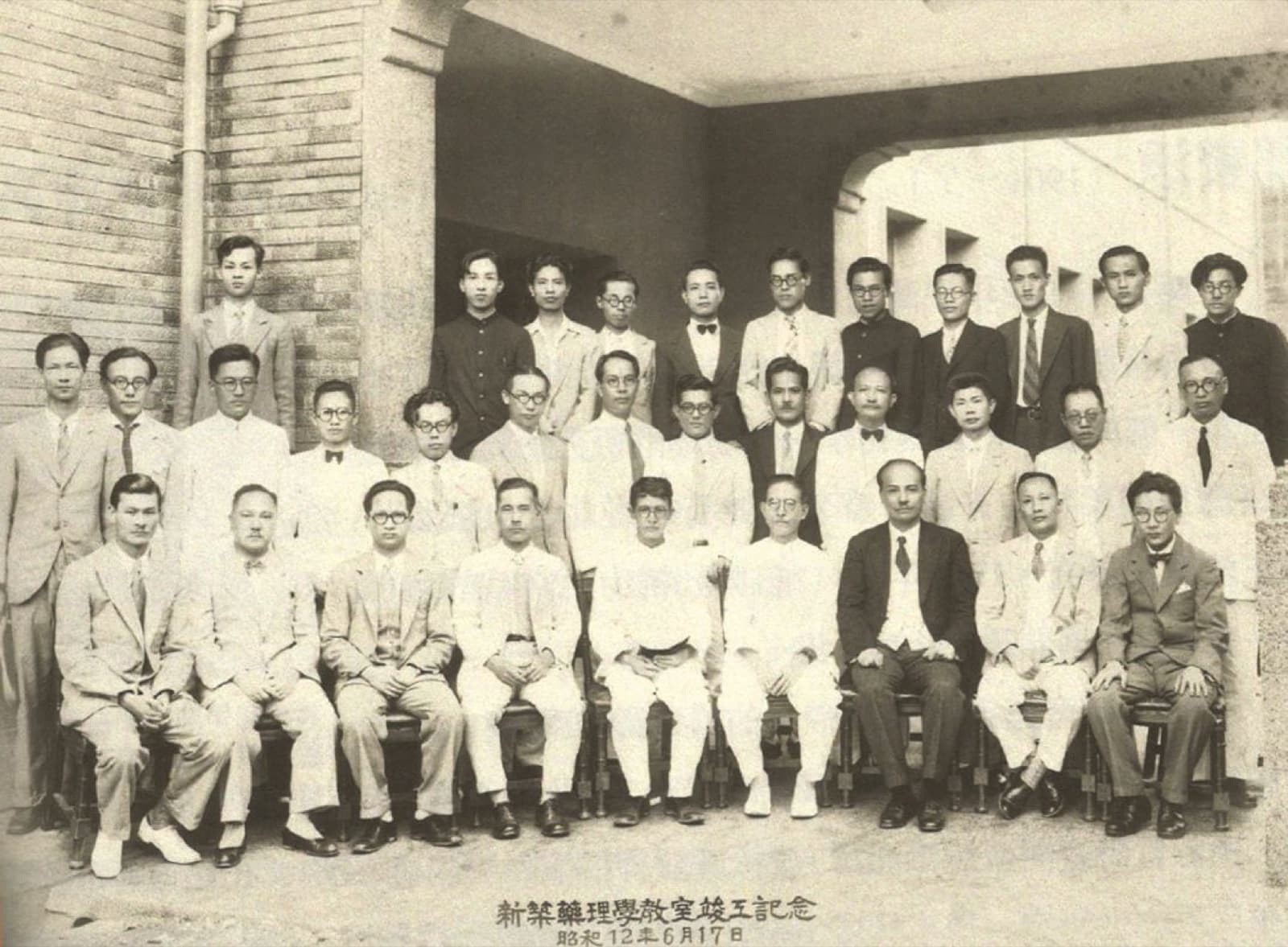
The opening of the pharmacology building at Taihoku Imperial University, 1937. Tu Tsung-ming's research on opium and narcotics was carried out inside.
Public domain; photographer unknown
Isle of Time