


Armed Resistance
The early decades of Japanese rule were marked by persistent armed resistance, revealing the depth of opposition to colonial authority across both Han and indigenous communities. In the first years after annexation, guerrilla fighters known as 'righteous bandits' (義匪) waged a sustained insurgency across the countryside, prompting the colonial government to launch massive 'bandit suppression' campaigns that killed thousands.
The most significant uprisings punctuated the colonial period like recurring tremors. The Beipu Incident of 1907 saw Hak…
The most significant uprisings punctuated the colonial period like recurring tremors. The Beipu Incident of 1907 saw Hakka and indigenous Saisiyat fighters briefly seize a Japanese police station in Hsinchu. The Tapani Incident of 1915, led by Yu Qingfang under the banner of a syncretic religious movement, was the last major Han armed revolt — its suppression resulted in nearly 900 death sentences, later commuted under public pressure. The Wushe Incident of 1930 sent shockwaves through the empire: Seediq warriors led by Chief Mona Rudao attacked a Japanese sports day gathering, killing over 130 settlers and officials. The colonial government's retribution was devastating — deploying aircraft, poison gas, and allied indigenous groups in a campaign that nearly annihilated the Seediq communities involved.
This volume traces the arc of armed resistance from the guerrilla campaigns of the 1890s through the watershed Wushe Incident, examining how each uprising reshaped colonial policy — from military suppression toward increasingly sophisticated systems of surveillance, co-optation, and assimilation — and how the memory of resistance became foundational to Taiwanese identity.
On the donor register of the Xilai Temple in Tainan in 1915, the stated purpose of the gifts was to avert calamity. Yu Ching-fang had served as an auxiliary constable and sold insurance, and had been to prison. The language he mobilized in was not political but religious: the Prince Lords would send down celestial troops, charm water would stop bullets, the compassionate kingdom of the Ming was about to return. Those who joined paid for a talisman, from fifty cents to five yuan, and received a slip of yellow paper. Most who followed him were farmers from Jiaxianpu and Tapani, few of them literate and many of them hard pressed — the camphor monopoly had cut off the income of the hill villages, and taxes had risen after the land survey. In July 1915 they took several police substations and killed several dozen Japanese officers and family members; in August they met the army head-on at Tapani, and the charm water did not stop the machine guns. Yu was captured at the end of August and tried in September. This was the last large armed rising by Han Taiwanese. For the thirty years that followed, resistance moved to newspapers, petitions and lecture halls.
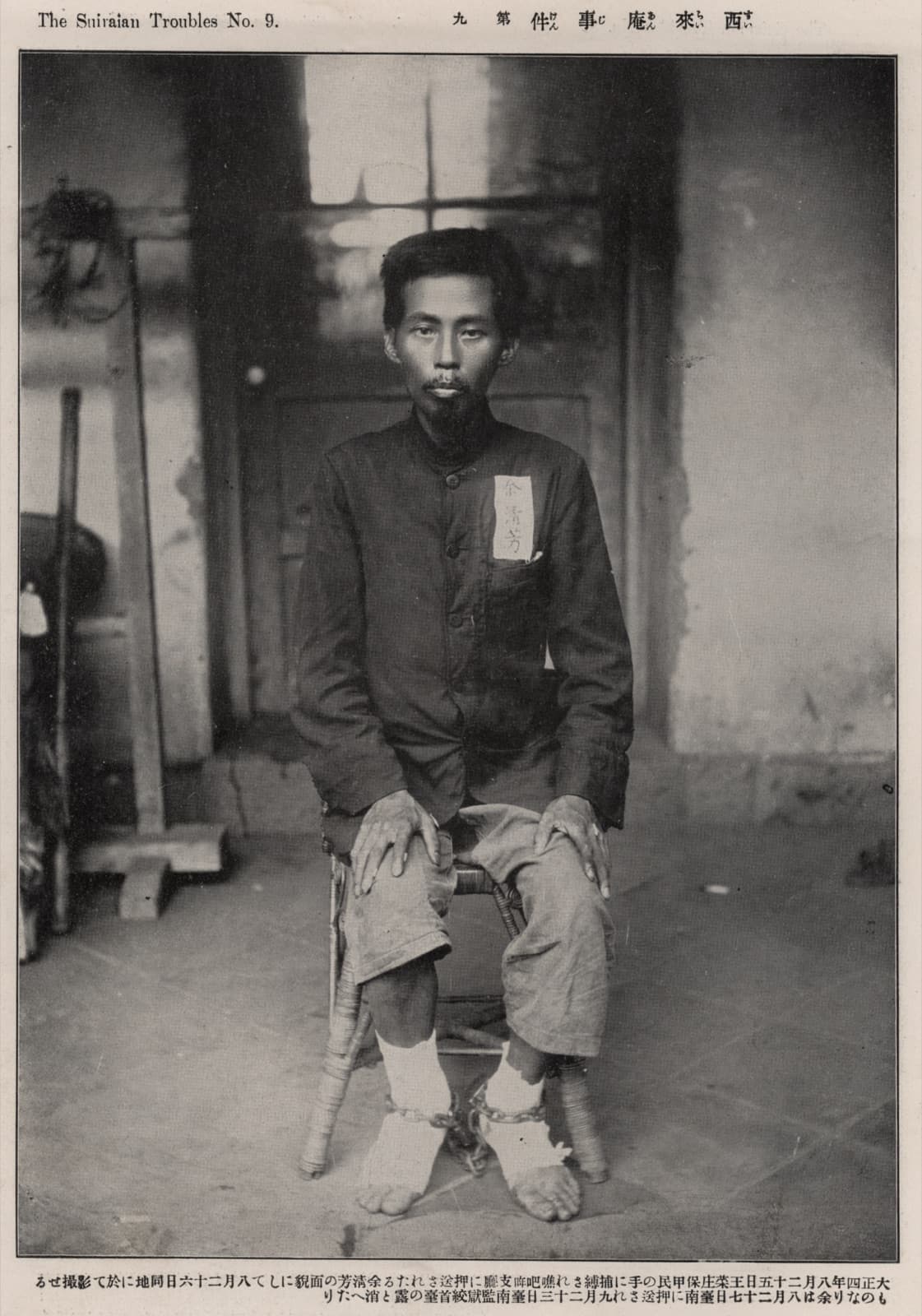
Yu Ching-fang photographed in leg irons after his capture. He raised his revolt from the Xilai Temple, was taken in Tainan in August 1915 and executed the following month.
Institute of Modern History, Academia Sinica
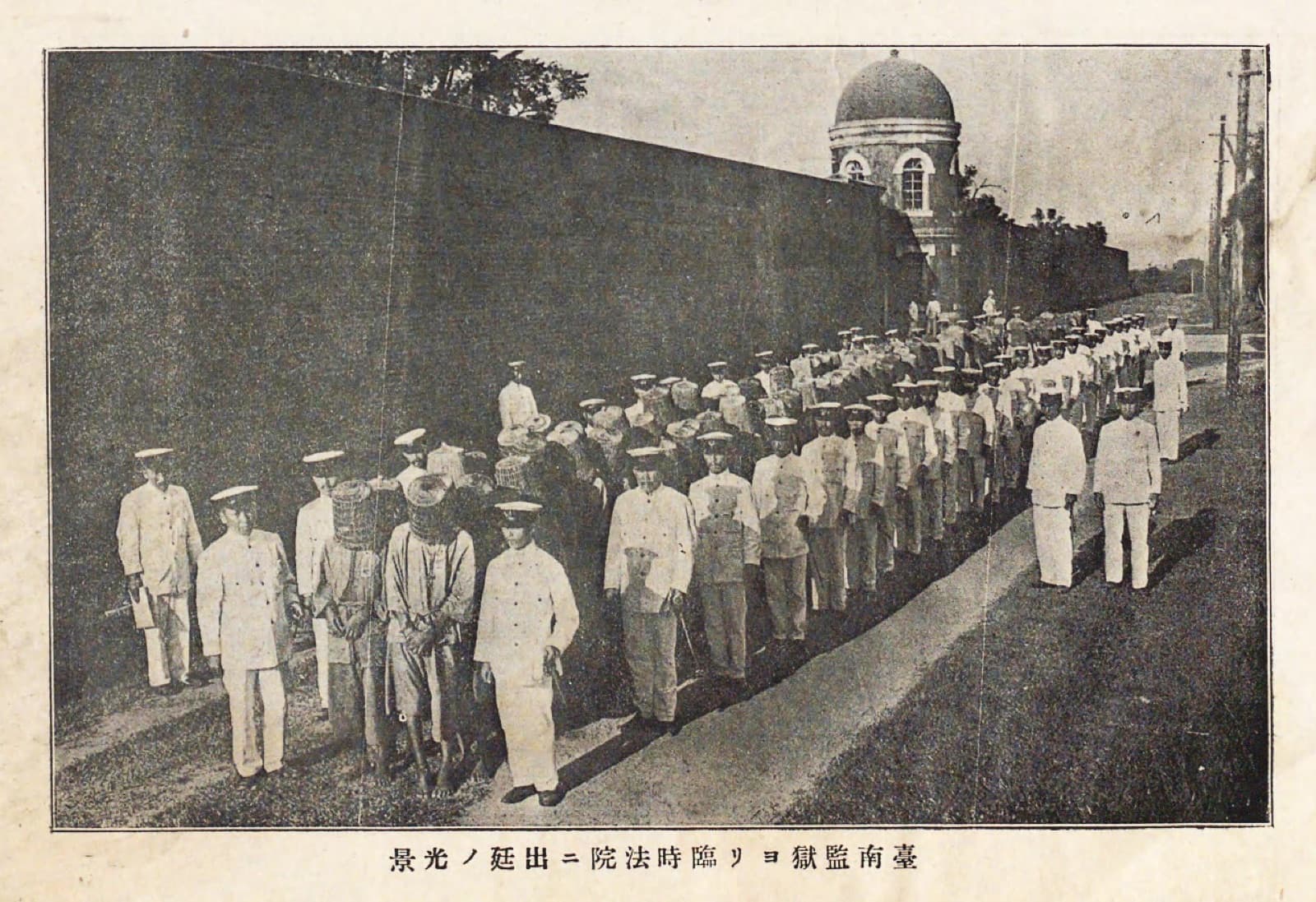
Defendants in the Tapani case filing out of Tainan prison to the temporary court. The trial handed down more than eight hundred death sentences — a figure large enough to cause an outcry in Japan itself.
*A Brief History of Bandit Disturbances in Taiwan*, Government-General of Taiwan

Blades, spears and banners seized after the Tapani uprising, laid out on a table to be photographed. Most of the rebels' weapons were farm tools reworked; they faced police and soldiers with rifles.
*Taiwan Photographic Album*, vol. 2 no. 1, Taiwan Photographic Society
Isle of Time