

The Penghu Incident of 13 July
In the summer of 1949 the staff and students of eight joint middle schools from Shandong came south by way of Qingdao and Canton, and were finally put ashore in Penghu. Most of them were in their teens. They had followed their schools for thousands of kilometres and their baggage had come down to textbooks. The terms the schools had secured from the government were that the students would go on with their schooling, and only those of age would serve.
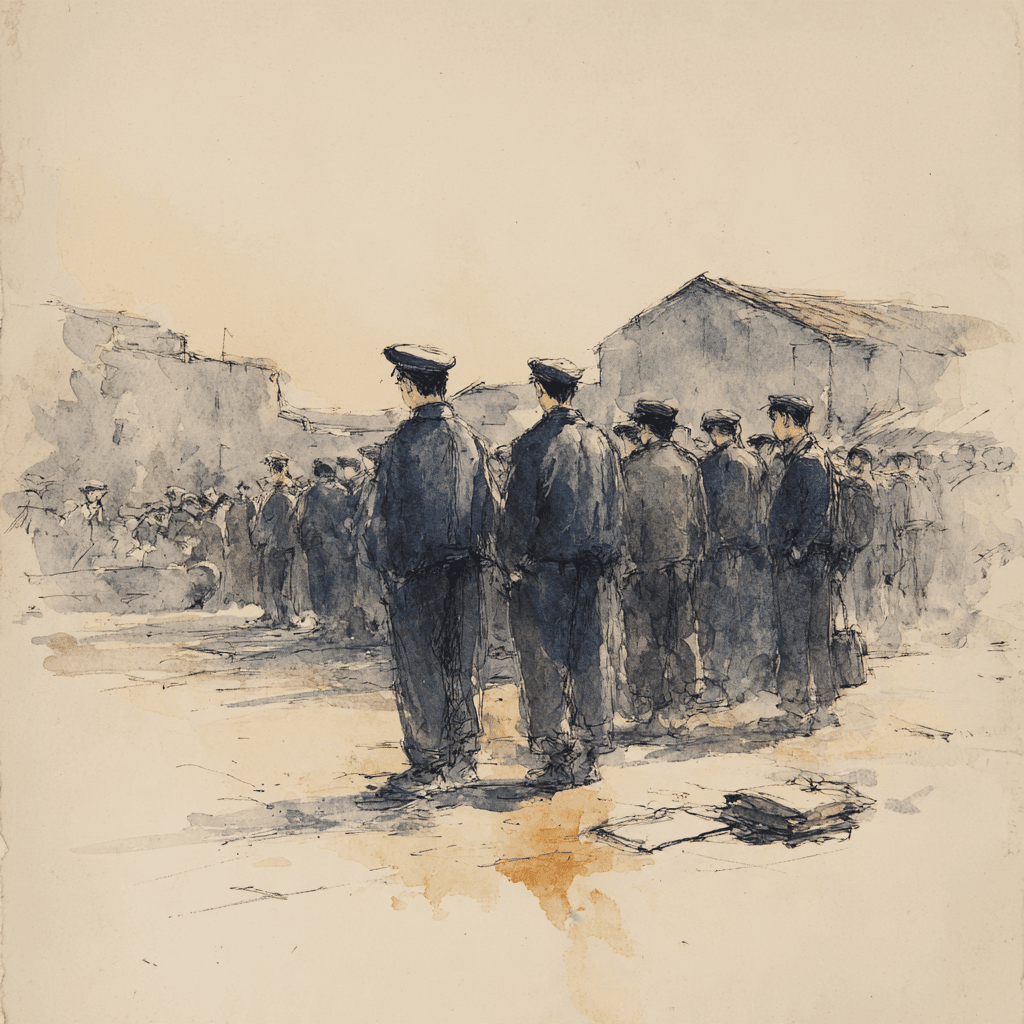
On the morning of 13 July the students were assembled at Magong. What met them was not their teachers but troops of the Penghu defence command. The order was announced on the spot: every male student over a certain height was to be taken into the ranks, whatever his age. Some spoke against it. Soldiers stepped forward, and bayonets drew blood.
The principals Chang Min-chih and Tsou Chien argued it out then and there on the strength of the earlier undertaking. The argument went nowhere. That summer the army was losing formations on the mainland by the division, what the Penghu command lacked was men, and in front of it stood several thousand boys of sixteen and seventeen.
It could have stopped there: a dispute about conscription age, one side losing. But after July the two principals kept a…
It could have stopped there: a dispute about conscription age, one side losing. But after July the two principals kept appealing upward, and pushed the matter as far as Taipei. On 11 December they were shot at Machangding in Taipei together with five students — Liu Yung-hsiang, Chang Shih-neng, Tan Mao-chi, Ming Tung-le and Wang Kuang-yao — on a charge of communist subversion.
Seven men. As numbers went in those years that is not a large one, but this was the first group of mainlanders to be dealt with wholesale under the White Terror — and they were the ones who had just fled to Taiwan with this same government, on foot, for thousands of kilometres. More died of fighting and disease on the road from Shandong to Penghu. Those have no names.
The surviving students put on uniform and served out their time in Penghu. Most were in their thirties by discharge, with no schooling behind them and no family on the island. Some stayed in Penghu for good. Ask them about it and what comes first is often not the executions but that morning on the parade ground, when their teachers were marched off and they did not move.
From the 1990s the survivors and the families began applying for redress, and the files came out one by one. In 2011 a memorial was raised at Magong. It carries the seven names, and as much as can be established of the several thousand who walked into Magong harbour that summer.
From Shandong to Canton on foot, then aboard ship from Canton, what they held onto the whole way was a sentence: stay with the school and you are still in school. They really did carry the books. People died on the road and the books were still there. Standing on the parade ground at Magong on 13 July, at the moment of the measuring, that sentence ended. Taller than a bamboo pole and you were a soldier, shorter and you were still a student. The difference between fifteen and seventeen became the difference of a pole. A classmate shouted, and then there was blood. Years later, telling it, what they say is that they themselves did not speak that day. As to why not, that is usually where the telling stops.
Isle of Time