


Rebellions and Unrest
Qing-era Taiwan earned a reputation as one of the empire's most turbulent frontiers. The folk saying 'every three years a minor revolt, every five years a major rebellion' (三年一小反、五年一大亂) was no exaggeration — over two hundred recorded uprisings occurred during two centuries of Qing rule. The roots of this instability lay in the island's unique social fabric: a rapidly growing settler population, weak imperial oversight, ethnic rivalries between Hokkien and Hakka communities, exploitative local officials, and the absence of a deeply rooted gentry class to mediate disputes.
The most consequential revolts each revealed different fault lines in Taiwanese society. The Zhu Yigui Rebellion of 1721…
The most consequential revolts each revealed different fault lines in Taiwanese society. The Zhu Yigui Rebellion of 1721 began as a protest against corrupt magistrates and briefly seized control of the entire island before Qing reinforcements arrived from the mainland. The Lin Shuangwen Rebellion (1786–1788), the largest uprising of the Qing period, mobilized tens of thousands of fighters across ethnic lines and required imperial troops dispatched by Emperor Qianlong himself to suppress. The Dai Chaochun Rebellion (1862–1865) engulfed central Taiwan for three years and exposed the frailty of Qing garrison forces. In each case, the court responded with a familiar pattern: military suppression followed by limited administrative reform — adjusting jurisdictional boundaries, rotating officials more frequently, or briefly relaxing migration restrictions.
This volume charts the cycle of revolt and response that defined Qing Taiwan's political life, examining how chronic instability shaped both the imperial administration's view of the island as an ungovernable periphery and the local population's growing sense of self-reliance and distinct identity.
Initiation took place at night, with incense, a blood oath and the recitation of the vows, and members addressed one another as brothers. Most people did not join for the sake of restoring the Ming. On this island there were no lineages, no established gentry and no magistrate who stayed more than three years, so when a man quarrelled over a field or a water share, or was simply bullied, there was nobody but his own to rely on. What the Heaven and Earth Society offered was a network of men who would recognize each other. In 1786 the authorities moved against the society, arresting widely around Changhua and Zhuluo, burning villages and pursuing relatives. Lin Shuangwen came from Pinghe in Zhangzhou, lived at Dalijie, and held some standing in the society. What made him rise was the arrest of his kin. He took up arms in November, held the Changhua county seat within a month and killed the magistrate, then laid siege to Zhuluo, while Zhuang Datian rose in the south. At its height only the prefectural city, Lugang and Tamsui remained in government hands. The court sent Fukang'an across with an army, and in the first month of 1788 he was taken at Laoquqi. He was executed in Peking at thirty-two.
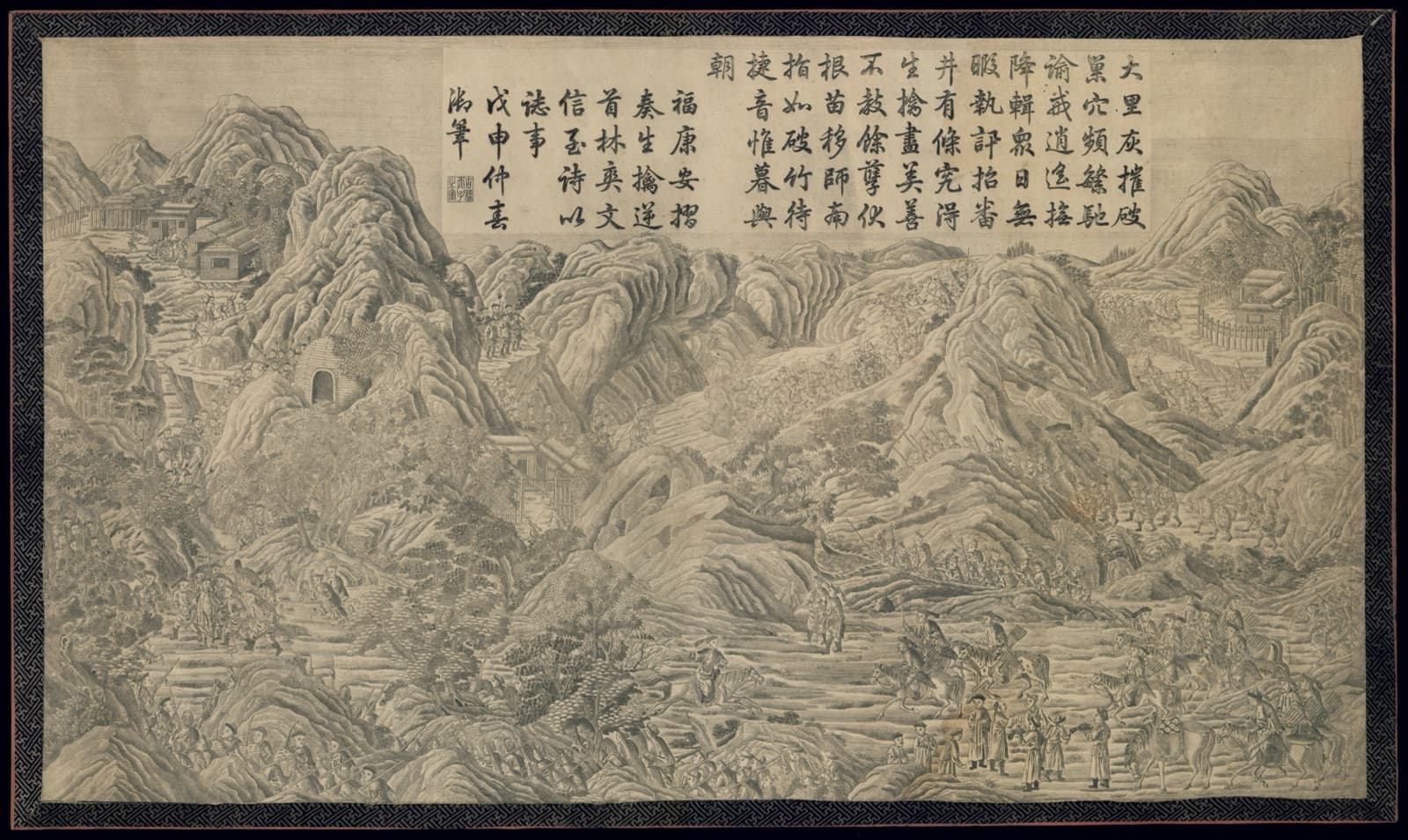
Lin Shuangwen taken alive, from *Victory Pictures of the Pacification of Taiwan*. His rising in 1787 besieged Zhuluo and took Changhua; the court sent Fuk'anggan across the strait, and Lin was caught at Laoquqi early the next year.
*Victory Pictures of the Pacification of Taiwan*, Library of Congress
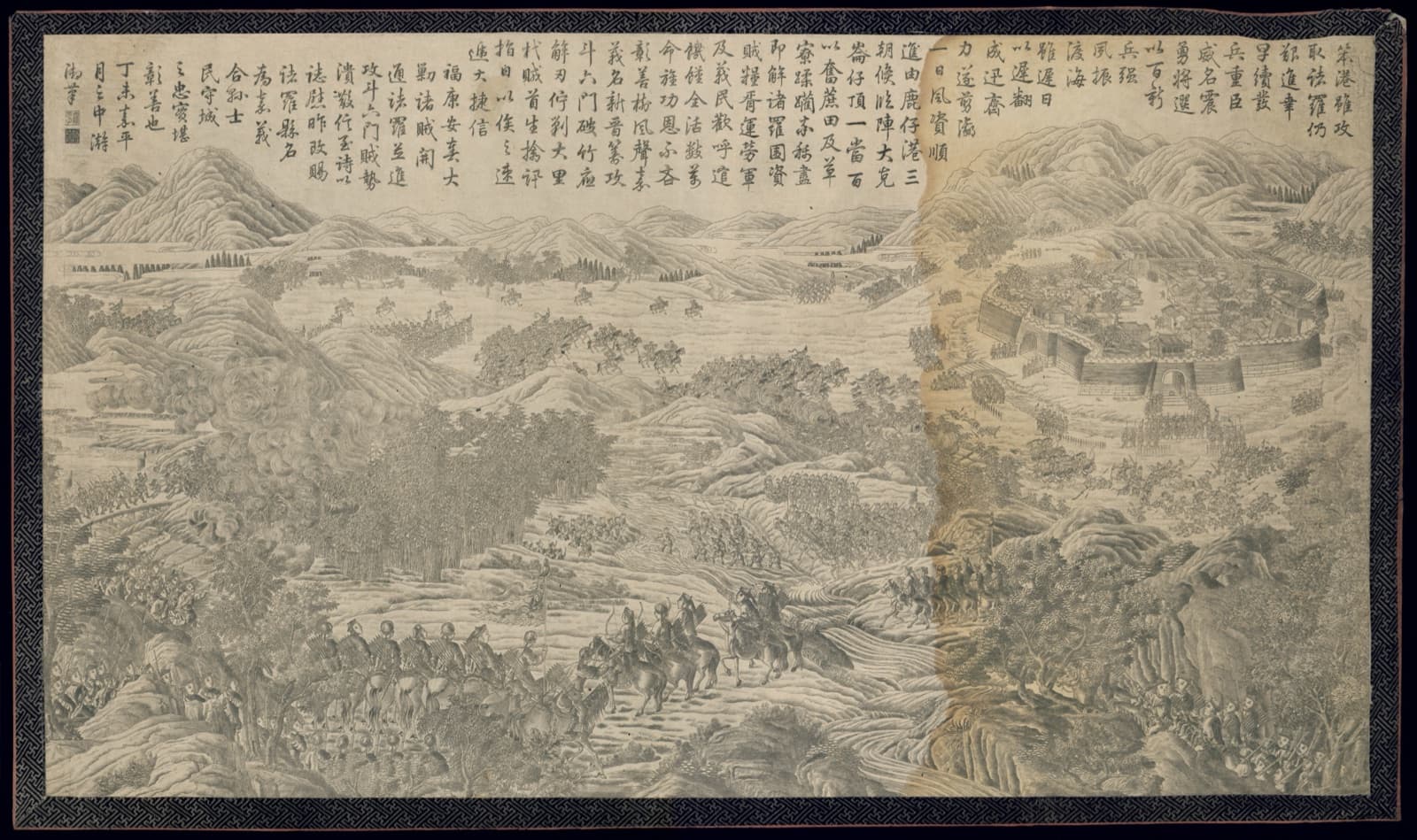
The siege of Zhuluo lifted. The town held out for close to ten months on sweet potatoes; afterwards Qianlong renamed it Chiayi — “commend its loyalty.”
*Victory Pictures of the Pacification of Taiwan*, Library of Congress
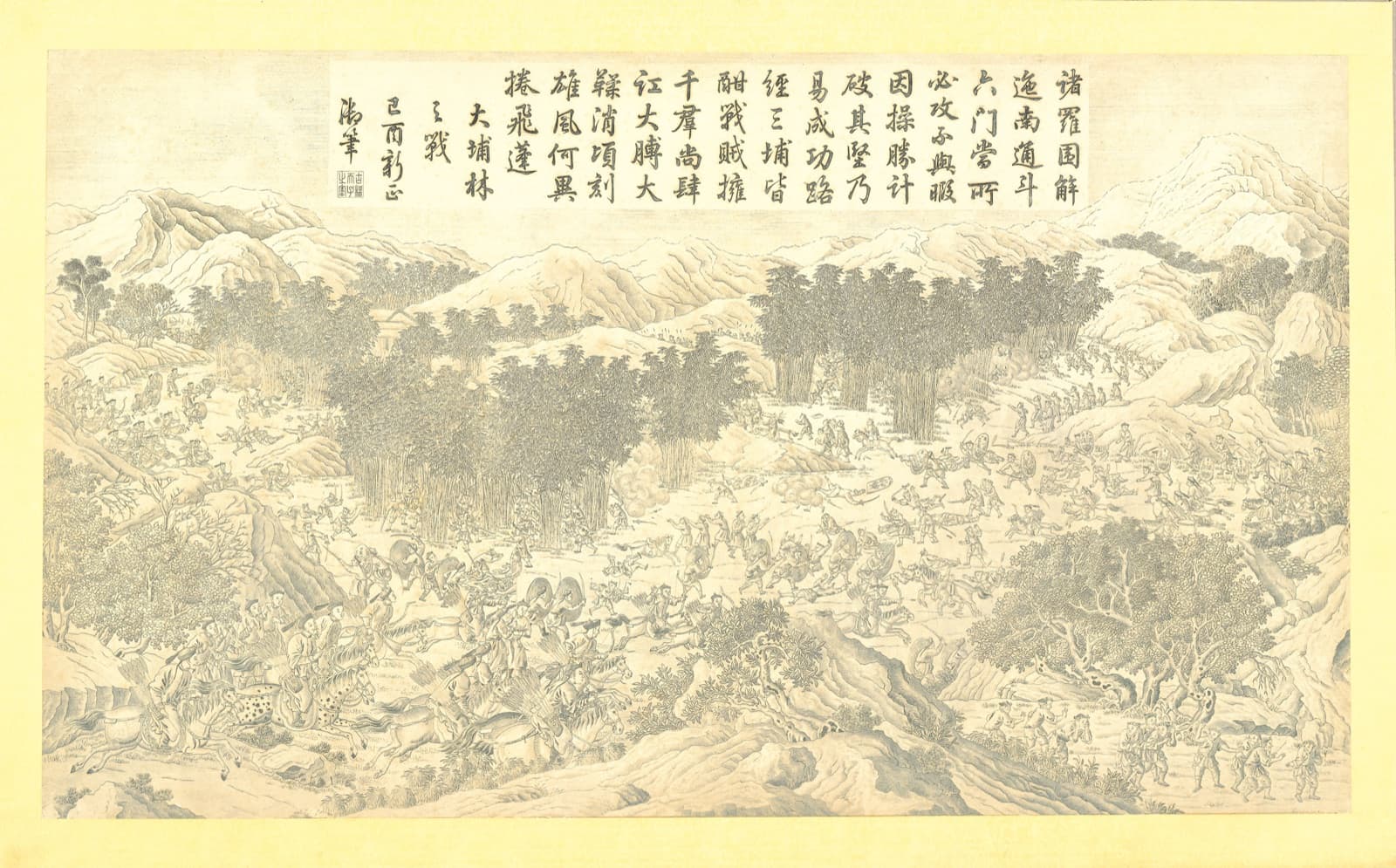
A detail from the *Pacification of Taiwan* scroll. Qianlong counted the campaign among his Ten Great Campaigns and had it issued as scroll and copperplate alike — a victory had to be seen to count.
National Palace Museum, Taipei
Isle of Time