


How Chiayi Got Its Name
In mid-eighteenth-century central Taiwan, the migrants who had braved the deadly Black Ditch crossing and survived the Qing's restrictive isolation policies found themselves in a society far more chaotic than the one they had left behind. The Qing Empire still treated the island with wary suspicion rather than genuine governance. Local officials grew rich through corruption, and rank-and-file Green Standard soldiers were little better than roaming thugs. Worse still, as arable land grew scarce, migrants from Zhangzhou, Quanzhou, and the Hakka regions of Guangdong fought endless ethnic feuds over water rights and farmland. In a land where law offered no justice and officials offered only extortion, the lower classes turned to extralegal networks for survival. This twisted pressure cooker eventually birthed a vast underground mutual-aid society in Dali, Taichung — the Tiandihui, or "Heaven and Earth Society."
At the heart of the storm that would sweep across Taiwan stood a Zhangzhou migrant named Lin Shuangwen. In his thirties, broad-shouldered and stoic, Lin had settled in Dali as a farmer and cart driver. In secret, however, he served as the lodge master of the central Taiwan Tiandihui. The Tiandihui of that era was essentially the immigrant society's mutual-aid network fused with an underworld brotherhood. Members swore blood oaths, called Heaven their father and Earth their mother, and stood by one another in ethnic clashes and against official extortion. With his easy charisma and remarkable organizational skill, Lin drew thousands of homeless Luohanjiao and desperate tenant farmers to his side. While this force quietly gathered strength underground, the Qing authorities played with fire atop the powder keg.
In 1786 (the fifty-first year of the Qianlong reign), the magistrate of Zhanghua and the Taiwan military authorities recognized the Tiandihui's expansion and ordered a sweeping crackdown. But Qing "crackdowns" were often nothing more than plunder dressed in official robes. Soldiers stormed villages near Zhanghua and Dali, unable to distinguish criminals from civilians — burning homes, extorting wealth, and abusing women. Some commanders openly threatened to exterminate the families of any suspected society members. This tyranny, leaving no path forward, finally ignited the rage that had simmered for years. Tiandihui leaders gathered at Lin Shuangwen's home in fury. Watching the smoke from his burning village, Lin shed his peasant linens, donned battle robes, and raised the banner of "Obeying Heaven" — the rebellion's standard against the Qing.
Lin's rebel army struck like a bolt of black lightning, tearing apart the Qing's grip on Taiwan. These men, hardened by years of frontier feuding, unleashed astonishing destructive power. Within days they had taken Zhanghua and beheaded the magistrate. Luohanjiao and oppressed peasants across the island rushed to join the cause; in the south, Zhuang Datian raised his own army in echo. In a matter of weeks, the rebels swept across most of Taiwan, surrounded the Tainan prefectural city, and routed the regular Qing garrisons stationed on the island. When news of the uprising crossed the strait to Beijing, the Qianlong Emperor flew into a rage. He could not tolerate that during his self-proclaimed "Ten Great Campaigns" era of imperial glory, a remote island had erupted in a rebellion that shook the empire. He dispatched general after general to suppress the revolt — each one defeated in turn.
At last, he played his trump card. He sent his most trusted Manchu commander, Fukang'an, Governor-General of Shaanxi-Gansu, leading sixty thousand elite Manchu, Han, and Hui troops armed with the empire's finest weaponry, bearing down on the Taiwan Strait.
But before that thunderous clash of steel could unfold, the rebellion's fate took a strange turn at a place called Zhuluo. The walled city of Zhuluo (today's Chiayi City) was the choke point on the rebels' path to Tainan. Lin's forces besieged it for months, but Zhuluo held like a nail driven into their throat. The defense was not the work of the Qing army; it was the result of a brutal ethnic survival contest within the walls. Zhuluo's residents were mostly Quanzhou migrants and local "cooked savages" (the Pingpu people), while the rebels outside were largely Zhangzhou Luohanjiao. The long-festering hatred of the Zhangzhou-Quanzhou feuds bred terror among Zhuluo's Quanzhou residents: they believed that if the Zhangzhou rebels broke through, the slaughter would be unimaginable.
Driven by sheer survival instinct, Zhuluo became the stage for one of the era's most harrowing scenes. The city's Quanzh…
Driven by sheer survival instinct, Zhuluo became the stage for one of the era's most harrowing scenes. The city's Quanzhou merchants, gentry, and common people — men, women, and children — climbed the walls together, allied with Pingpu militia and the remnants of the Qing garrison. For months under siege, with food and arms exhausted, residents boiled bark, roots, and even the leather of their mules and horses to survive. Not one opened the gates. Lin's army hammered the walls day and night while the defenders hurled logs, stones, and crude cannon fire in return. Corpses piled high outside; blood reddened the moat. This unity, forged from ethnic hatred and existential fear, pinned down Lin Shuangwen's elite forces and bought Fukang'an the critical time he needed to land his sixty-thousand-strong army.
In the depths of winter 1787, Fukang'an's massive fleet landed at Lugang and Anping. The renowned Qing commander combined relentless artillery advance with masterful political manipulation, exploiting the Zhangzhou-Quanzhou and Hokkien-Hakka rifts to woo one side while crushing the other. Fukang'an personally led the Manchu cavalry that broke the siege of Zhuluo. When this general in the imperial yellow jacket stepped into the scarred, skeletal city, the surviving residents knelt across the streets. Fukang'an's report on Zhuluo's loyal defense reached the Qianlong Emperor — then basking in the joy of the "Pacification of Taiwan." Reading how the city had withstood the "rebels" for months without imperial relief, sustained only by its civilian militias, Qianlong was deeply moved. To honor the residents' loyalty — "the righteous people of all mountains, united as one heart" — he personally issued an edict renaming Zhuluo County to "Chiayi County" (literally "Praising Righteousness"). This is the origin of the place name "Chiayi" that Taiwan carries to this day.
But the renaming came with a historical reckoning. Lin Shuangwen's forces, encircled by Fukang'an's regulars, collapsed step by step. Fierce as the rebels were, they could not withstand the discipline, heavy artillery, and divide-and-rule tactics of imperial troops. Lin retreated with his remnants into the Nantou mountains along the old aboriginal boundary. Starving and freezing, betrayed and informed upon by former comrades, he was captured by Qing soldiers in a valley between Hsinchu and Miaoli. In 1788, Lin was hauled to Beijing. Under torture in the imperial clan court, he refused to yield. He was sentenced to lingchi — death by a thousand cuts — and his entire family was brutally executed.
The end of the Lin Shuangwen rebellion was yet another historic hangover of Qing policy in Taiwan. In this bloody storm that swept across the island, there were no true winners. The Qing court used treasury silver and sixty thousand troops to crush the revolt, but it never resolved the deeper contradictions of institutional exploitation and resource scarcity that drove the immigrant society to violence. The name "Chiayi" — sounding so noble and righteous — was in truth painted onto history with the blood of ethnic feuds, the survival gambits of the powerless, and the political calculations of an emperor.
The story of how Chiayi got its name is, in miniature, the story of Qing-era Taiwan itself — a land where "small revolts every three years and great upheavals every five" became proverbial. Bureaucratic corruption forced the Tiandihui into armed resistance, while the deeply rooted ancestral feuds within immigrant society became the empire's most effective weapon against rebellion.
Lin Shuangwen lost his life on history's chessboard. But he and the men of Dali, through a rebellion that shook the Forbidden City, carved into the mountains and plains of central Taiwan the eternal mark of the powerless yearning for survival and refusing to bow.
The siege began in December 1786. The defences were a bamboo palisade and an earth rampart, and inside were the people who had fled in from the surrounding villages, together with the garrison and their families, some tens of thousands. There was stored grain for the first three months. In the fourth they began on sweet potato vines and bark, and after the sixth there were no dogs or rats left in the city. The defenders were not the garrison alone. The villagers formed militia companies, took turns on the parapet through the night, while the women cooked, carried earth and hauled stone. Relief columns came several times and were driven off. What they did not know was that this city had become the hinge of the war: while Zhuluo held, half of Lin Shuangwen's strength had to stay in front of it, and his northern and southern fronts could not be joined. Fukang'an's relief arrived in November 1787 and the siege lifted. On the day the gates opened, the number of people who could walk out on their own feet was less than half of those who had been inside when it began. The official record gives it one line: soldiers and people held to the death; when the grain was gone they ate grass.
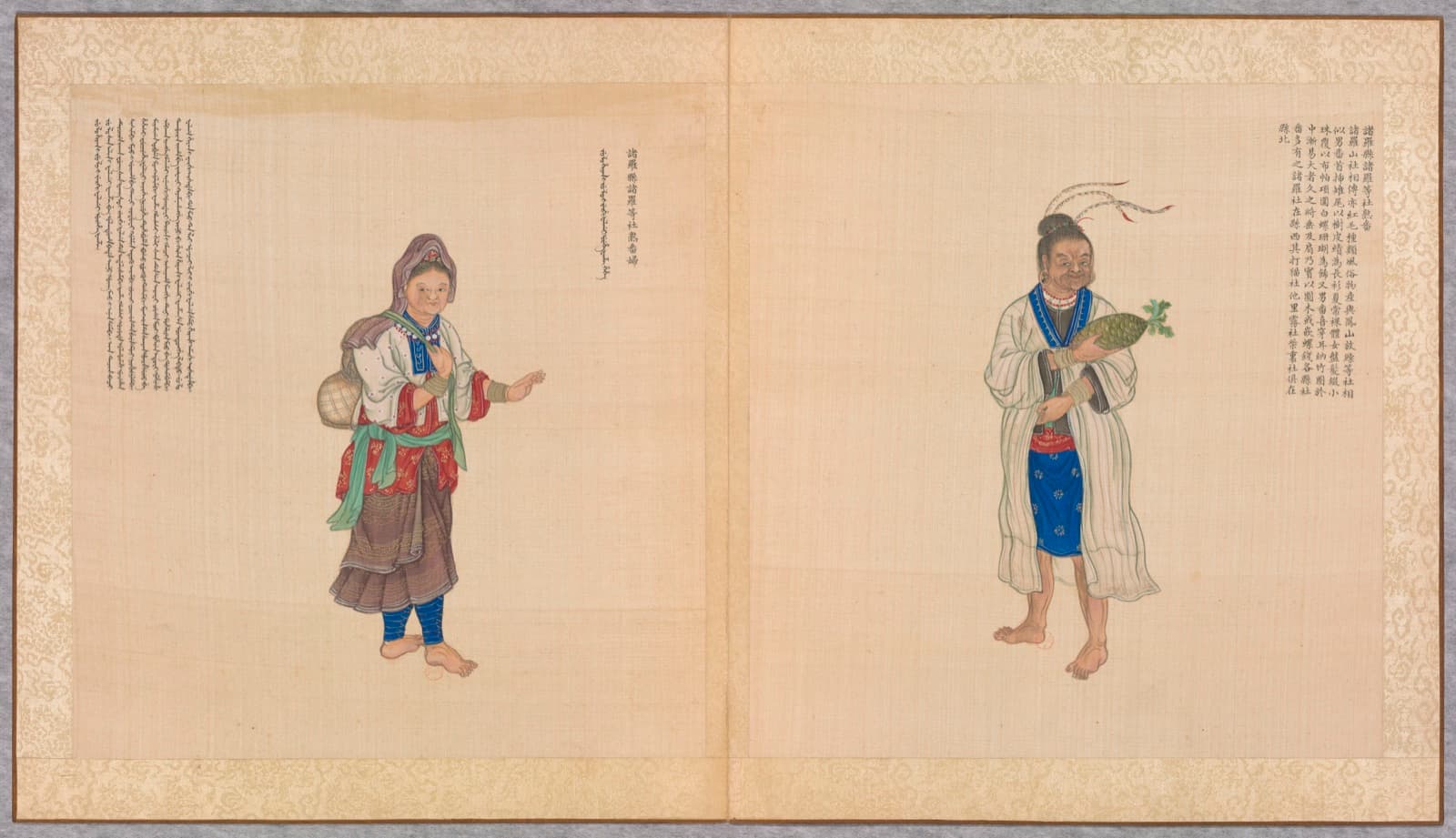
A couple of the Zhuluo villages in Zhuluo county, from the *Zhigongtu*. When the plate was painted the place was still Zhuluo; the renaming to Chiayi came more than thirty years later.
*Zhigongtu*, Bibliothèque nationale de France
Isle of Time