


The Sino-French War in Taiwan
In 1884 a war fought far away over suzerainty and control of Vietnam suddenly washed up on Taiwan's shores. As relations between the Qing and France broke down over the Vietnamese question, the fighting spread along China's southeastern coast, and Taiwan — an isolated island guarding the maritime approaches to Fujian — became overnight a frontline in a contest between great powers. For the island's inhabitants it was a disaster that fell from the sky without warning, and they called the whole ordeal the 'Western barbarians' revolt.'
The first blow fell on the north. Admiral Courbet, commander of the French Far Eastern squadron, sought a bargaining chip against the Qing and turned his guns on the port of Keelung and its surrounding coalfields. Keelung's coal was an indispensable fuel for steamships and warships, and its strategic value was immense. In August 1884, under cover of naval gunfire, French troops stormed ashore and seized the town, and for a time gunsmoke hung over the mountains and shore of northern Taiwan while fear gripped the population.
The true turning point came at Tamsui, today's Danshui. On 8 October 1884 the French attempted an amphibious landing at the mouth of the Tamsui River, only to meet fierce resistance from Qing forces under General Sun Kai-hua, fighting alongside local militia. Exploiting familiar terrain and shore defences, the defenders threw the French back into the sea — a rare and celebrated victory on Taiwan's front in the war, remembered as the Great Triumph of Tamsui and passed down through generations of Tamsui residents.
Frustrated on land, the French changed tactics and declared a blockade of the entire island. Their fleet cut off Taiwan'…
Frustrated on land, the French changed tactics and declared a blockade of the entire island. Their fleet cut off Taiwan's shipping and supply lines, choking off imports and battering the local economy, effectively marooning the whole island in the open sea. The French then sailed south and occupied the poorly defended Pescadores, seizing the archipelago that commands the Taiwan Strait, and for a time the campaign settled into stalemate.
Overseeing the island's defence was Liu Ming-chuan, who had been rushed to Taiwan by the court as imperial commissioner for military affairs. Based in the north, he marshalled limited troops and resources to contend with the French along the Keelung–Tamsui line. In the south, the Taiwan intendant Liu Ao organised the defence of the Tainan region on his own, shoring up the walled city and its harbours. Yet the friction and rivalry over authority between Liu Ming-chuan and Liu Ao had already begun to surface during the war, and that rift would bring bitter consequences.
The war finally ended in 1885 with a wider peace between China and France. As the treaty was signed, the siege and blockade were lifted, and French forces withdrew from Keelung and the Pescadores, bringing to a close the conflict that had swept over northern Taiwan and its outlying islands. For the shaken islanders life could return to its ordinary rhythms, though the scars the war had left on the land and in memory did not fade easily.
Brief though it was, the war taught the Qing court a hard lesson about Taiwan's strategic value. Long dismissed as a peripheral island on the empire's edge, it had now proven to be a linchpin of the entire southeastern coastal defence. Within months of the war's end the court resolved to separate Taiwan from Fujian and elevate it to a full province, appointing Liu Ming-chuan as its first governor. The guns of the Western barbarians' revolt had, unexpectedly, pushed open the door to a new era for Taiwan.
On the morning of 8 October 1884 more than six hundred French troops landed at Huwei, today's Tamsui, intending to take the forts, control the mouth of the river and move on Taipei. The defence was Sun Kaihua's Zhuosheng battalions and Zhang Gaoyuan's troops together with local militia, some two thousand in all. Their preparations were unrefined: hulks and stone sunk to block the channel, ambushes set among the beach scrub and screw pine, and guns taken off the fort's platforms and re-sited on the flanks. Once ashore the French were caught in the pandanus and acacia along the shore, their formation opened out and their sight lines gone, and the Chinese fired on them from three sides at close range. The action lasted under four hours and the French withdrew to their ships with several dozen casualties. It was one of the few outright Chinese victories of the war and the reason Huwei did not fall. Afterwards people said that Master Qingshui had shown his power, and the temple still keeps an image whose nose is said to have fallen off during the battle. The official account praised the devotion of officers and men. Both accounts have coexisted in Tamsui for a hundred and forty years without difficulty.
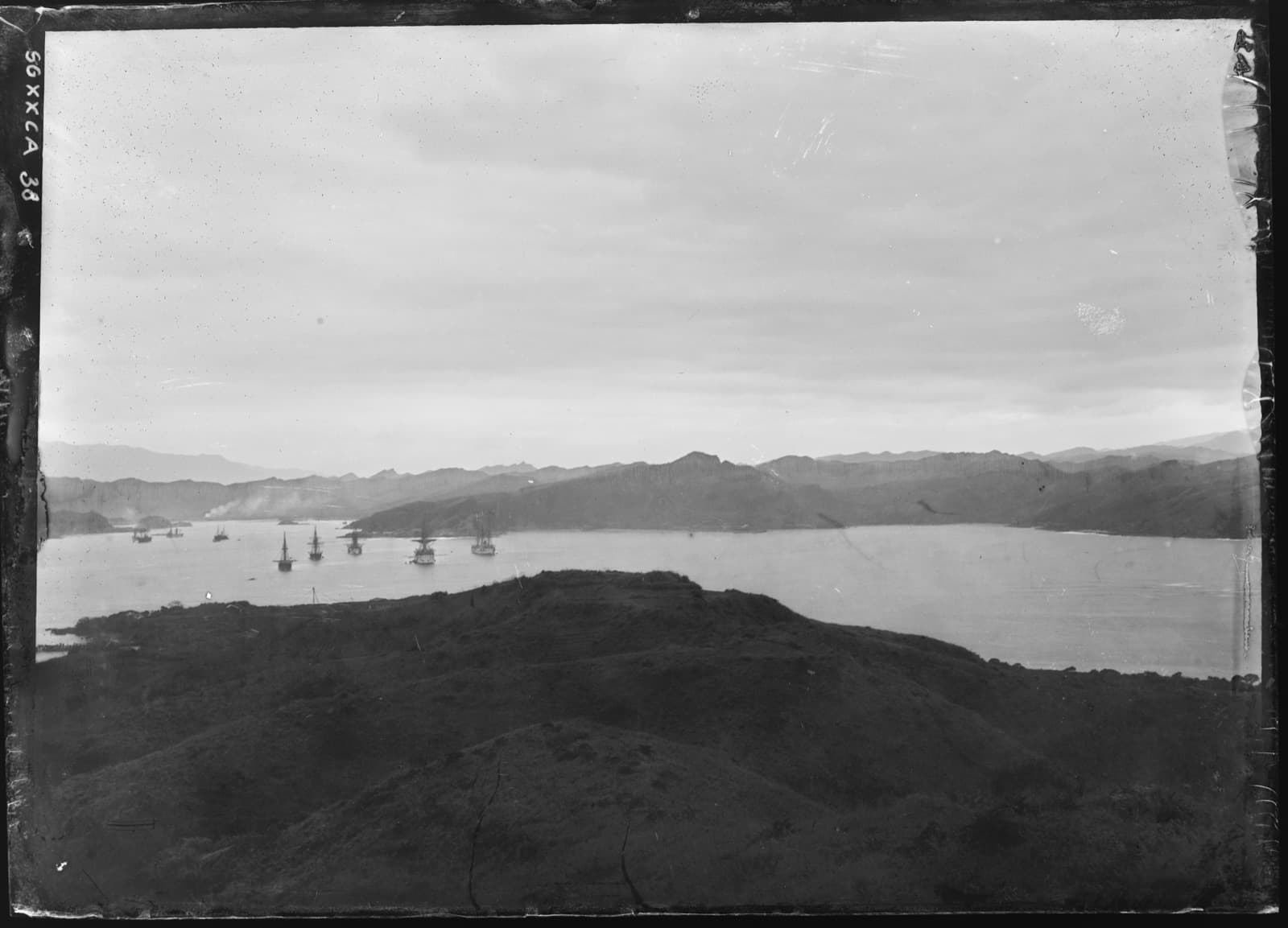
The Keelung roadstead seen from the summit of Palm Island, 1885. The French took the town in October 1884 but never got past Shiqiuling, and the Qing had wrecked the coal mines before they arrived.
Photograph by André Salles; Bibliothèque nationale de France
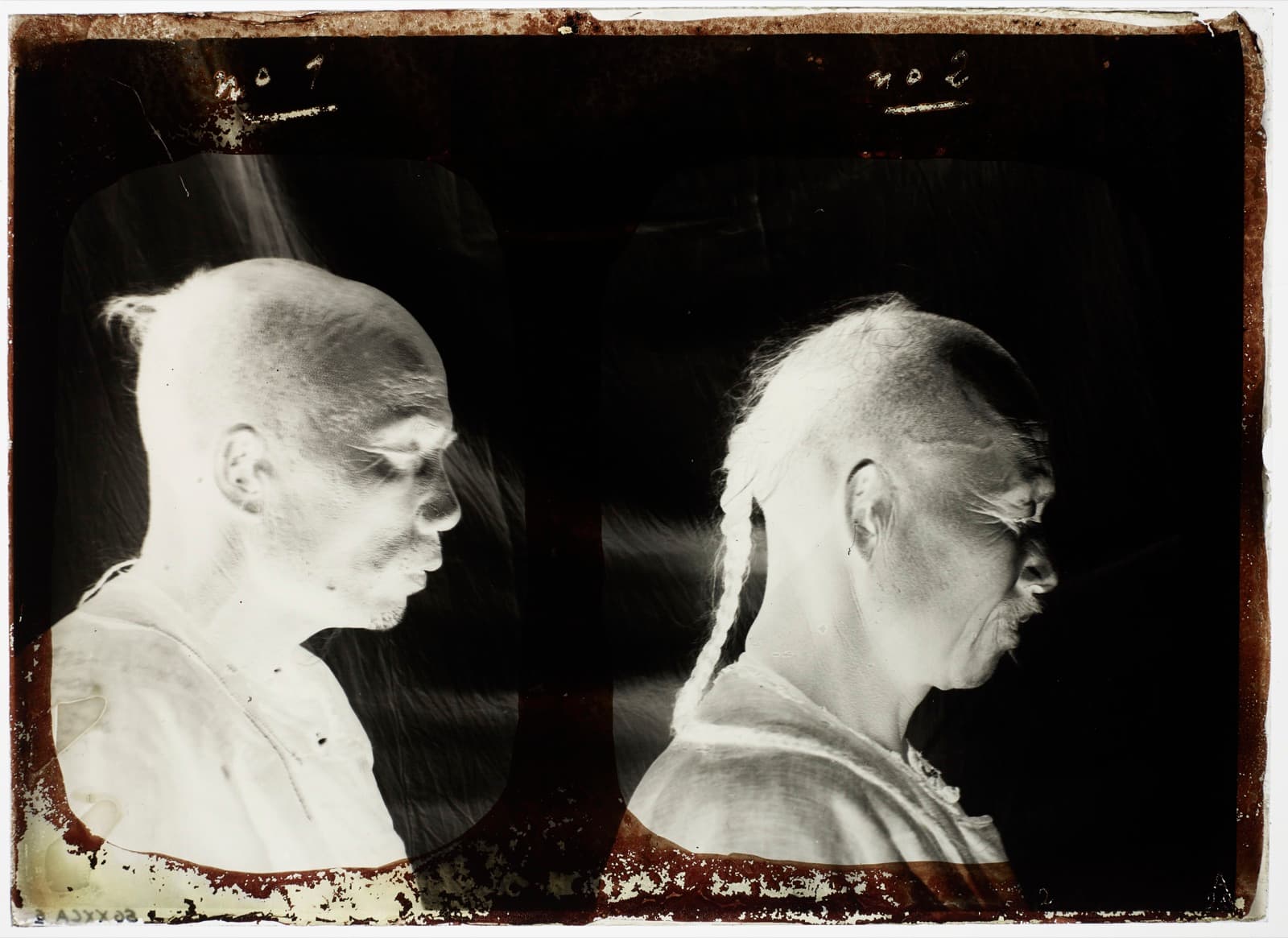
Chinese fishermen taken off junks during the blockade of Tamsui and photographed on the deck of the *Eclaireur*, full face and profile. The blockade ran from October 1884 to June 1885, and nothing — rice, sugar, coal — left the island.
Photograph by André Salles; Bibliothèque nationale de France
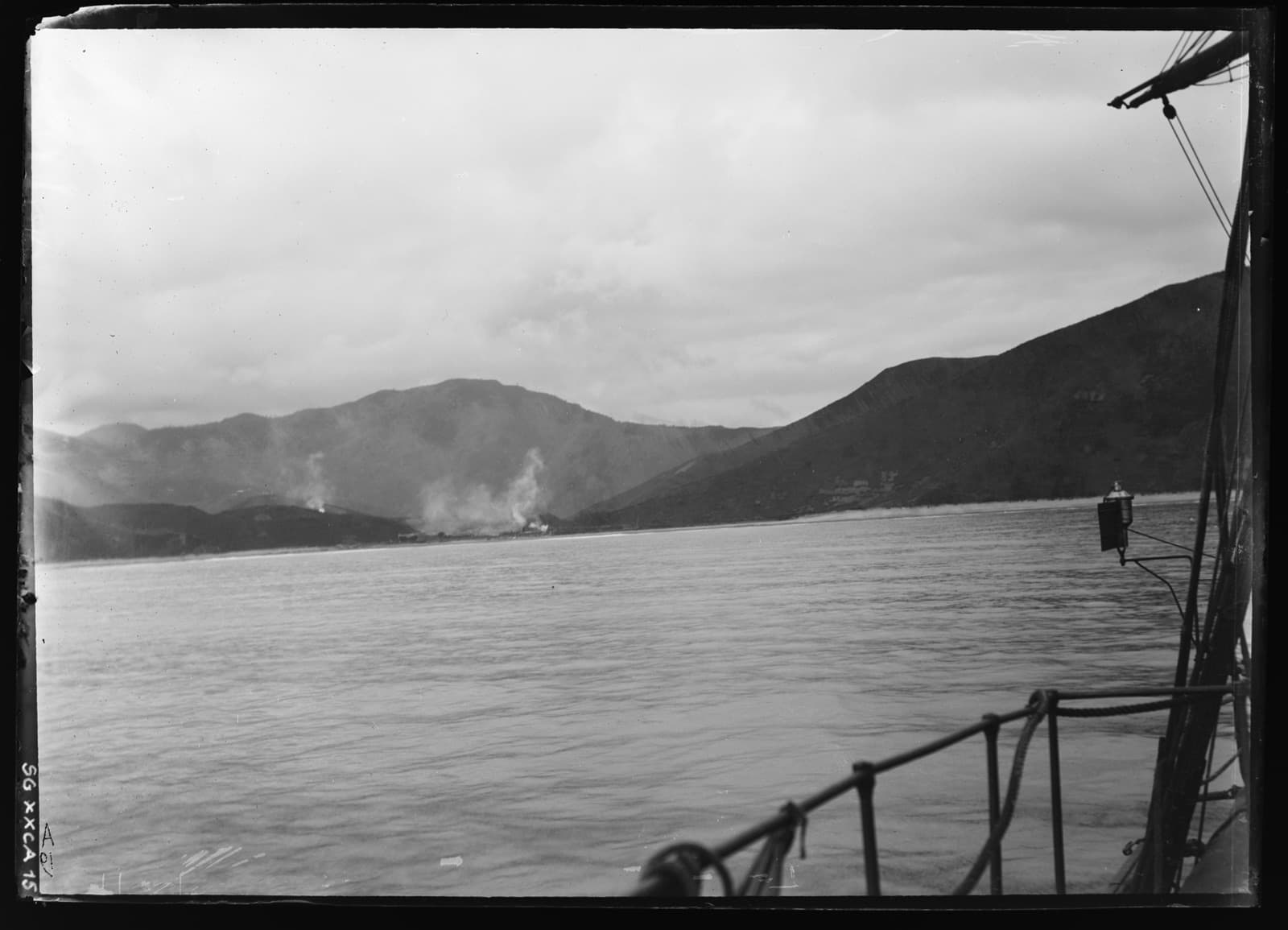
Sau-o seen from the bridge of the *Eclaireur*, looking west and south, 1885 — the first of a four-part panorama. While blockading the east coast the squadron was also surveying it; the plates went into the Bibliothèque nationale.
Photograph by André Salles; Bibliothèque nationale de France
Isle of Time