


Kōminka Movement
In 1937, gunfire at the Marco Polo Bridge crossed the Yellow Sea and bore down upon this island. As freighters continued to load Taiwan's rice, sugar, and camphor for the Japanese home islands, and as the canals of the Jianan Plain went on watering a land already colonized for thirty years, atop the newly consecrated grounds of the Taiwan Grand Shrine at Yuanshan in Taipei, a ritual bell rang out through the morning mist, again and again. In that very same hour, inside a century-old temple on the island's western coast, the wooden body of Guanyin was kicked to the earth by the boots of the military police, and fire spread across the mud — this was the "Temple Rectification Movement." Shrine and flame together carved the deepest fissure in Taiwan's colonial history: the Kōminka Movement, a vast imperial project that sought, in less than a decade, to rewrite the soul of an entire generation of Taiwanese.
The architect of this transformation of the soul was the seventeenth Governor-General of Taiwan, Kobayashi Seizō (1877–1962), who took office in 1936. A cold-eyed admiral from Hiroshima, he declared in his inaugural address the "Three Principles" that would shake the entire island: kōminka (imperialization), industrialization, and the doctrine of the "southern advance base." Taiwan was to become the empire's steel platform for expansion into Southeast Asia — and the first prerequisite was that its inhabitants must first be turned into "Japanese." The National Language Movement rolled out across the island; Chinese instruction vanished from the public schools; the Chinese-language columns of newspapers were abolished that same year; shop signs, family door couplets, and ancestral tablets were all ordered, decree by decree, to be replaced. In 1940 he launched the "Name-Changing Movement": Taiwanese who adopted Japanese surnames would receive preferential access to rations, employment, and schooling. It was a noose disguised as a favor — soft to the touch, iron in its grip.
In 1940, Hasegawa Kiyoshi (1883–1970) took over the Government-General and pushed the movement still deeper into wartime totalization. He established the Kōmin Hōkōkai — the Imperial Subjects Public Service Association — weaving every neighborhood, ward, township, school, factory, and women's association on the island into one dense net of mobilization. Patriotism, Public Service, Decisive Battle — three words now covered every school assembly and every radio broadcast. Kōminka was no longer merely a cultural remaking; it had become the machinery through which an entire generation of the island's young would be prepared to be pushed into the fires of war.
The first face pushed onto the propaganda stage was that of an Atayal girl named Sayun (1921–1938). In the autumn of 1938, carrying the luggage of her departing Japanese teacher Tabei Masaki — who had been called up for military service — she stepped onto a wooden bridge in the Nan'ao mountains in the middle of a typhoon, slipped, and fell into the ravine below. Her body was never recovered. The Government-General sensed at once the political weight this mountain accident could carry. Hasegawa Kiyoshi himself presented the inscribed "Bell of the Patriotic Maiden Sayun." The full literary machine of empire then went into motion: the film Sayun's Bell, starring Li Xianglan, opened across Taiwan; the theme song poured from every radio, day and night; textbooks turned her into a model of virtue; the memorial bell was hung at the entrance of the Nan'ao public school. A seventeen-year-old indigenous girl was thus sculpted into the most perfect face of Kōminka.
Li Xianglan (1920–2014) herself was the most exquisite product of that same machine. Her real name was Yamaguchi Yoshiko…
Li Xianglan (1920–2014) herself was the most exquisite product of that same machine. Her real name was Yamaguchi Yoshiko; she was Japanese by birth, yet her fluent Mandarin, Japanese, and Manchu carried her between Man'ei and Tōhō, singing "When Will You Return?" and "Fragrance of the Night" — the silver-screen voice of the Greater East Asia Co-Prosperity Sphere. Her songs drifted from Shanghai back into the radios of Taipei, and made an entire generation of youth half-believe that the culture of empire could be soft, luminous, even tender.
As for Suniyuwu (1919–1979), an Amis youth renamed Nakamura Teruo, he was drafted into the Takasago Volunteer Unit and sent to the South Seas. In the jungles of Morotai he fought out the war's final battle — never learning that Japan had surrendered. He hid alone beneath the coconut palms for a full twenty-nine years, until Indonesian troops discovered him in 1974. When he was brought back to Taiwan, he had been renamed once more — this time as Lee Kuang-hui. Three names in a single lifetime: the record of a man christened, in turn, by three regimes.
Yet not every Taiwanese would accept that new name. Lin Hsien-tang (1881–1956) of Wufeng — the soul of the Taiwan Parliament Petition Movement — refused, to the very end, to change his surname, refused to appear at Shinto worship, refused to hang the Rising Sun flag at his gate. With the almost-silent bearing of a gentleman, he inscribed "non-cooperation" into a long, patient form of resistance. The far more radical Wang Min-chuan (1889–1942), leftist leader of the Taiwan Cultural Association, had already been swept up in the 1923 political prosecutions and the crackdowns that followed; at the height of the Kōminka years he died of illness inside the Taichung Prison, never living to see the movement's end. Chen Cheng-po (1895–1947), meanwhile, kept guard over his colors on canvas — the temple courtyards of Chiayi, the red brick of Chihkan Tower, the yellow dusk of Tamsui — the landscape being taken away inch by inch by shrines and the national language, he sealed into oil paint, one brushstroke at a time.
In August 1945, Emperor Hirohito's "Jewel Voice Broadcast" reached Taiwan through the crackle of the radio. The shrine bells fell silent; the Rising Sun vanished from the streets overnight. Those who had changed their names walked back to the household registry to change them again, one stroke at a time — but they could not erase the Japanese lullabies in their memory, nor the school assemblies, nor the afternoons of youth spent lifting wooden rifles on the training ground. The Kōminka Movement had ended, but the wound it left lay not upon the body — it was carved into the seams of the soul of an entire generation. They would spend their lives searching, between two languages, two names, and two ancestral tablets, for the answer that truly belonged to themselves. This volume looks back upon that: a state-imposed remaking of the soul, and its deepest scar — a place where even hatred has been folded into silence.
Changing one's name was permitted, not compelled. Applications opened in 1940 and the conditions were explicit: the household had to qualify as a national language family — Japanese in daily use, a manner of living that met the standard, children attending school satisfactorily. Approved households hung a wooden plaque at the door, drew a little more rice and sugar on the ration, and stood a better chance of a middle school place for their children. By 1943 about a hundred and seventy thousand Taiwanese had changed their names, under three per cent of the population. Deciding whether to apply was usually the longest argument a family ever had. The father counted school places and rations; the grandmother's reason for refusing stood on the ancestral tablets. Some chose a compromise, taking a Japanese surname that kept a piece of the old one: Lin became Kobayashi, Chen became Eikawa, which was the Chen clan's hall name. After 1945 all these names had to be changed back, and a line was added to the household register. As for the plaque at the door, most families took it down themselves that August.
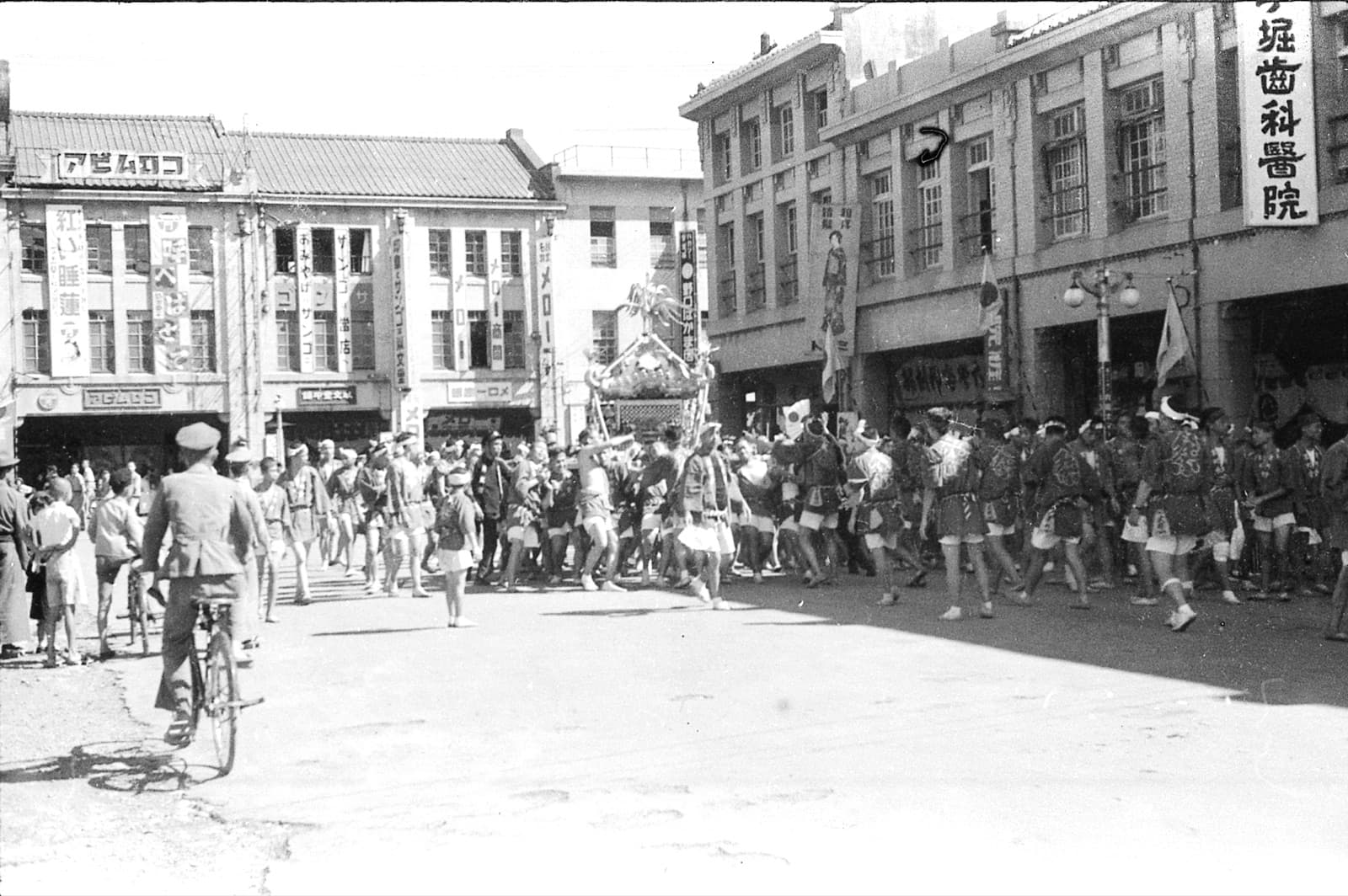
The Taiwan Shrine festival procession through the streets of Taipei, 1938. Under Kōminka, shrine worship moved from encouragement to obligation, and the shrine became a place where loyalty was assessed.
Photograph by Li Huo-tseng; Iconography of Taiwan image archive
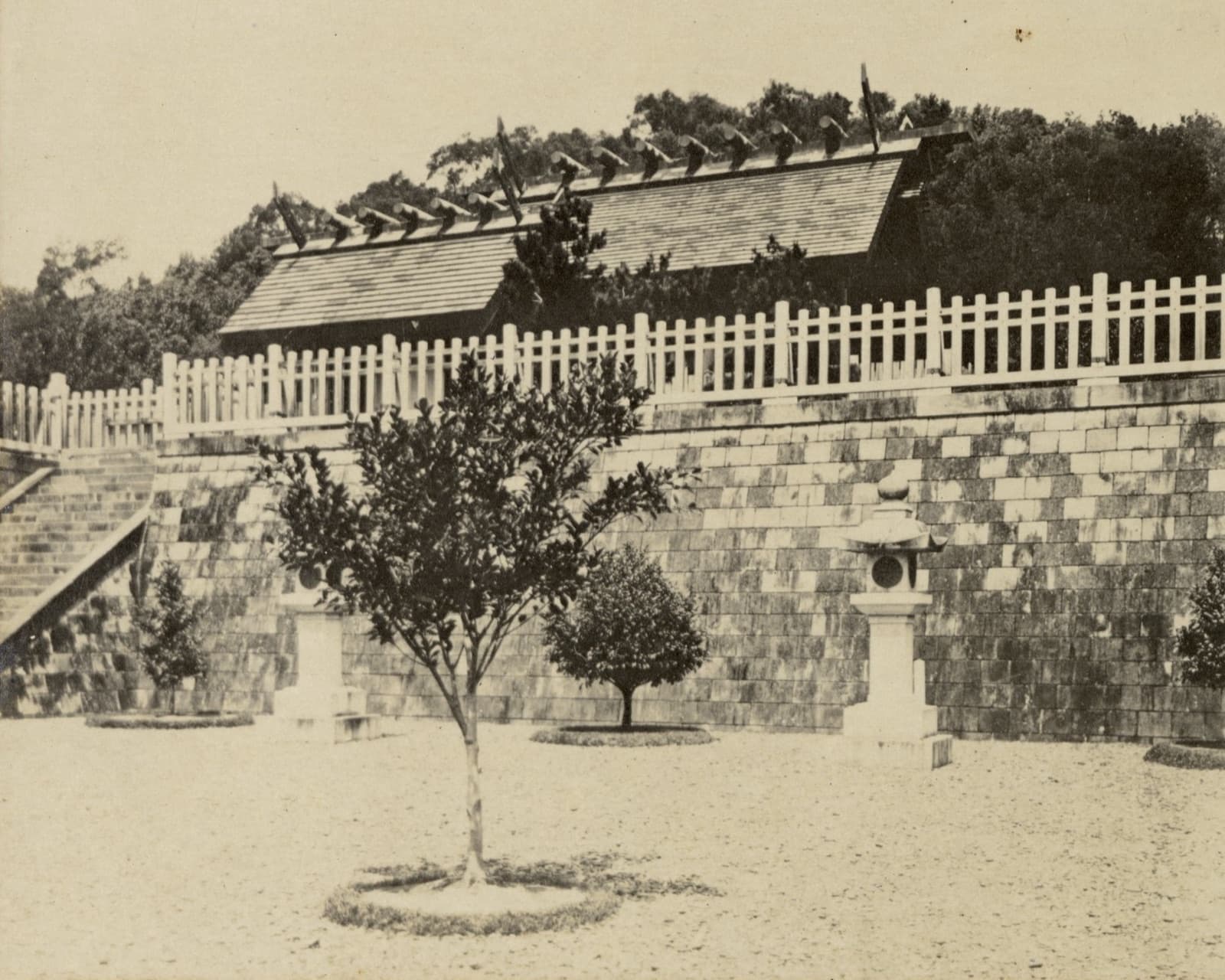
The main sanctuary of the Taiwan Shrine, photographed in 1917. The shrine had stood at Yuanshan since 1897, but only after 1937 did attendance become an obligation islanders could not avoid.
Taiwan Education Association, *Photographic Album of Prince Kitashirakawa in Taiwan*
Isle of Time