


The Takasago Volunteers
Japanese forces took Manila in January 1942, and the front kept moving south, closer to the equator, until it reached the rainforests of the Philippines and New Guinea. The Imperial Army had been trained for temperate ground. What broke there first was not the line but the supply: trucks could not get in, horses died, ammunition and tinned rations ended up on men's backs, and malaria and dysentery put soldiers down faster than bullets did. The army turned to the mountains of Taiwan — to people who had spent their lives moving where there were no roads.
On 12 March 1942 the first five hundred boarded ship at Kaohsiung, under a name that translated as the Takasago Corps Volunteering to Serve the Nation and was later shortened to the Takasago Volunteers. In May they made their name on the Bataan peninsula, and newspapers in Japan wrote them into legend. The call-ups came in waves after that: a thousand more in June, four hundred and fourteen in November, two hundred the following June, five hundred in July, then eight hundred and eight hundred again. Seven or eight drafts had gone out by 1944, and estimates of the total run anywhere from four thousand to eight thousand — how many men were actually sent is a number nobody kept.
"Volunteer" was the word on the paper. Quotas came down from the Government-General to the prefectures and were carried out by the aborigine-affairs police who ran the mountain districts; school had taught loyalty, teachers and policemen came to the door, and a village that produced no one was remembered for it. Newspapers of the day liked to report that applicants far outnumbered the places, and that was also true. The men filed under "Takasago" were Atayal, Bunun, Paiwan and Amis — peoples with different languages, different hunting grounds and different ancestors, folded into a single column on an imperial form. Only a generation earlier their grandfathers had lost those mountains to the same army, and the elders still spoke the names of those campaigns. What the empire wanted from them now was exactly the knowledge the Government-General had spent decades trying to school out of them.
At the front the heaviest work was theirs. They cut trails and dug trenches, carried ammunition, rations and wounded men across ground no truck or horse could cross, and when the line gave way they were sent forward to fight at close quarters. After the first draft most were shipped to New Guinea, facing the Australians and Americans. Commanders wrote in their reports that without these men the supplies would not have reached the front. On the night of 26 November 1944, forty-eight men of the Kaoru Airborne Raiding Detachment boarded four transport aircraft with demolition charges, meaning to crash-land on the American-held airfields at Burauen on Leyte. None came back.
Few of the dead were killed by gunfire. More went down to malaria, dysentery, hunger and the encirclements that followed…
Few of the dead were killed by gunfire. More went down to malaria, dysentery, hunger and the encirclements that followed once supply was cut. In New Guinea alone the estimated toll runs past three thousand. Survivors recalled that in the last months the unit ate what its Takasago men brought back out of the forest — they knew what could be eaten and the Japanese soldiers did not. Those who came home came back to a world that had changed under their feet.
Japan withdrew in 1945 and Taiwan passed to the government of the Republic of China. The object of their loyalty was gone and their standing went with it: the new authorities saw men who had fought for the enemy, while the old empire kept former colonial subjects outside its compensation schemes for decades — and in the 1952 treaty between Japan and the Republic of China, Taipei gave up its claims for reparations. Taiwanese veterans began pressing Tokyo in 1977; Japan legislated only in September 1987 and began paying the year after, two million yen to the family of each man killed. By the closing date at the end of March 1993, 29,913 applications had been filed.
Suniuo received none of it. In 1943 the Amis man from Taitung was sent to Morotai under the name Nakamura Teruo. He was separated from his unit when the war ended, never got word, and went into the jungle alone, where he built a shelter, planted crops, set traps and stayed for close to thirty years. He was found in 1974, and walked out to learn that the Japan he had served, the Taiwan he had left and the language he knew were none of them where he had left them — he spoke Amis and Japanese, and Taiwan by then spoke Mandarin. He died of illness in 1979, four years after coming home.
Their spirit tablets are still enshrined at Yasukuni. In February 2006 the Taipei County government ordered the demolition of the Takasago memorial in the waterfall park at Wulai; the association took the county to administrative court, and three years later the court ruled the order unlawful. The memorial went back up, and every March the association still holds its service in front of it. Most of the men whose names are cut into it have no remains to send back to their villages.
"Takasago" was a name given by others. The men who boarded the transports were Atayal, Bunun, Paiwan, Amis — distinct peoples with their own languages, hunting grounds and ancestors, compressed into a single column on an imperial form. Only one generation earlier, their grandfathers had lost those mountains to the same army. Why go anyway? Colonial rule had closed every old road by which a young man proved himself — the hunt, the raid, the earning of a name within the village. The army opened one, and the hand that opened it was the hand that had closed the others. School had taught loyalty, teachers and police urged them on, the village had a quota, and refusing marked a man. Some also simply wanted to go, wanted to be seen. In the jungles of the south they were praised for precisely the skills the government had spent decades trying to school out of them: reading ground, tracking, staying alive in dense forest. Officers said supplies would never have reached the front without them. It was the first time the empire admitted they were irreplaceable — and the price was carrying the heaviest loads and walking in front.
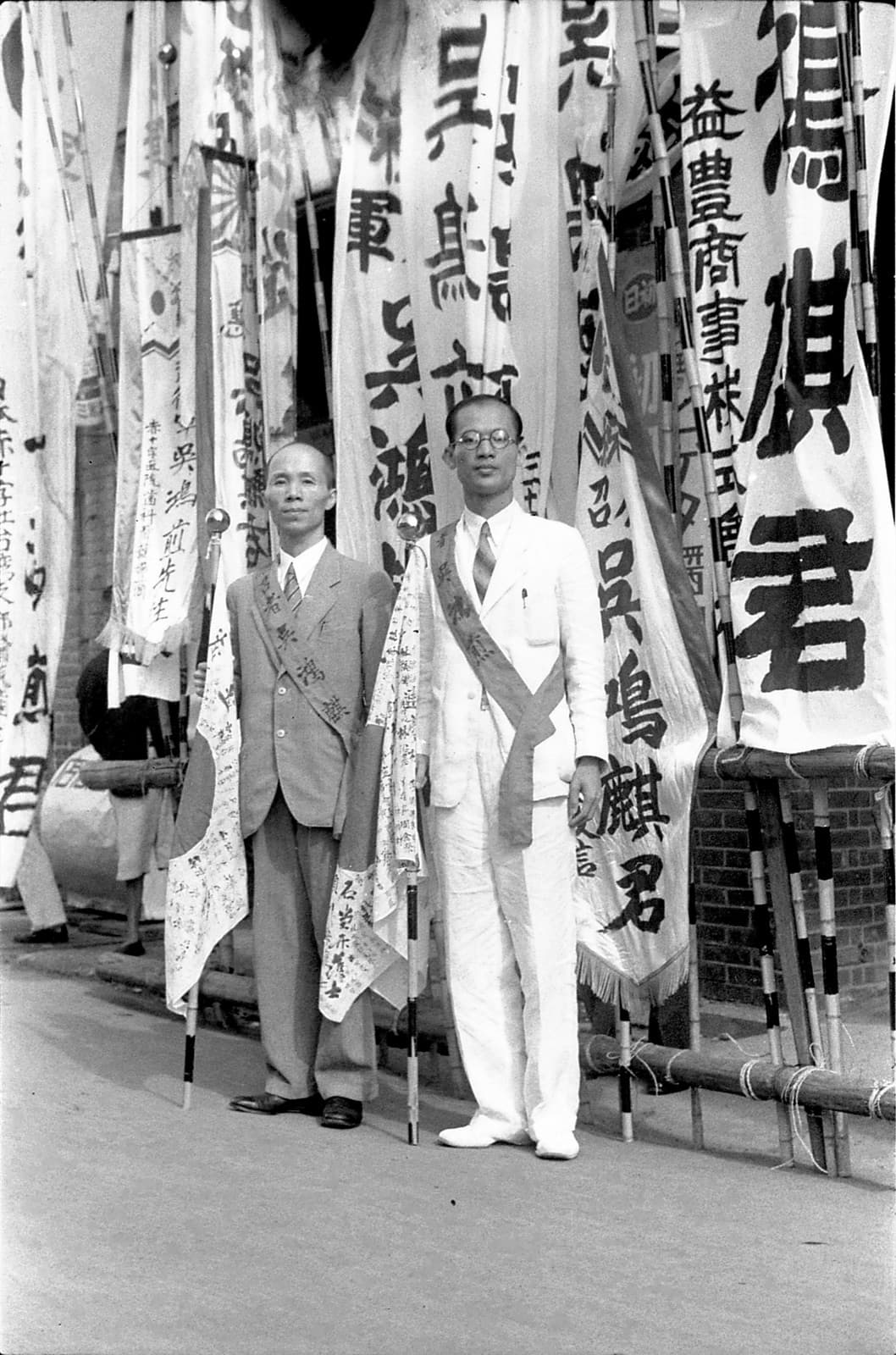
Taoyuan, 1940. Two Taiwanese men about to enlist stand before send-off banners bearing the names of local businesses. This was the army's special volunteer scheme; two years later the Takasago units were sent to the rainforests of the south.
Photograph by Deng Nan-guang; Summer Gate Photography Studio
Isle of Time