

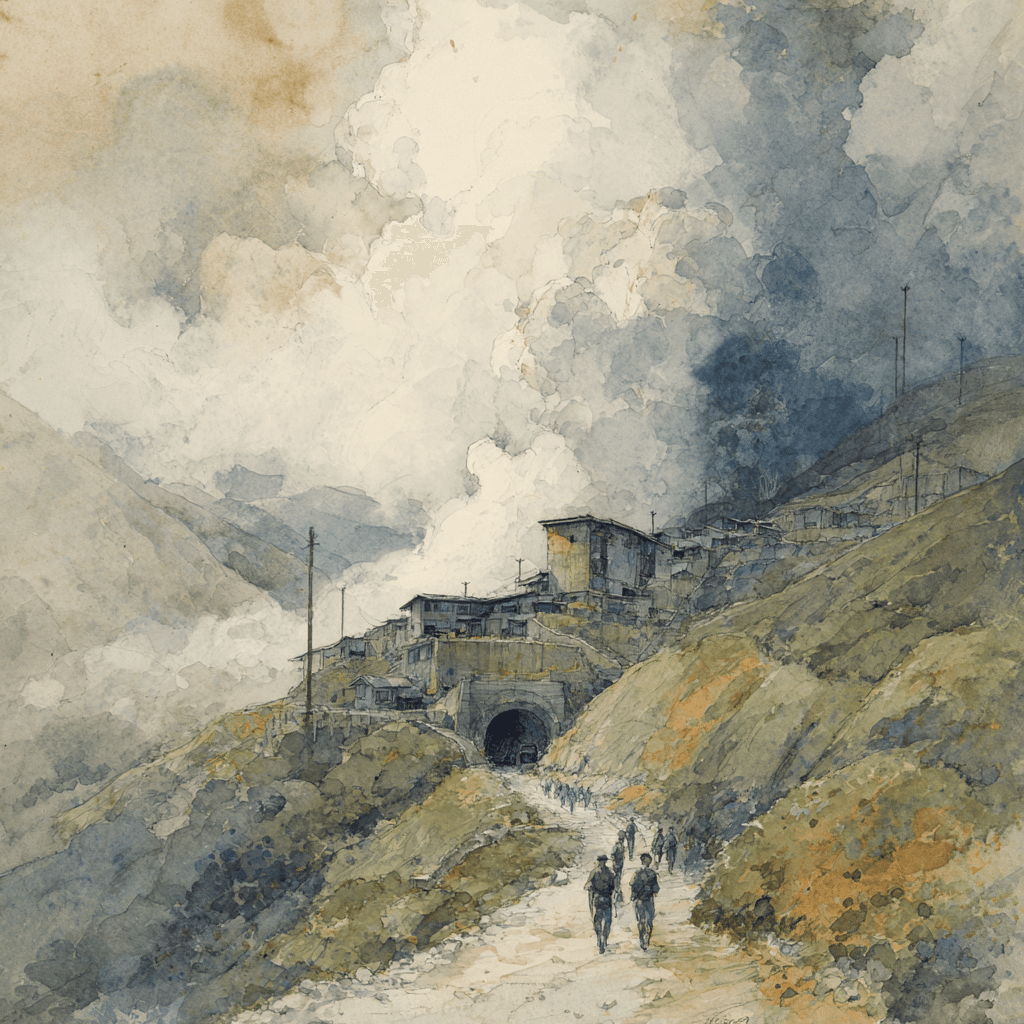
In 1890, while the Qing government was building a railway bridge over the Keelung River, workers panned gold dust from the riverbed. The news travelled upstream. In 1893 someone found a gold deposit on the hills at Jiufen, and the following year another was found on a rocky hill to the east shaped like a pumpkin. That hill came to be called Jinguashi, Gold Melon Stone.
In 1896 these hills passed to Japan. The Government-General's Taiwan Mining Regulations allowed only Japanese nationals to hold mining rights, and in October that year the mountain was cut in two. The Ruifang mine on the western side went to Fujita Densaburo's Fujita Group, and Jinguashi on the eastern side to Tanaka Chobei's Tanaka Group. In 1898 Jinguashi employed a hundred and thirty Japanese miners and a hundred and twenty Taiwanese pitmen. On the western side, at Jiufen, the Fujita Group later leased its rights to Yan Yunnian, a man from Ruifang.
By around 1902 Jinguashi was producing more than twenty thousand taels of gold a year. In June 1904 the main workings struck an enargite deposit, and the mountain turned out to hold copper as well as gold. In 1922, expecting a visit from Crown Prince Hirohito, the mine built a guesthouse of cypress, cedar, teak and zelkova, joined without a single iron nail. The crown prince never came up the mountain. The guests it received were envoys sent by the imperial household, five or six times in all. In 1925 Gomiya Shintaro took over management. In 1933 Nippon Mining bought the entire mine for about twenty million yen and built a concentration plant that stepped down the hillside level by level. In 1938 gold output passed seventy thousand taels.
On 14 November 1942, five hundred and twenty-three Allied prisoners of war marched into Jinguashi, thirty-four officers and four hundred and eighty-nine other ranks. Most were British and Commonwealth soldiers captured when Singapore surrendered in February, and they had spent close to three weeks shut in the hellship England Maru before reaching Keelung. This was Camp No. 1 of the Taiwan prisoner of war camps. The work was copper, and the war needed copper.
Every morning the prisoners climbed the hill behind the camp, went down the far side to the mine entrance, and walked about a kilometre and a half through the tunnels before they reached the places where they worked. Those places were so hot and so dangerous that local Taiwanese and Japanese miners refused to go there. At the start of each day a quota was set, and men who fell short were lined up against the tunnel wall and beaten with the wooden handles of mining hammers. Dysentery, pellagra and beriberi came one after another, medicine was scarce, and some of what there was was withheld. When men became too sick to work, they were moved to other camps and replaced with men who could still walk. Over three years more than eleven hundred prisoners passed through the camp.
In early March 1945, with Allied ships sinking the convoys bound for Japan one after another, the copper could not be shipped out and the mine was shut. From the middle of May the prisoners were moved in groups to Kukutsu, a new camp in the mountains south of Taipei, where they were held until the war ended in August. There were camps on the same island at Taichung, Pingtung and Karenko too; Jinguashi was the one numbered first.
After the war the mine was taken over by the National Resources Commission, reorganised in 1955 as the Taiwan Metal Mining Company, decided in 1985 to wind up, and closed in 1987 when copper prices fell. Ten years later, in 1997, the first memorial to Taiwan's prisoners of war went up, on the site of the camp the five hundred and twenty-three had marched into in 1942.
Singapore surrendered in February 1942, and these soldiers spent several months as prisoners there before they were loaded onto the England Maru and shut in its holds for close to three weeks. Of the five hundred and twenty-three who marched into Jinguashi on 14 November, thirty-four officers and four hundred and eighty-nine other ranks, most had never been down a mine. The equipment they were given was crude, and the workplaces lay deep in the tunnels, so hot that local miners would not go down there.
In the memories they left behind, a day was counted in output. Fall short and you were lined up by the tunnel wall and beaten with a hammer handle. Fall sick and the camp's medical officers had almost no medicine, and what the Japanese side held was often withheld. Dysentery, pellagra and beriberi came one after another. Men too ill to go below were sent to other camps and replaced with new men, and in all more than eleven hundred passed through. The mine was shut in March 1945, in May and June they were moved to a camp in the mountains south of Taipei, and only when the war ended in August were those still alive set free.
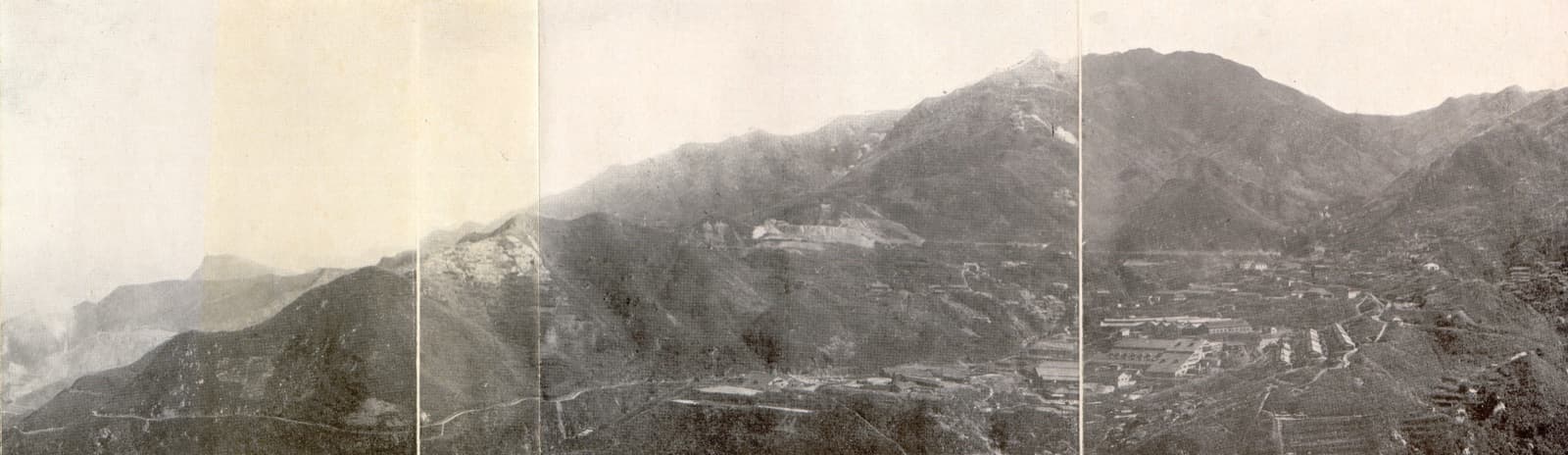
A panorama of the Jinguashi mine run by the Tanaka Group, published in the Government-General of Taiwan's statistical handbook of 1912. The clusters of buildings in the valley are the mine works and the settlement. Thirty years later the prisoner of war camp was set up in these hills.
Government-General of Taiwan, Taiwan Tokei Yoran, 1912
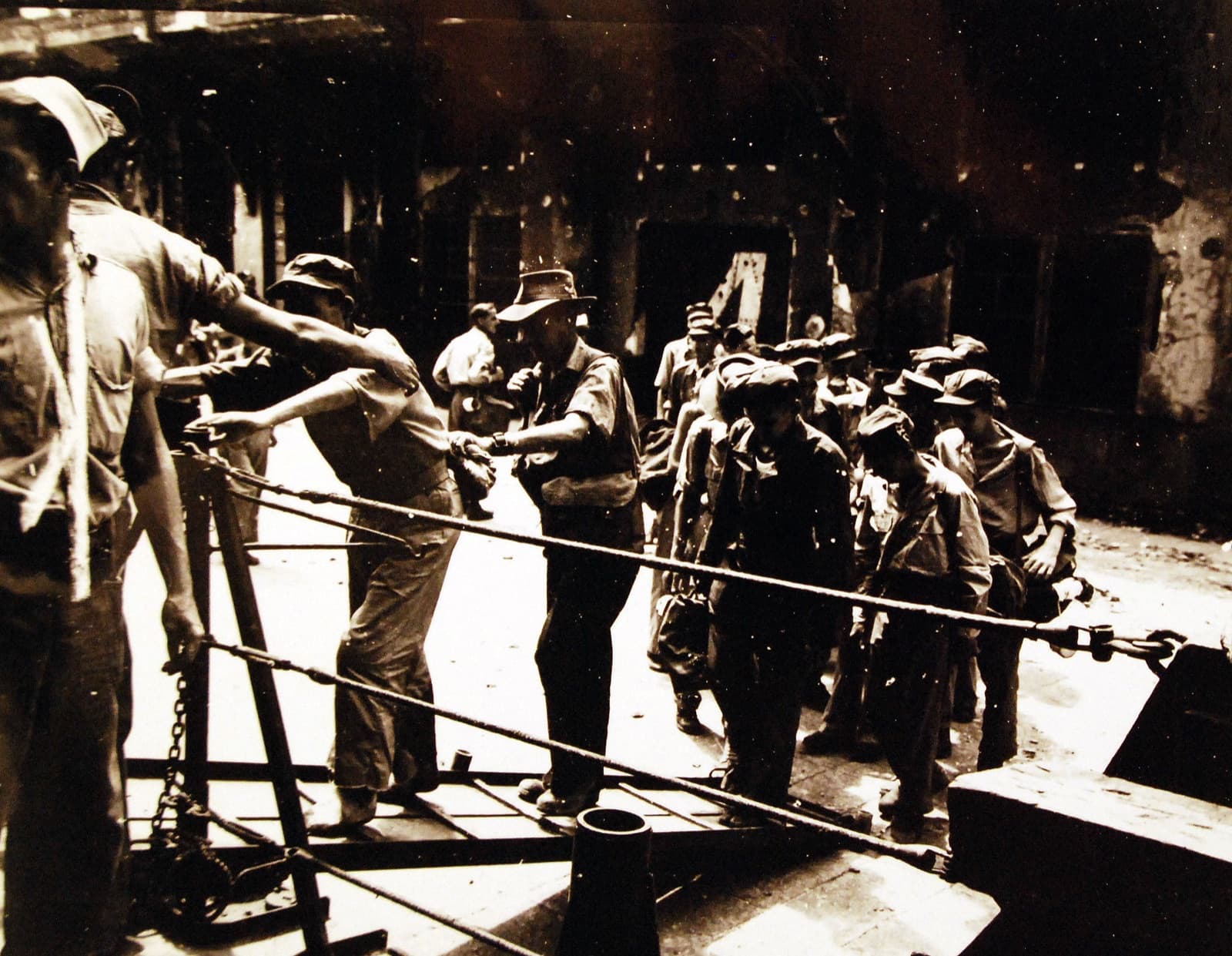
British and Australian prisoners of war freed on Formosa go aboard the US Navy destroyer escort Thomas E. Gary, 1945. The original caption adds a single line: the men are weak from malnutrition and must be helped on board.
U.S. National Archives, 127-GW-244-134744; National Museum of the U.S. Navy