


The Taroko War
The high mountains of Taiwan were the homeland of Indigenous peoples who for centuries had bowed to no lowland power. To a colonial state hungry for the resources of the forests and determined to complete its rule over the whole island, these cloud-wreathed ranges were the last and hardest frontier to conquer. In 1910 Governor-General Sakuma Samata launched a Five-Year Plan to Subjugate the Aborigines of unprecedented scale, resolved to bring the highlands into the fold by force.
At the heart of the plan was the relentless advance of the guard-line deep into the mountains. This guard-line was a cordon woven from stationed guards, watch-blockhouses, electrified wire, mines and artillery. The colonisers deployed it in tier upon tier along the ridgelines, a vast net drawn slowly tighter to sever the communities' contact and their lines of retreat and force them to surrender their arms.
Behind it all, driving the will of the state, lay the immense value of the camphor locked in those forests. Taiwan's camphor output then led the world, an indispensable raw material for making celluloid and smokeless powder; whoever controlled the camphor-clad highlands commanded a fortune great enough to move world markets. "Pacification" was never merely about "civilising" — it was a seizure of resources and land.
The plan's climax was the 1914 campaign against the Truku people of the eastern mountains, the largest military operation in the entire history of colonial pacification. Undaunted by his age, the seventy-year-old Sakuma personally took the field and directed the campaign, commanding a combined force of army and police numbering more than twenty thousand that converged on the depths of the gorges from several directions, from Hehuanshan and the inner Taroko country.
The Truku were a people renowned for their valour and their consummate skill at mountain warfare. Against this vastly better-armed modern host, their warriors, numbering only a few thousand, resisted stubbornly amid the deep gorges and dense forest, relying on an intimate knowledge of the terrain. They knew every rock face, every hunting trail, every pass fit for ambush, and made the Japanese pay a real price in the steep and difficult mountains, dragging the campaign out for months.
Yet under the merciless grinding of machine guns and mountain artillery, this desperately unequal resistance could not, …
Yet under the merciless grinding of machine guns and mountain artillery, this desperately unequal resistance could not, in the end, be sustained. The Truku strongholds were broken one by one, and the people were forced to lay down their arms and submit to the coloniser's rituals of "surrender." After the war the authorities went further, carrying out "collective relocation," forcibly moving many highland communities to the foothills or the plains for easier surveillance and control — severing forever the traditional hunting grounds and the dwelling places of the ancestral spirits.
The war left its own deep mark on the old governor. Gravely injured while directing the fighting in the mountains, Sakuma stepped down the following year and died in 1915 — he had spent almost the last years of his life on the conquest of these ranges, binding his name forever to this blood-stained chapter of history.
The Taroko campaign was, in fact, no isolated event but the climax of the Five-Year Plan. Before it, the colonisers had already launched a string of campaigns against the Atayal and the Daxi groups of the north, pressing forward with the guard-line and breaking community after community with artillery; the victory at Taroko set a blood-red full stop to this five-year conquest of the highlands.
From then on the Governor-General was able to plant police stations and "savage children's schools" across the vast mountains, embedding the power of the police and the education of assimilation deep among the communities. The people who had once ranged freely over their hunting grounds now lived under close surveillance, and even the guns and ammunition on which their hunting depended were registered, controlled and tightly restricted, their traditional way of life shaken to its roots.
The Taroko War brought the highlands firmly under colonial administration and opened the way for the large-scale timber extraction, camphor monopoly and resource plunder to come. Yet the "submission" won by force was only a thin calm laid over the embers. The deep resentment sown by Sakuma's iron-fisted rule did not die with the fighting; sixteen years later, not far away at Wushe, it would erupt once more, with a roar, in a form more terrible still.
The ninety-odd settlements along the Liwu River stood on terraces around a thousand metres up, linked to one another by hunting paths. From May 1914 the guard line below climbed section by section: electrified wire, watch blockhouses, mines laid in the trails, and mountain guns hauled up from Hualien harbour. The rifles the people held were hunting pieces with less than a tenth of a mountain gun's reach. The only way to fight was to wait: for a column to enter a gorge, for the mist to come down, for the enemy's supply line to stretch. Women carried grain up, children hid in the higher creek beds. When the ammunition ran out after three months, the settlements came down one by one and surrendered their guns, several thousand of them, each entered in a register. In the years that followed the administration moved the people down to the Hualien plain under the name of group resettlement, justified by ease of schooling and medical care. From the new villages the Central Range is visible to the west. The Liwu River is not.
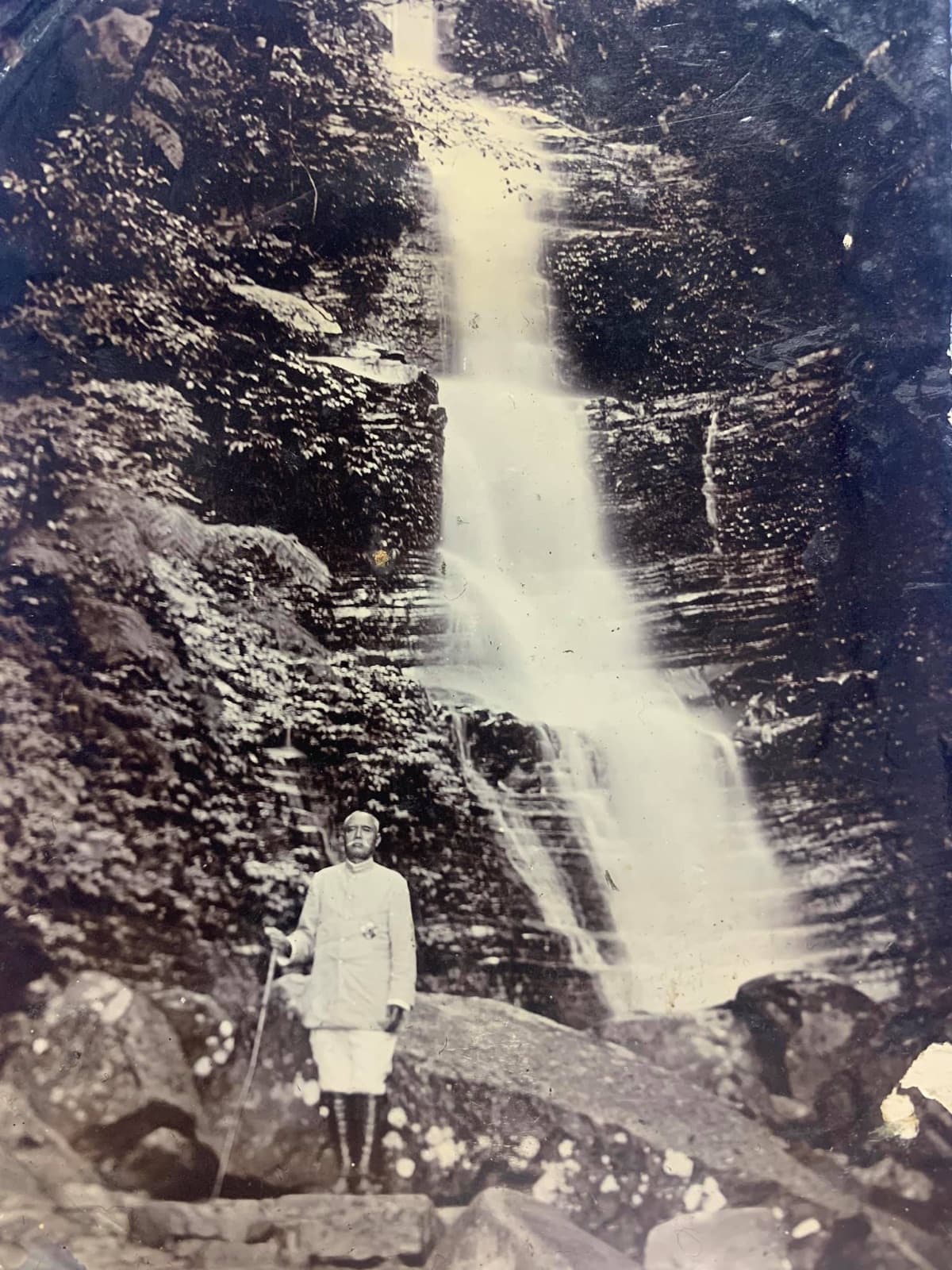
Governor-General Sakuma Samata standing before a waterfall near Tapung. His five-year plan for the mountains pushed the guard line deeper into the interior year by year.
Public domain; photographer unknown
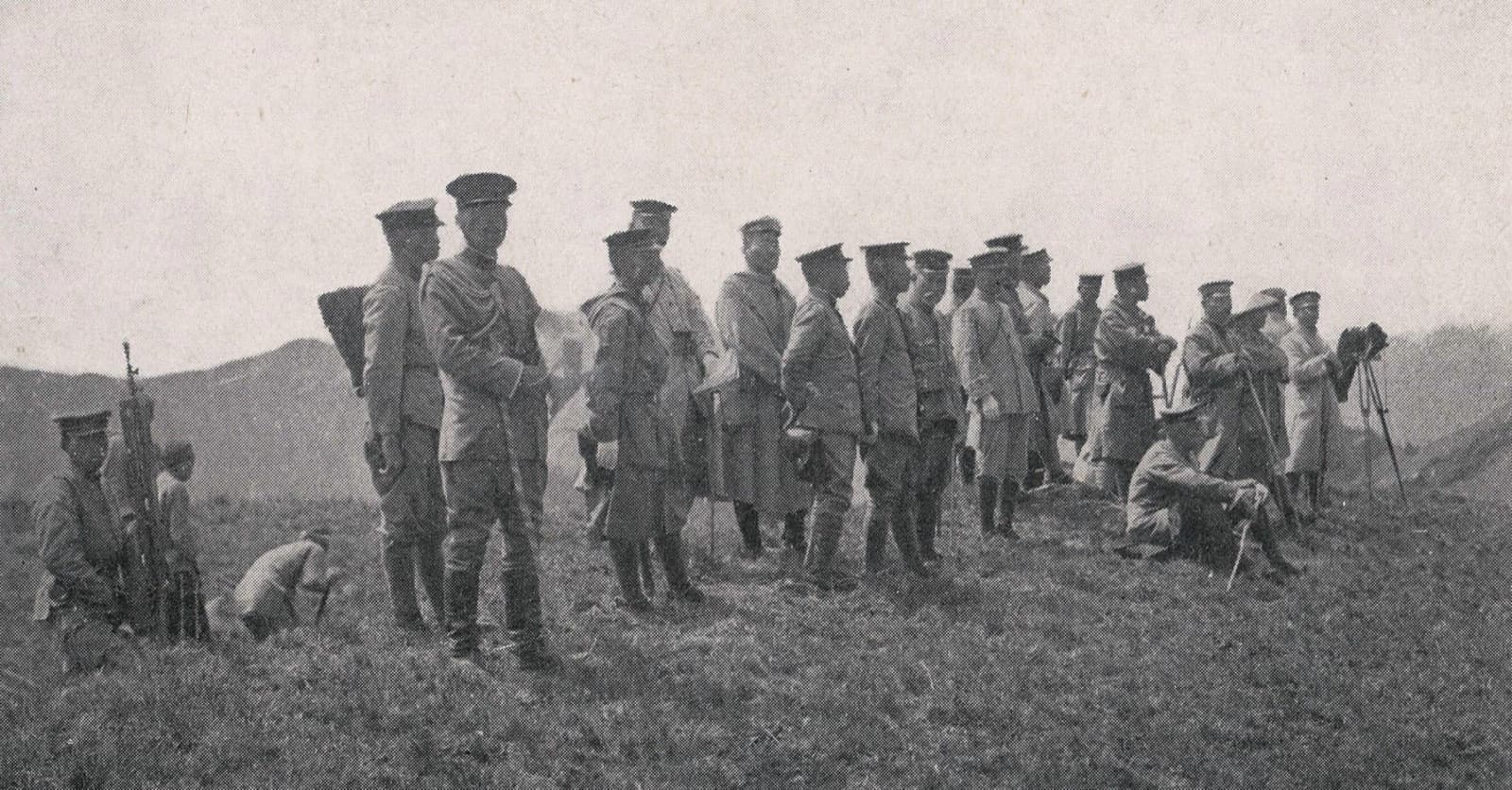
Sakuma Samata with his officers in the mountains, 1914. He directed the Taroko campaign in person, at the age of seventy.
Public domain; photographer unknown
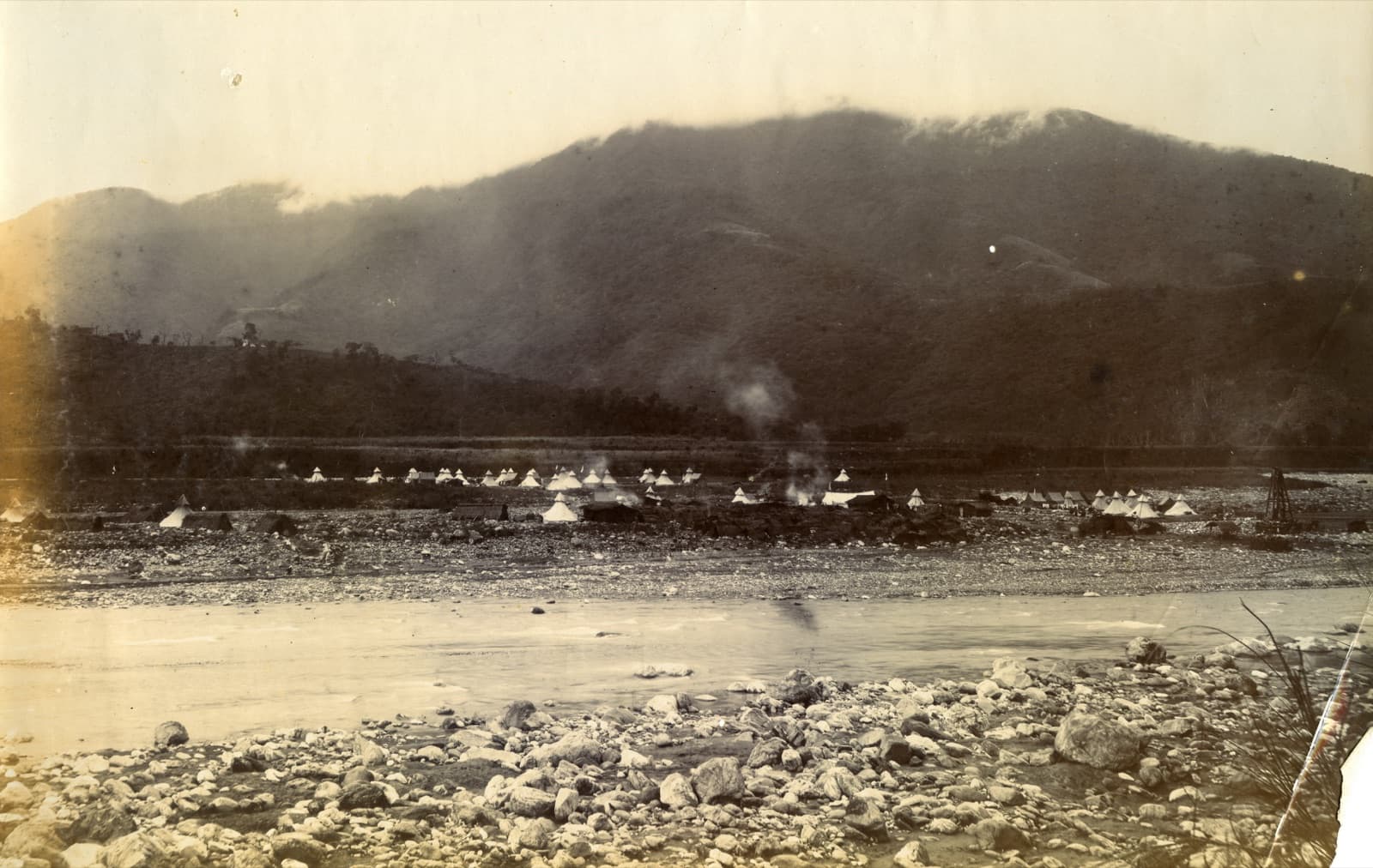
The Japanese army camped at Karenko, tents strung out along the riverbed. The Taroko campaign mobilised more than twenty thousand men against fewer than three thousand Truku.
Photograph by Li Chun-lun; Iconography of Taiwan image archive
Isle of Time