


The Treaty of Shimonoseki
On April 17, 1895, the Treaty of Shimonoseki ended the First Sino-Japanese War and ceded Taiwan and the Penghu Islands to Japan in perpetuity. The decision was made without any consultation of Taiwan's inhabitants — their fate was sealed in a conference room in the Japanese port city of Shimonoseki, where Qing envoy Li Hongzhang and Japanese Prime Minister Itō Hirobumi negotiated the terms of China's surrender. For the Qing court, Taiwan was a disposable bargaining chip; for the two million people living on the island, it was a catastrophe.
The news ignited desperate resistance. Local elites, led by Tang Jingsong — the Qing-appointed governor — hastily procla…
The news ignited desperate resistance. Local elites, led by Tang Jingsong — the Qing-appointed governor — hastily proclaimed the 'Republic of Formosa' (臺灣民主國) on May 25, 1895, in an attempt to invoke international sympathy and deter Japanese annexation. It was Asia's first republic in name, but it lacked meaningful military capacity or foreign support. When the Japanese army landed at Keelung on May 29, Tang Jingsong fled to the mainland within days, and the republic's capital at Taipei fell without a fight. Resistance continued in the south under Liu Yongfu and local militia, but by October the Japanese had secured the entire island through a campaign that cost thousands of lives on both sides.
This volume examines the diplomatic negotiations that severed Taiwan from the Qing empire, the brief and tragic experiment of the Republic of Formosa, and the military campaign that marked the beginning of Japan's fifty-year colonial rule — a period that would fundamentally transform every aspect of Taiwanese society, from language and law to infrastructure and identity.
Li Hongzhang arrived at Shimonoseki bearing the weight of a dynasty in decline. The First Sino-Japanese War had exposed the Qing military's fatal weaknesses, and the court in Beijing was desperate to end hostilities. Taiwan, a peripheral frontier province only recently modernized under Liu Mingchuan, became a bargaining chip on the negotiation table. For the Qing court, ceding Taiwan was a painful but calculated sacrifice — preserving the Liaodong Peninsula and containing further Japanese advances on the mainland took priority. The court reasoned that Taiwan was distant, difficult to defend, and less strategically vital than Manchuria. Li Hongzhang reportedly wept as he signed the treaty, but the decision reflected cold imperial calculus: the dynasty's survival demanded the sacrifice of its margins.
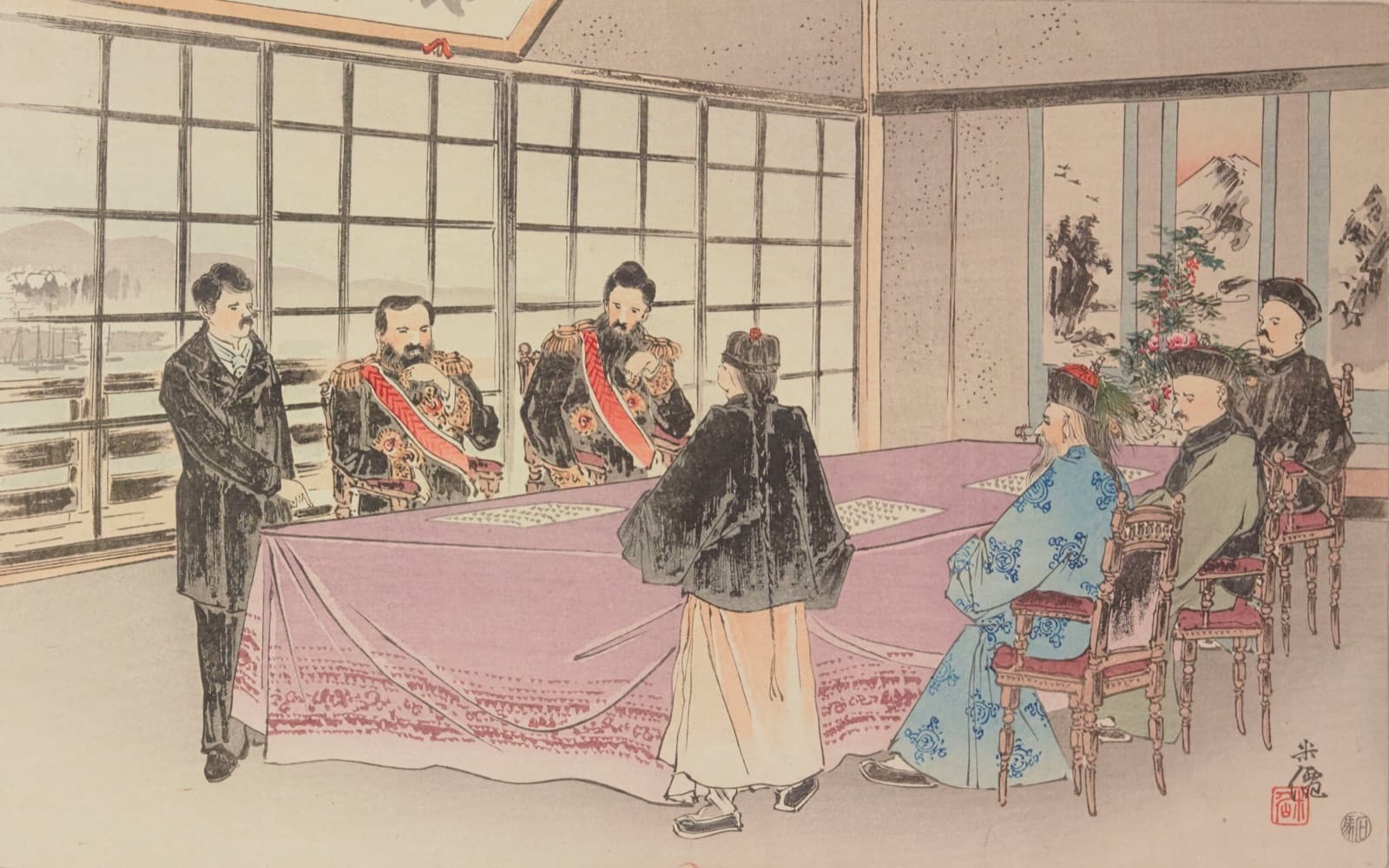
Shunpanro, 17 April 1895. Li Hongzhang and Ito Hirobumi settled the treaty that handed Taiwan and the Pescadores to Japan. Drawn by Kubota Beisen, who travelled with the delegation. No islander was present.
Drawn by Kubota Beisen; Bibliothèque nationale de France
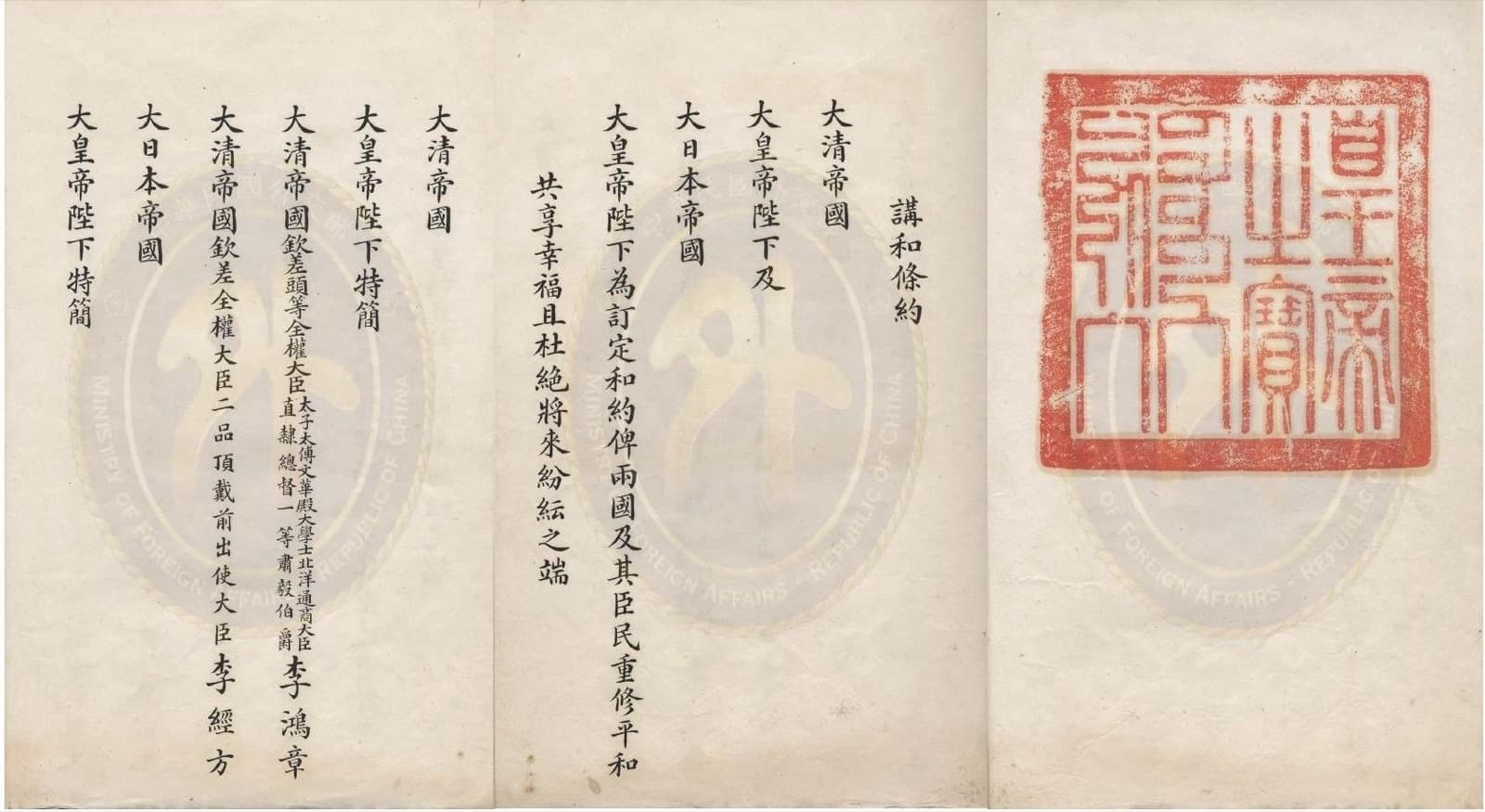
The Qing ratification copy of the Treaty of Shimonoseki, bearing the imperial seal. Article II cedes Taiwan, all its appertaining islands and the Pescadores to Japan in perpetuity.
National Palace Museum
Isle of Time