


The Yiwei War
In the early summer of 1895, an enormous fleet darkened the sea off Cape Santiao near Keelung. It was the Imperial Guard Division, led by Prince Kitashirakawa Yoshihisa, a general of the Imperial Japanese Army. For the people of Taiwan, it was a moment of historical despair — of being torn open. Across the strait, the Qing Empire had suffered devastating defeat in the First Sino-Japanese War, signed the Treaty of Shimonoseki, and ceded Taiwan and Penghu to Japan in perpetuity. When the news of the imperial court's "abandonment of Taiwan" reached the island, lamentations rose everywhere. Gentry cried out in anguish: "The prime minister has the power to cede land — but this lonely subject has no strength to turn back the heavens!"
In this historical crack with no retreat left, the officials and gentry of Taiwan who refused to bow to Japanese rule launched an extraordinary movement of self-rescue. On 25 May 1895, in Tainan and Taipei, they proclaimed the founding of the "Republic of Formosa" and raised the "Blue Field, Yellow Tiger Flag" — a golden tiger on a field of blue. It was the first republic to declare independence in Asian history, an attempt to use the international-law mechanism of nationhood to summon the intervention and aid of the Western powers.
Yet under the cannon fire of the Japanese army, the grand founding myth of the "Republic" quickly revealed its bitterly ironic, absurd undercurrent.
Tang Jingsong, the last Qing governor of Taiwan, was acclaimed as the first president of the Republic of Formosa. But this scholarly president, his mind still framed by the imperial examination bureaucracy, had no nerve for an all-out fight against the imperial army. After the Japanese landed at Aodi, the Qing garrison at Keelung — the Cantonese Brave Battalions — collapsed at the first contact. Before the Japanese even reached the gates of Taipei, the city was already engulfed in fire and chaos as routed soldiers turned to looting.
On 4 June, learning of the front's collapse, Tang Jingsong fell apart in terror. He stripped off the official robes that marked the dignity of his presidency, changed into the plain clothes of an old woman, and — covered by close attendants — fled in disgrace to the mouth of the Tamsui River, squeezing aboard a foreign merchant ship bound for the mainland. Soon after, Liu Yongfu, the celebrated Black Flag Army commander stationed in Tainan, held out for a few months. Seeing the Japanese close in on Tainan from north, center, and south, he too — under cover of pitch-black night — disguised himself as a civilian, clutched a beloved cat, and fled on the British steamer "Thales" to Xiamen.
Both presidents of the Republic of Formosa abandoned the island in less than six months. The exquisite Blue Field, Yellow Tiger Flag was reduced to a trophy carried into the Governor-General's Office by the conquering Japanese.
If history had stopped there, the Republic of Formosa would be remembered only as a farcical political pantomime staged and starred by Qing bureaucrats. But what raised this episode into Taiwan's tragic "ceremony of beginning" was not the high officials who wrote grand declarations and then turned to flee — it was the dispossessed common people who had lived on this land for generations.
When Taipei's gates were thrown open in the chaos and the Imperial Guard Division marched in to medals and military bands, the Japanese government believed the "taking of Taiwan" was settled. They had not foreseen that once Japanese boots crossed Hsinchu and stepped into the hills and plains of central Taiwan, they would meet the wildest, most uncompromising hand-to-hand resistance on the entire island's horizon.
The bloody campaign that history would later call the "Yiwei War" became, in central Taiwan, an iron-and-blood symphony of Hakka righteous armies and Hokkien civilian militias.
In the valleys of Miaoli and Hsinchu, three men stepped forward: Wu Tangxing, a thirty-year-old Hakka licentiate; Jiang …
In the valleys of Miaoli and Hsinchu, three men stepped forward: Wu Tangxing, a thirty-year-old Hakka licentiate; Jiang Shaozu, the young heir of Beipu's "Jin-Guang-Fu" family; and the fearless Xu Xiang. They poured out their family fortunes and rallied thousands of Hakka villagers — men hardened by years of struggle against the wilderness and against indigenous warriors — into stubborn "righteous armies." These militias had no standard Western rifles and no proper artillery. They carried matchlocks and fowling pieces used for clearing land, and heavy machetes for cutting through brush.
It became a months-long classic guerrilla war. Using central Taiwan's labyrinth of bamboo groves, tea plantations, and ravines, the Hakka militias launched ambushes day and night. The Japanese, modern and disciplined as they were, suffered heavily on the steep mountain paths against the elusive Taiwanese fighters.
Jiang Shaozu, just twenty-one, was wounded and captured during a fierce battle to retake Hsinchu. Under brutal Japanese interrogation, the young Hakka heir showed no fear. On the walls of his cell, with his own blood and his last strength, he wrote a death poem: "Beacons stretch across the sky and my thirst burns dry; the scholar has cast aside the pen, his heart in pain. Since ancient times, what man has not died? Let my crimson heart shine upon the old mountains." He then took poison and ended his own life, embodying the unyielding "stiff-necked" spirit that Hakka culture has long honored against foreign rule.
The most savage and harrowing of all the Yiwei War's confrontations exploded at the Battle of Bagua Mountain in Changhua.
In August 1895, after breaking through the militias' lines, the Japanese army gathered in force on the Changhua plain. The military height that commanded the entire plain was Bagua Mountain. There Wu Tangxing and Xu Xiang merged the surviving Hakka militias with the remnants of the southern Black Flag Army and the local Hokkien civilian fighters. Under the shadow of death, the Hokkien and Hakka people — divided for generations by ancestral suspicion — set aside their grievances for the first time and stood shoulder to shoulder in the same trench.
Late on the night of 27 August, the Japanese launched their general assault. Prince Kitashirakawa Yoshihisa personally ordered a carpet bombardment by massed heavy artillery against Bagua Mountain. The entire ridge blazed in the darkness, earth and rock hurled into the sky. At dawn, Japanese infantry surged forward with fixed bayonets like a rising tide.
What followed was true blood-drawing bayonet warfare. Wu Tangxing was struck down at his command post by a direct artillery hit and died a hero. On learning the news, his wife refused food and starved herself to death, following her husband. Xu Xiang, with a few dozen surviving warriors, fought a final desperate melee with long swords amid corpses on the ridge, took multiple bullets, and collapsed in a pool of blood. At the Battle of Bagua Mountain, the Taiwanese righteous armies were almost entirely wiped out. Thousands of bones lay scattered across the blackened slope. Blood stained the whole of Bagua Mountain red.
In the deep winter of 1895, with Tainan finally fallen and the Imperial Guard Division's commander, Prince Kitashirakawa Yoshihisa, dead of illness in Taiwan (some accounts hold that he was mortally wounded in battle by the militias), the months-long "Yiwei War" came to its close amid clouds of gunsmoke and tears.
It was a scandal of Qing officials fleeing in shame — but it was also the first true island epic written in blood by Taiwan's common people. These nameless militiamen, who died in bamboo groves, in valleys, and on the slopes of Bagua Mountain to defend their homes, proved with their lives one thing to the proud Imperial Guard Division: this island could be ceded by an imperial treaty, but the soul and spine of its people could not be enslaved so easily. This tragic ceremony of beginning ended in defeat, yet the blood it spilled soaked deep into Taiwan's soil like spring rain, becoming the most rebellious and resilient genetic origin of the fifty years that followed — fifty years in which Taiwanese awakening and resistance against colonial rule would never cease.
The Republic of Formosa was proclaimed in Taipei on 25 May 1895, its reign title Yongqing, its flag a yellow tiger on blue, its president Tang Ching-sung. The proclamation the gentry of Tainan read declared that the republic honoured the Qing calendar from afar and would serve forever as a screen for the empire — from its first day it had no intention of leaving China. It wanted a name under which foreign powers might intervene. Keelung fell on 4 June, Tang sailed from Tamsui, and Taipei opened its gates three days later. Tainan held out until October. Liu Yung-fu's Black Flag troops went unpaid, and the gentry issued Tainan official notes, one yuan apiece, secured against rice and salt. On 19 October Liu left on a British merchant vessel, and the city was without command, its unpaid soldiers looting. The following night several elders went to the Presbyterian missionary Thomas Barclay and asked him to leave the city and negotiate its surrender on one condition: no massacre. Barclay walked out of the Small South Gate carrying a lantern. The walls of Tainan remember that night better than any document does.
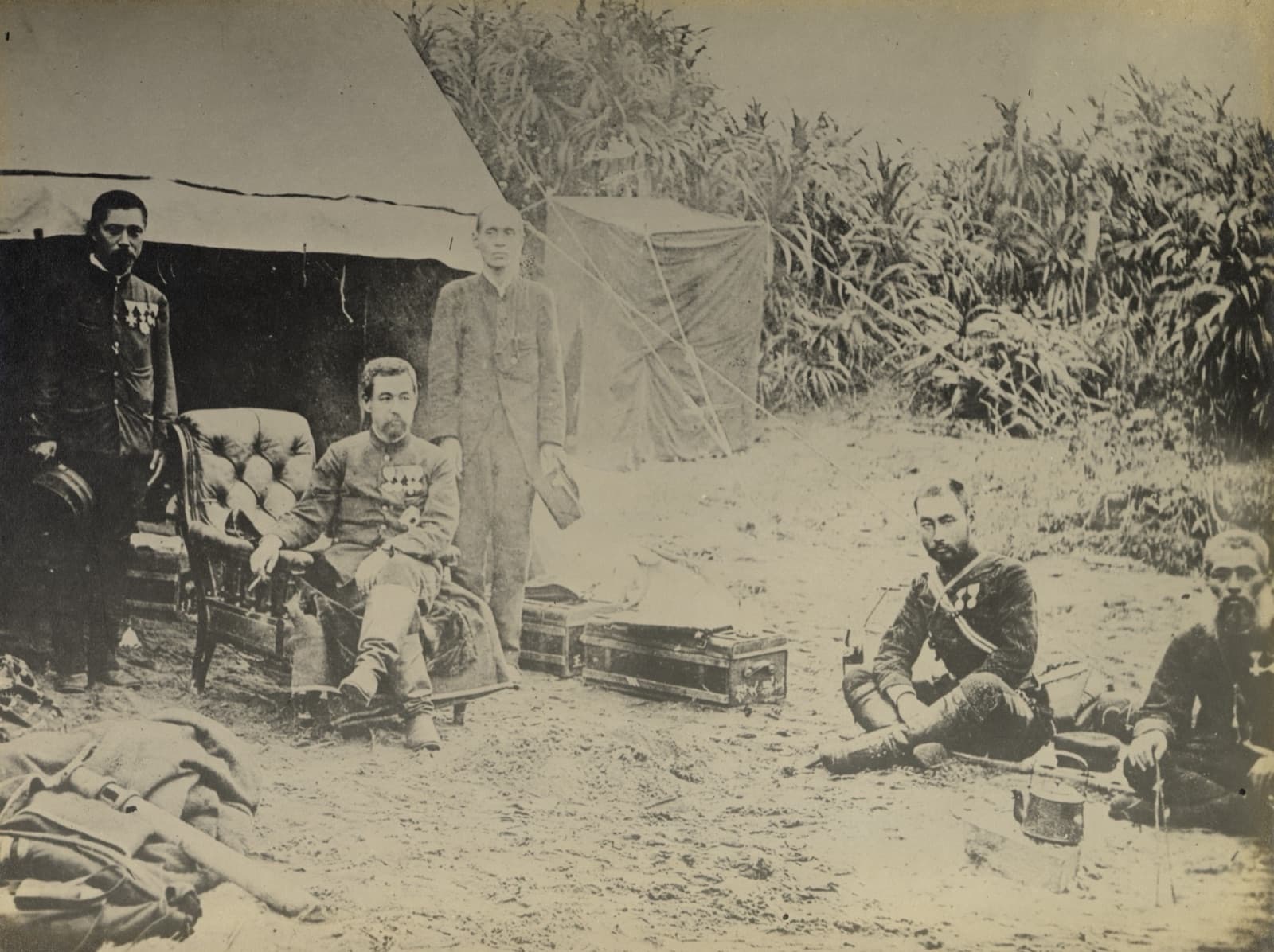
May 1895: the Imperial Guard Division encamped on the coast at Aodi. Prince Kitashirakawa Yoshihisa landed here with his troops and spent the first night of the southward advance on this shore.
Taiwan Education Association, *Photographic Album of Prince Kitashirakawa in Taiwan*
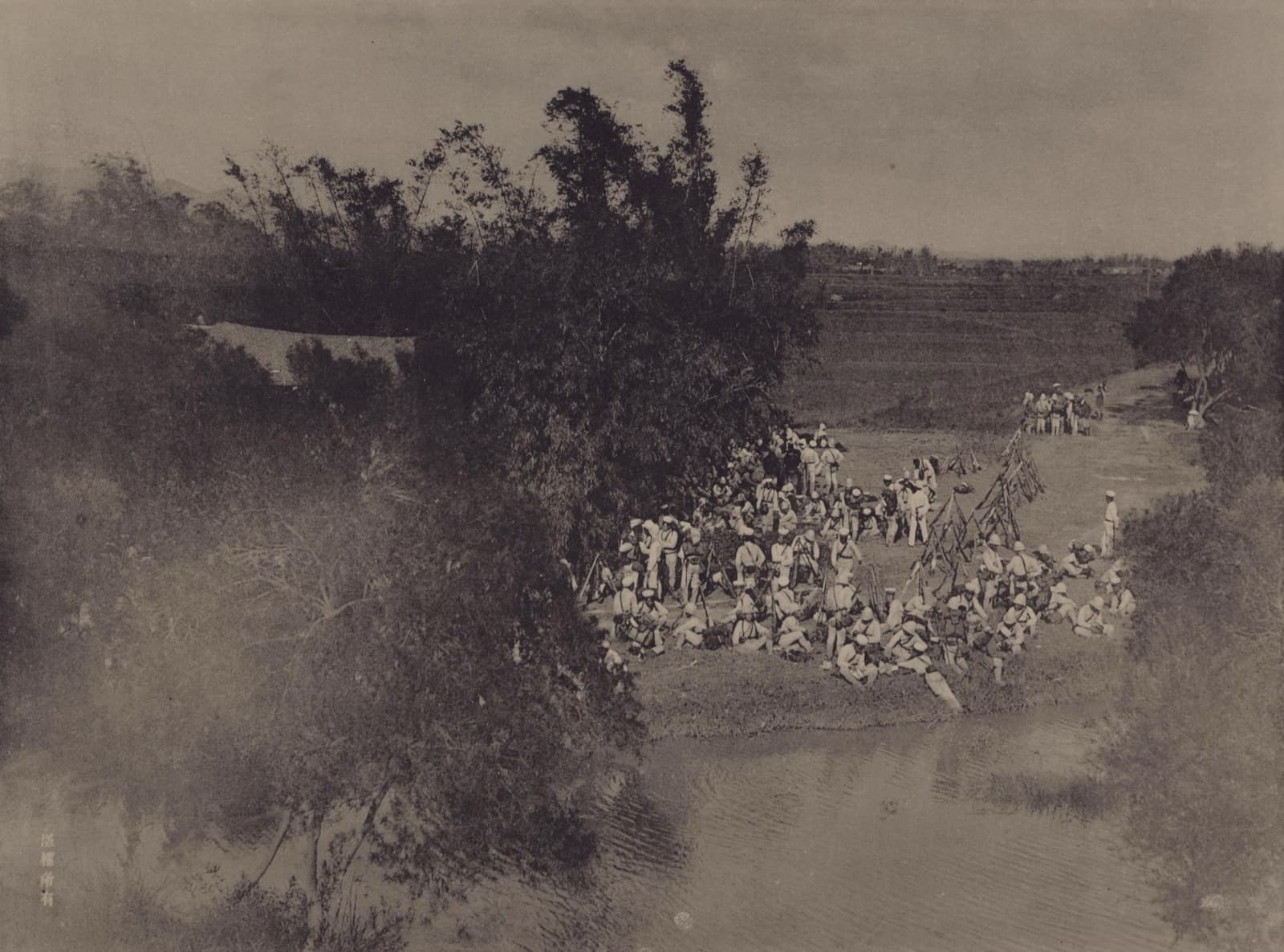
Men of the Japanese 5th Regiment resting outside Taipei's North Gate. After the city fell on 7 June 1895, this Qing-era gate became the passage in and out for the new administration.
*Campaign in Formosa*, photographic album of the First Sino-Japanese War
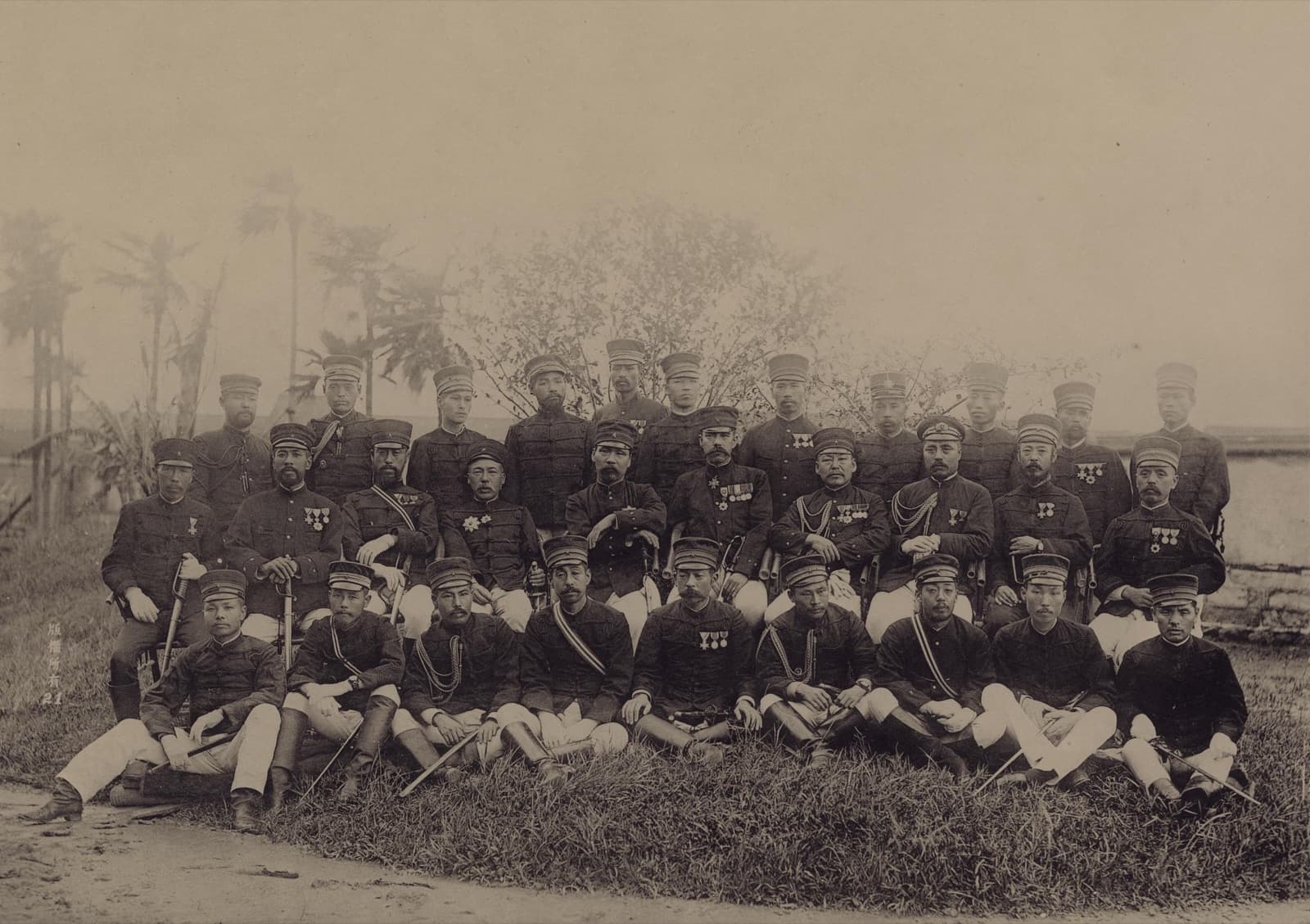
Japanese naval and army officers, and officials of equivalent rank, attached to the campaign headquarters. Their war was not officially a war: in the paperwork it was a punitive expedition.
*Campaign in Formosa*, photographic album of the First Sino-Japanese War
Isle of Time