


The American Perspective
The United States played a subtle yet critical role in post-war Taiwan history. As the principal victor of the Pacific War, the U.S. wielded significant influence over Taiwan's disposition, yet its policies wavered between strategic interests and democratic values.
Reports by American diplomats and military observers stationed in Taiwan meticulously documented the various forms of ch…
Reports by American diplomats and military observers stationed in Taiwan meticulously documented the various forms of chaos following the Nationalist takeover. These reports directly criticized Chen Yi's government for corruption, administrative incompetence, and boiling public discontent. However, as the Cold War framework gradually took shape on the international stage, the United States ultimately chose to support the Nationalist government, viewing Taiwan as an important chess piece in its anti-communist strategy.
This volume compiles American diplomatic archives, military reports, and intelligence assessments to reexamine post-war Taiwan's historical turning points from across the Pacific.
After 1945 the American consulate in Taipei was one of the few channels through which news could leave the island. Vice-consul George Kerr had taught in Taipei before the war and served as a Taiwan specialist for the Navy during it, and knew both the terrain and the people; Consul Ralph Blake handled dealings with the Administrative Executive Office. Their reporting was already blunt in 1946: the corruption of takeover officials, monopoly and trade controls, prices, unemployment, judicial abuse, and the speed with which Taiwanese feeling toward the new government turned hostile, itemized for Washington. In March 1947 the event was outside the consulate's windows. Taiwanese brought in a petition asking for American intervention or for United Nations trusteeship; the consulate recorded gunfire and bodies while explaining that it could offer no refuge. Kerr's subsequent report became one of the fullest accounts from outside, and made him, in the eyes of the Republic of China's government, a man promoting Taiwanese independence; he left the island that year. In 1965 he published Formosa Betrayed, turning what he had seen into an indictment. For overseas Taiwanese that book was the most important narrative source for decades afterward. For Taipei it confirmed that the diplomat had been on the wrong side from the start.
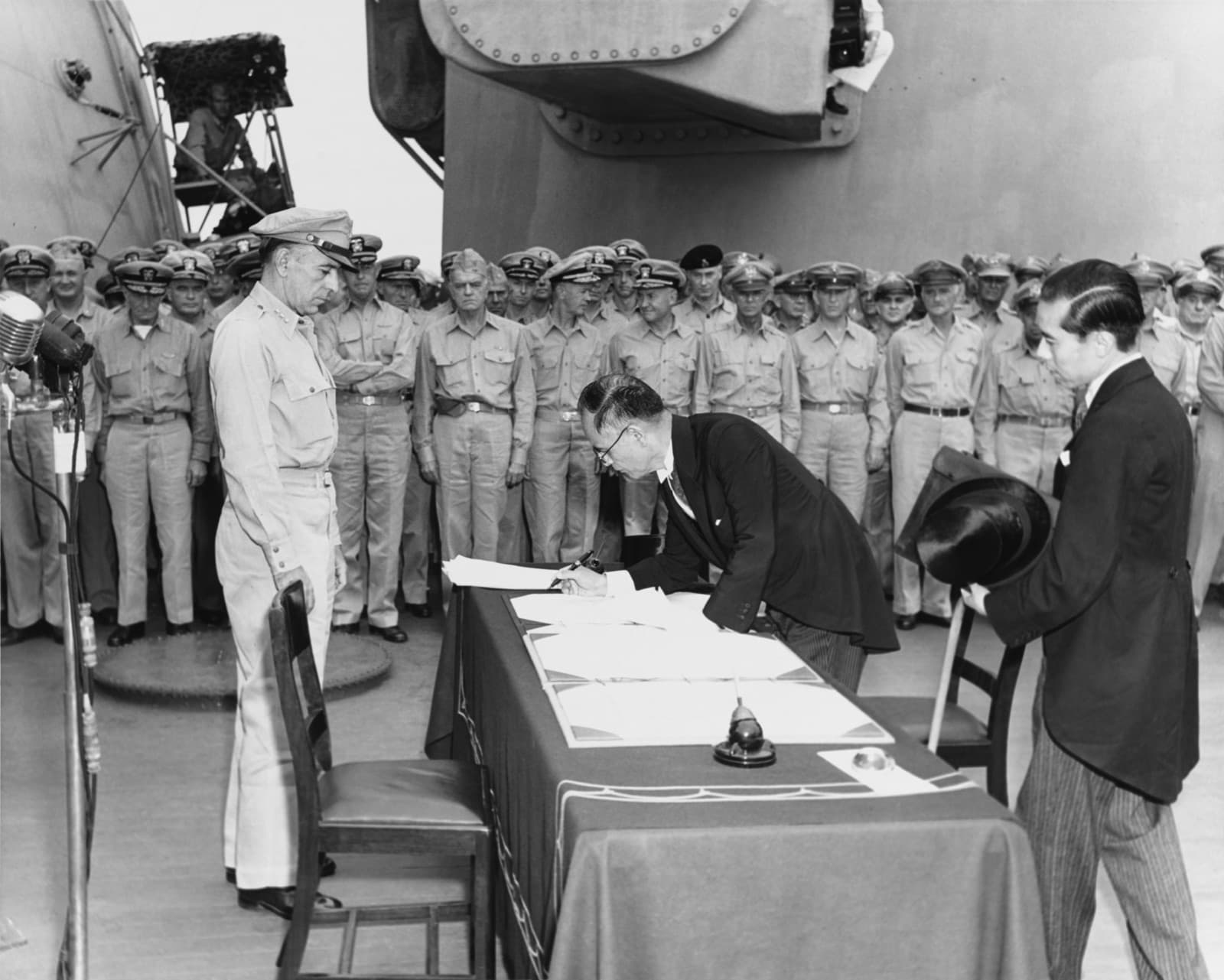
Mamoru Shigemitsu signing the Instrument of Surrender aboard the USS Missouri, 2 September 1945. Taiwan's future was settled inside this set of documents and the Allied orders that followed. Nobody on the island was asked.
Lt. Stephen E. Korpanty, US Army Signal Corps; Naval Historical Center
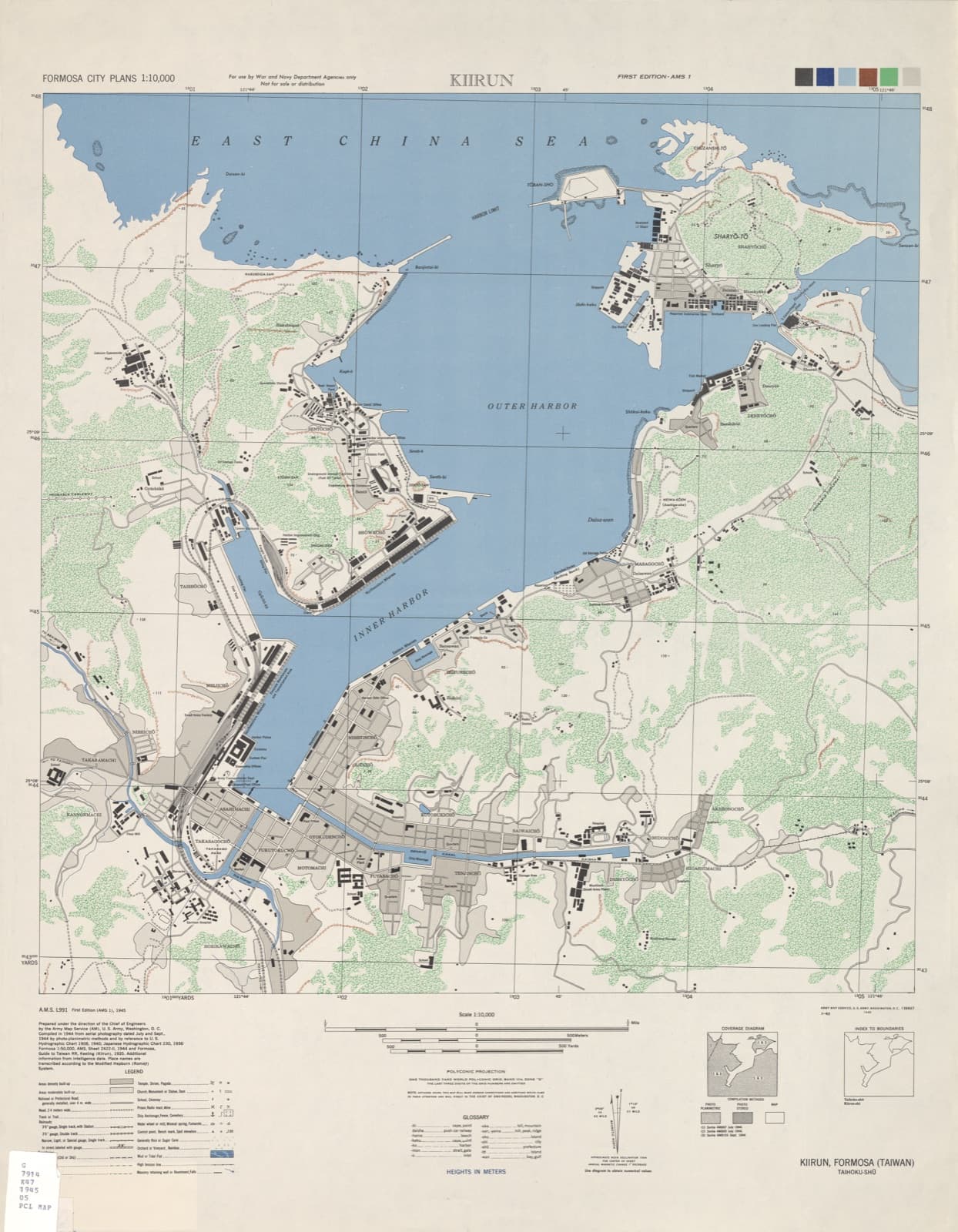
A 1:10,000 street plan of Keelung made by the US Army Map Service in 1945. The Americans mapped Taiwan's cities for an invasion they never launched; the troops who came in October landed at these wharves.
US Army Map Service; Perry-Castañeda Map Collection, University of Texas
Isle of Time