


Vanishing Plain Warriors
In the 1660s, the landscape of central Taiwan offered a stark contrast to the highly sinicized, scholarly atmosphere taking root in Tainan. This was a wild, untamed frontier nourished by the currents of the Dadu and Zhuoshui rivers.
Across these vast plains and rolling hills flourished a powerful, multi-ethnic confederation of over ten indigenous Plain Tribes—including the Papora, the Babuza, and the Hoanya—which later historians would call the Kingdom of Middag. Their supreme ruler, revered as King Middag (Kamachat Aslamie), governed an ancestral homeland that had never been touched by the hand of any imperial Chinese dynasty.
However, as the Ming-Zheng regime aggressively pushed its "military settlement system" northward to sustain its anti-Qing campaigns, thousands of Han soldiers armed with steel blades and matchlock guns began encroaching upon the frontier. These Han settlers, desperate for grain and territory to survive, were placed on a violent, inevitable collision course with native warriors sworn to defend their ancestral hunting grounds.
The spark of conflict erupted into an absolute inferno at the Shalu Community (modern-day Shalu District, Taichung City). Desperate to alleviate a severe grain crisis racking his military camps, Zheng Jing imposed forced labor and heavy agricultural taxes upon the tribes of the Kingdom of Middag—a demand that, to an indigenous society reliant on hunting and shifting cultivation, amounted to total cultural annihilation.
Pushed beyond the brink of endurance, the Plain Tribe warriors of the Shalu community rose in open rebellion, launching …
Pushed beyond the brink of endurance, the Plain Tribe warriors of the Shalu community rose in open rebellion, launching fierce guerrilla raids against the Han agricultural outposts. Upon hearing news of the uprising in the central plains, Zheng Jing ordered a ruthless military pacification. He dispatched Liu Guoxuan and Feng Xifan—the regime’s premier commanders, renowned for their cold, calculated efficiency—to march north with a heavily armed elite force. It was a deeply unequal war of technology and tactics; despite the native warriors' flawless mastery of the terrain and unmatched bravery, their defenses were rapidly obliterated under the crushing volleys of Han musketry and ironclad cavalry.
Upon breaching the defenses of the Shalu Community, the Ming-Zheng army enacted a devastating strategy of total extermination. To permanently shatter any residual spirit of indigenous resistance across central Taiwan, Liu Guoxuan ordered the complete annihilation of the settlement. Soldiers torched the thatched-roof villages, and whether they encountered armed Papora warriors or defenseless women, children, and the elderly, all were ruthlessly cut down in a tempest of fire and blade.
According to historical records, this brutal "Shalu Incident" reduced a thriving tribal community of hundreds down to a mere handful of traumatized survivors, effectively wiping the settlement from the face of Taiwan's history. Horrified by the sheer cruelty of the Shalu massacre, King Middag and the remaining confederated tribes bowed to the Ming-Zheng regime in grief and terror, reluctantly accepting the humiliating terms of imperial taxation and forced labor.
The tragedy of the vanishing Plain Tribe warriors remains a profound and solemn elegy in the history of Taiwan. While this merciless military conquest allowed the Ming-Zheng regime to successfully expand its dominion into central Taiwan and open fertile plains for Han agriculture, it dealt a fatal blow to the vitality of the Kingdom of Middag, causing the ancient confederation to fracture and collapse over the ensuing decades.
The proud warriors who once ran free across the central plains, their skin etched with tribal tattoos and their ears adorned with traditional discs, were gradually silenced and erased from the margins of written history. Today, as coastal trains rumble through the high-rises of modern Shalu, it is hard to imagine that over three centuries ago, an ancient kingdom bled its last drop of life upon this very soil—and that the wheel of Taiwanese history moved forward heavily, rolling over the bones of these forgotten warriors.
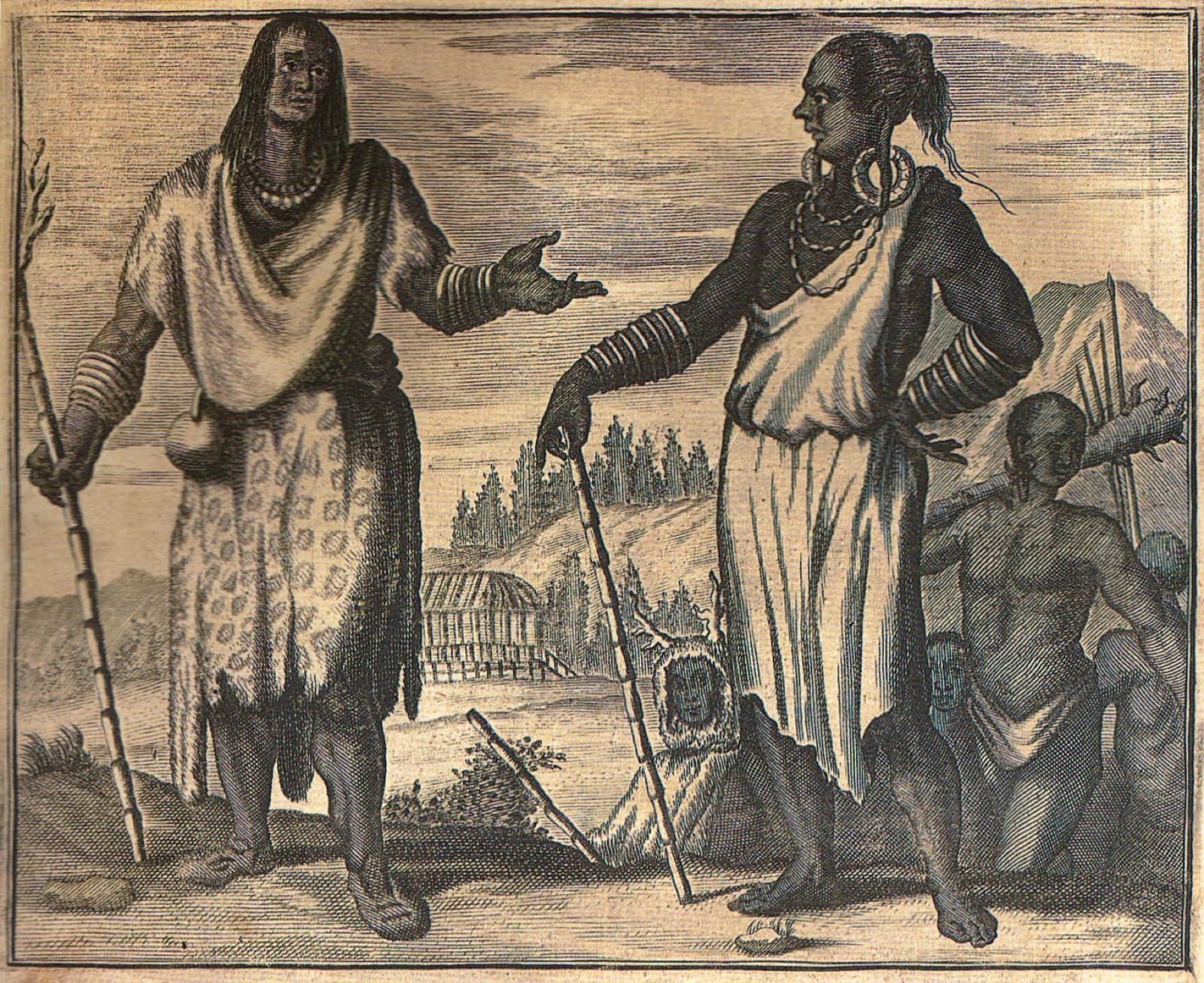
Formosans as engraved for Dapper's book. Plates like this were worked up from travellers' sketches and hearsay, so the detail is unreliable — but this was the only picture of the islanders a European reader could see.
Olfert Dapper, 1670; Radboud University Library, Nijmegen
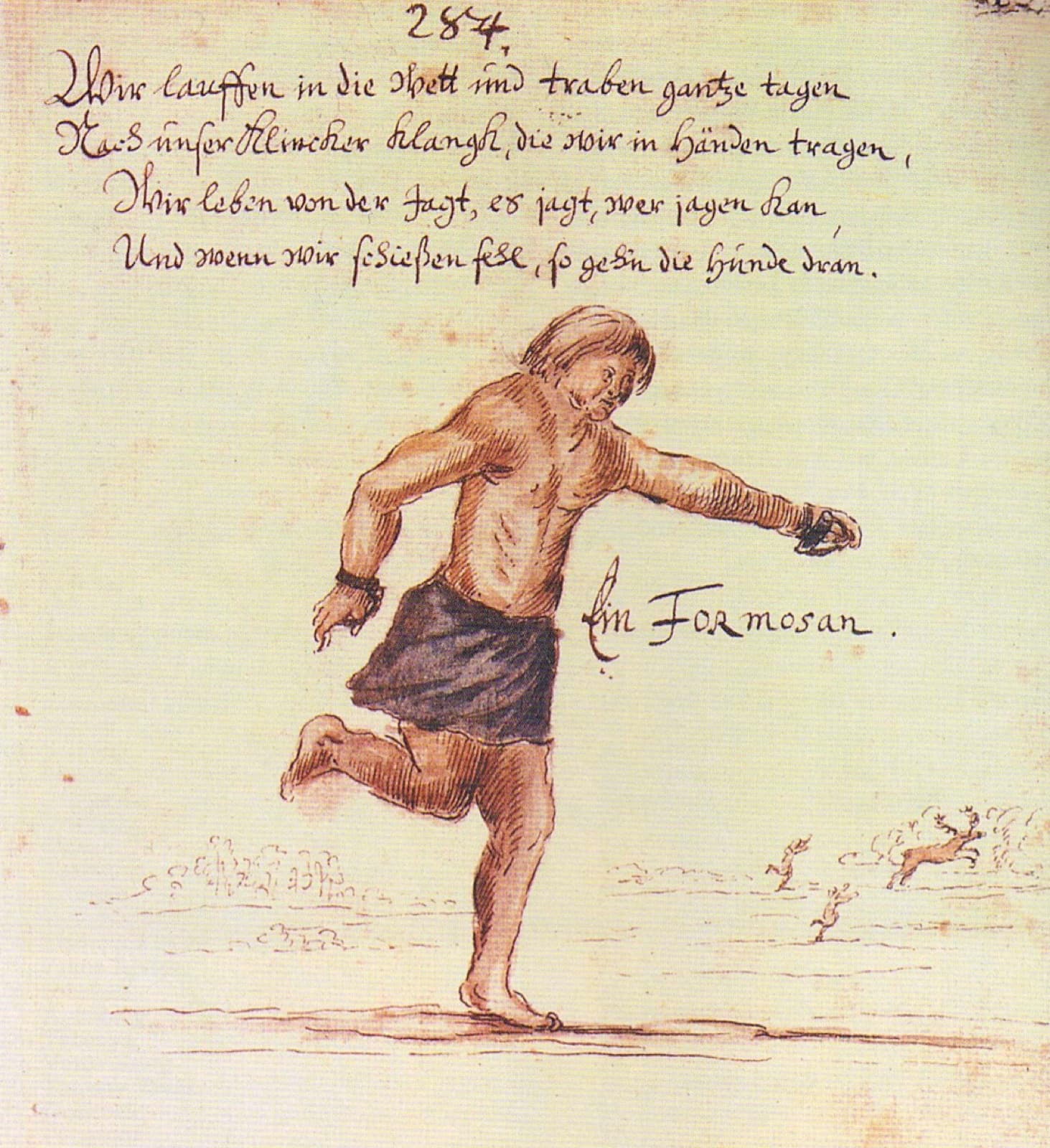
A Formosan hunter at a run, painted by the German traveller Caspar Schmalkalden in the 1650s. The note beside him reads: they run in the fields all day with javelins in their hands, and live by the hunt.
Caspar Schmalkalden, *Die wundersame Reisen*
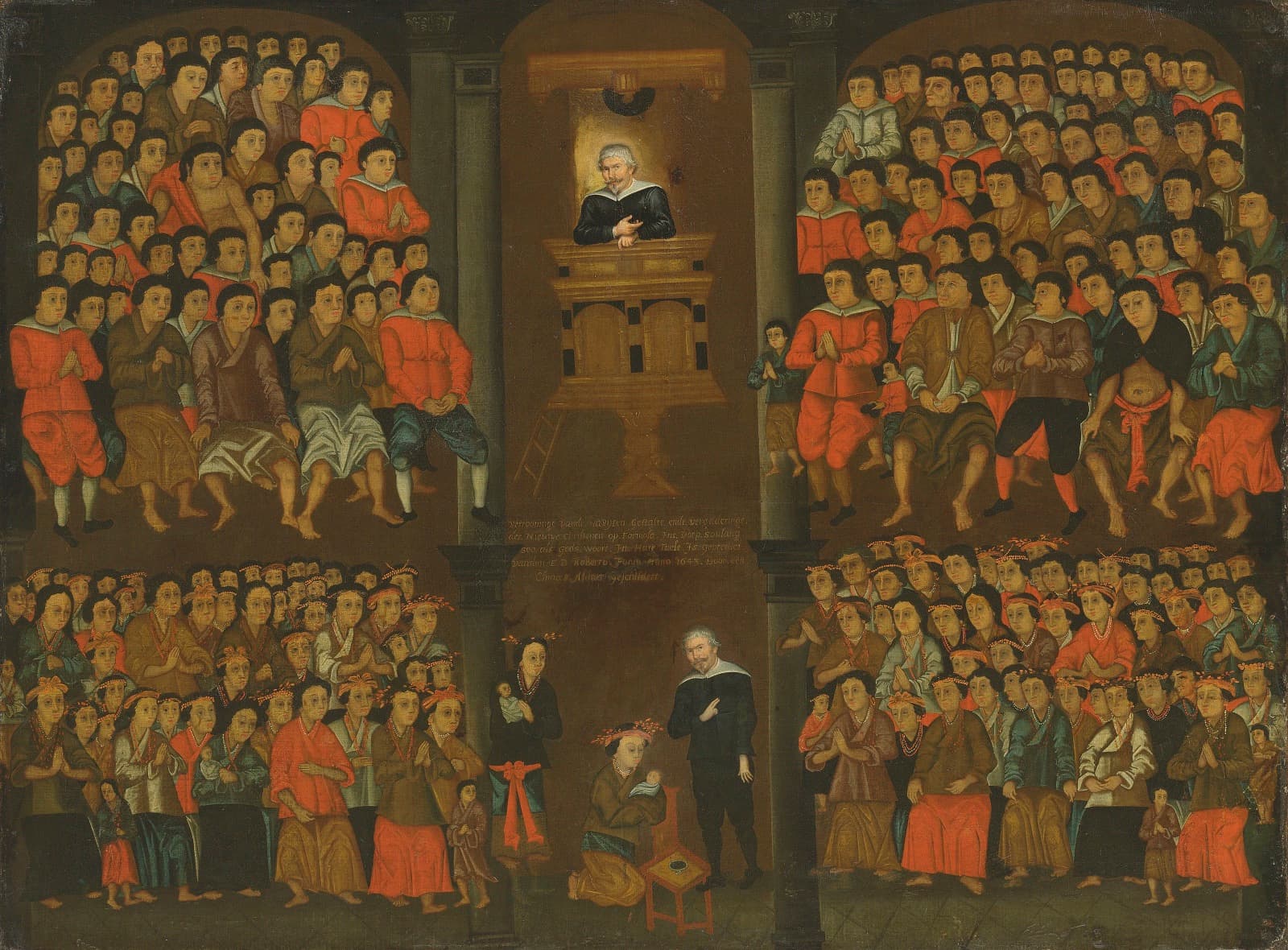
The Dutch minister Robert Junius baptising newly converted Siraya, 1643. Dozens stand ranked on either side — the most direct record we have of the scale of the Dutch mission.
Painted by Adriaen Souter
Isle of Time