


The Anping Secret Pact
In the summer of 1670, a majestic vessel named The Experiment, flying the flag of the English East India Company, glided gracefully into Anping Harbor in Tainan. At that moment, Taiwan was suffocating under the harsh maritime embargo of the Qing Empire’s "Great Clearance" policy, which had severed almost all supplies and trade revenues from the Chinese mainland.
Inside the Anping Royal Palace, the sovereign of Eastern Ning, Zheng Jing, knew his regime had reached a perilous crossroads. When he learned that these fair-haired, strangely attired European merchants had arrived with a desire for trade, he recognized that this was far more than a simple merchant deal.
It was a golden, desperate opportunity to shatter the Qing blockade and thrust his kingdom onto the global stage. Assisted by his brilliant adviser Chen Yonghua, Zheng Jing received the English representatives with a grand royal ceremony, launching a secret web of international diplomacy and maritime commerce in Tainan.
The negotiations unfolded in an atmosphere thick with calculated political maneuvering and sharp diplomatic wit. The English East India Company was desperate to establish a new base in East Asia, hoping to use Taiwan as a vital stepping stone to break into the lucrative Japanese and Chinese markets, which were then heavily monopolized by the Dutch and Spanish. Zheng Jing’s demands, however, were far more immediate and visceral—he needed the strategic materials to fuel his war against the Qing.
The two parties ultimately signed a formal commercial treaty, and the Zheng regime allocated a large villa in Anping to serve as the very first Western trading post in Taiwanese history: the English East India Company’s Anping Factory.
In this historic accord, the English were granted extraordinary trading privileges, including the freedom to travel and conduct business throughout the island. In return, the English agreed that every vessel arriving in Taiwan must carry a specified quota of gunpowder, muskets, cannons, and raw iron, which the Zheng government would purchase entirely at premium prices.
This English factory in Anping rapidly transformed into a bizarre, vibrant crossroads of East and West at the height of …
This English factory in Anping rapidly transformed into a bizarre, vibrant crossroads of East and West at the height of the Age of Sail. Every morning, the docks of Anping Harbor choked with oxcarts laden with native Taiwanese sugar, deer hides, and local crafts harvested from the mid-southern military settlements, all bound for the English warehouses.
At night, under the heavy shroud of darkness, the English merchantmen quietly unloaded crates of advanced Western weaponry and ammunition, transferring them directly into the royal armories.
Cloaked by the unique international status of the English ships, the Zheng maritime fleets were able to bypass the Qing naval blockades, re-establishing lucrative smuggling networks with Chinese merchants in Nagasaki, Manila, and across Southeast Asia. Taiwan, once a desperate and isolated rebel island, transformed almost overnight into an indispensable and thriving hub along the global maritime trade routes.
This transnational pact stands as the very first formal commercial treaty signed between Taiwan and a Western superpower, showcasing the sophisticated maritime diplomacy of the Zheng regime.
Although this global partnership dissolved thirteen years later when the Qing Empire conquered the island and the Anping Factory fell into ruin, the treaty proved that as early as the seventeenth century, Taiwan possessed a distinct maritime DNA, capable of leveraging its strategic geography to play the dangerous game of geopolitics.
Today, when we discuss Taiwan's role in global trade and international diplomacy, we find its earliest roots in that autumn twilight over 350 years ago, when a young king stood on the ramparts of Anping Castle and signed a piece of parchment that connected his island to the wider world.
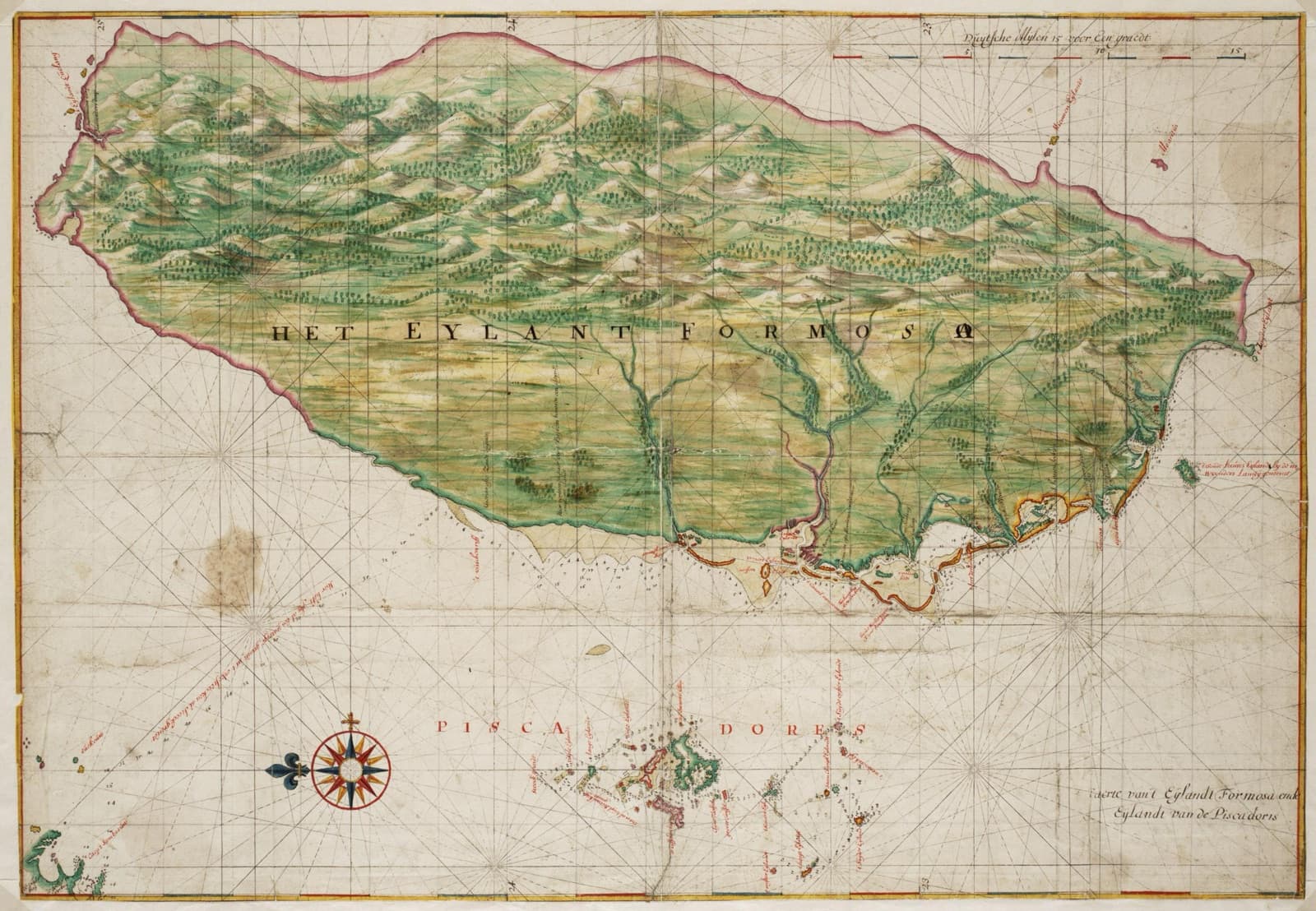
Johannes Vingboons's map of Formosa, 1665. Company charts placed the island at the junction of China, Japan and Manila — the trade Zheng Jing was negotiating over with the English East India Company ran along these lines.
Johannes Vingboons; Nationaal Archief, The Hague
Isle of Time