


Han Settlement
Under Koxinga and Zheng Jing, Taiwan absorbed what was, for its time, a demographic flood. The 25,000 soldiers who crossed with Koxinga in 1661 did not leave; over the following two decades tens of thousands more Fujianese — some driven from the mainland by Qing coastal clearance policies, others drawn by the promise of land — made the eight-hour crossing from Xiamen or Quanzhou in shallow-draft junks. By the time the kingdom fell in 1683, the Han population of Taiwan had grown perhaps tenfold over what the Dutch had counted, and the island's ethnic map had been permanently redrawn.
The tuntian military colonies were the forward edge of this settlement. Regimental units, disbanded or semi-retired after campaigns, took up the plow on lands allocated by Chengtian Prefecture, giving rise to the grid of "ying" (encampment) and "zhen" (garrison) place-names that still anchors the geography of southern Taiwan. Behind them came civilian pioneers: lineage-based settlement from Zhangzhou and Quanzhou, Hakka households pushing inland from the foothills, merchants setting up shophouses along the Tamsui, Lukang, and Kaohsiung coasts. Land was opened through the ken-ho (patent) system, in which approved headmen received rights to recruit tenants and develop tracts in exchange for tax obligations — a structure that would shape Taiwan's rural society for the next two centuries.
The consequences for the island's indigenous peoples were profound and asymmetrical. The lowland Siraya, Makatao, Hoanya…
The consequences for the island's indigenous peoples were profound and asymmetrical. The lowland Siraya, Makatao, Hoanya, and Pazeh nations — the so-called "Pingpu" or plains aborigines — found themselves increasingly displaced from the same alluvial soils now prized by Han cultivators. Relations were a tangled fabric of trade, intermarriage, conversion, and conflict. The Zheng administration taxed indigenous communities through the existing "village assessor" system it inherited from the Dutch, but tightened levies and extended corvée demands. Some villages negotiated accommodation by leasing land to Han tenants; others retreated into the hills, eastward toward territory still held by highland nations whose sovereignty no outside regime had yet challenged.
This volume traces the settlement transformation that turned Taiwan's demographic map upside down in a single generation. Through land-patent documents, military-colony registers, village tribute rolls, and the terse marginalia of indigenous tribute records, it reconstructs how, beneath the surface of formal proclamations, a new Han-majority society was quietly taking root across the southwestern plains — and what that rooting meant for the peoples who had lived there for centuries before.

The church at Sakam, from *'t Verwaerloosde Formosa*. The Dutch had preached here for thirty-eight years; under Zheng rule the churches and schools fell away and romanised script gave way to Chinese letters.
*'t Verwaerloosde Formosa*, 1675
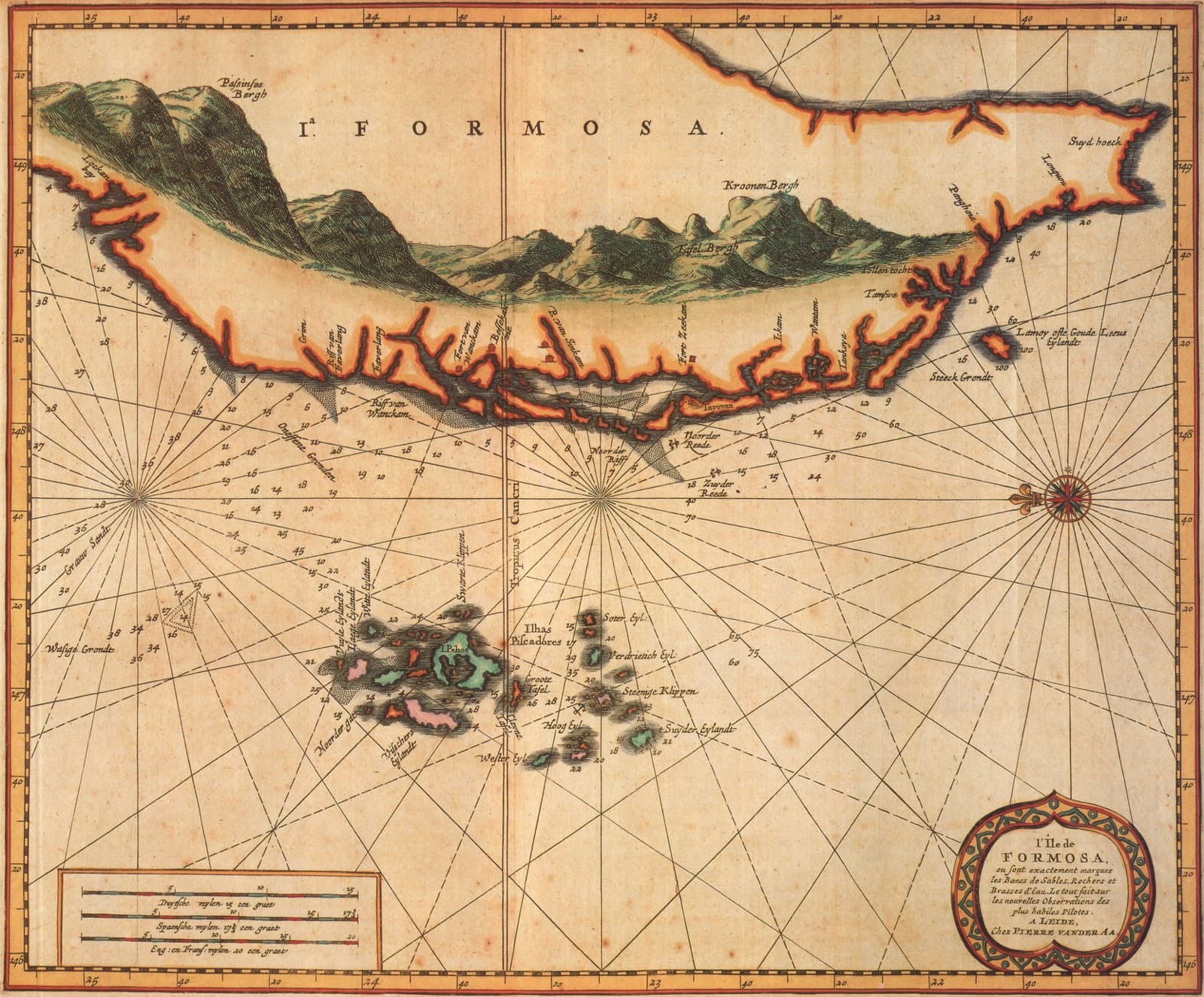
Pieter van der Aa's map of Formosa, 1727. The western plain is crowded with Chinese settlements and rivers; the east is left blank — country the mapmakers could not reach and did not intend to.
Drawn by Pieter van der Aa, 1727
Isle of Time