


Wu Sha Opens the Kavalan Plain
Beyond the mountains of Taiwan's northeast lay a fertile expanse cradled between the Snow Mountains and the Pacific — the Kavalan plain, today's Yilan. For most of the Qing era this plain lay outside the empire's borders, and Han settlers were expressly forbidden to cross into it. It was the ancestral home of the Kavalan people, who lived by rice farming, fishing, hunting, and trade among the villages scattered across the lowland. Yet on the western coast, only a mountain range away, Han settlement had already saturated the available land, and this rich but unclaimed valley became, in the eyes of adventurers, the most tempting prize of the age.
Wu Sha was one such frontier trader. A man from Zhangzhou who had crossed to Taiwan in his youth, he had spent years dealing with the Kavalan villages around Tamsui and Sandiao, exchanging cloth, salt, and iron tools for mountain goods and deer hides. Those years of contact left him familiar with the roads and the people of the plain, aware of the land's promise, and keenly conscious of the dangers of seizing it. He gathered landless settlers from among the Zhangzhou, Quanzhou, and Hakka communities, stockpiled grain and arms, and waited for his moment.
In 1796 Wu Sha led a band of settlers over the steep pass into the plain and built a walled camp at the northernmost point, Toucheng, the first permanent Han foothold on the Kavalan lowland. The earthen wall was at once a settlement and a fortress. The Kavalan, watching their homeland invaded, resisted fiercely, and the first years of the venture were marked by constant conflict and bloodshed on both sides. Several times the camp stood on the brink of collapse, and the future of the enterprise hung in doubt.
Then the situation turned in a way no one had foreseen. When a smallpox epidemic swept through the Indigenous villages, …
Then the situation turned in a way no one had foreseen. When a smallpox epidemic swept through the Indigenous villages, claiming countless lives, Wu Sha used his knowledge of variolation and healing to treat the stricken. That hand extended in a moment of despair won him a measure of trust that neither weapons nor walls could ever have secured. The strained hostility eased, and the settlers gained a firmer footing on the plain, pushing their frontier inland inch by inch.
Wu Sha died in 1798, only two years after he had entered the plain, with the great work barely begun. But his nephews and kinsmen took up the unfinished task, following the path he had opened and pressing steadily southward. The settlers organized themselves into cooperative pioneering groups under the jieshou system, opening a chain of settlements — Toucheng, Erwei, Sanwei, Siwei, Wuwei — as paddy fields and irrigation channels spread across the plain and villages rose one after another.
Within a single generation the face of the Kavalan plain had been utterly rewritten. Han settlements stretched from north to south, rice harvests were abundant, and the once-forbidden land beyond the pale had become a presence the empire could no longer ignore. The Qing court at last reversed its policy, formally annexing the region during the Jiaqing reign and establishing Kavalan Sub-prefecture to govern it — dispatching officials, surveying fields, and levying taxes, drawing the frontier into the administrative order of the empire.
The opening of the Kavalan plain was the last great chapter in the history of Han pioneer settlement in Qing Taiwan. The western plains had long been fully claimed, and this northeastern valley became the final destination of the settlement wave, marking the close of a pioneering age. It is a story of enterprise, cooperation, and endurance, of migrants rebuilding their lives on unfamiliar and dangerous ground. Yet, as always on the frontier, the achievement was shadowed by the deep dispossession of those who were there first. The Kavalan people lost the plain they had guarded for generations; their numbers dwindled and they were driven to migrate elsewhere — a cost that remains, to this day, an inescapable part of this history.
To the Kavalan, the plain was never wilderness awaiting cultivation. Thirty-six villages were spread across it, the paddy fields long since cleared, the streams running down to fishing grounds, deerskin and mountain goods moving north to Tamsui along trade routes that already existed. They had dealt with Han merchants for decades — Wu Sha among them, a familiar face. The word "opening" carries someone else's vantage point: by any measure that mattered to the people living there, the land was already open. The earthen wall raised in 1796 changed that. Resistance lasted years and cost lives. What broke the villages, though, was not weapons but the smallpox that arrived alongside the traffic — and when whole settlements fell ill, the remedy lay in the newcomers' hands. What followed was slower and more complete: contracts written in a script they could not read, debts that never closed, a boundary giving way inch by inch. By the middle of the nineteenth century many Kavalan had moved south along the coast to the Qilai plain to build again elsewhere. The plain kept their place names. It did not keep them.
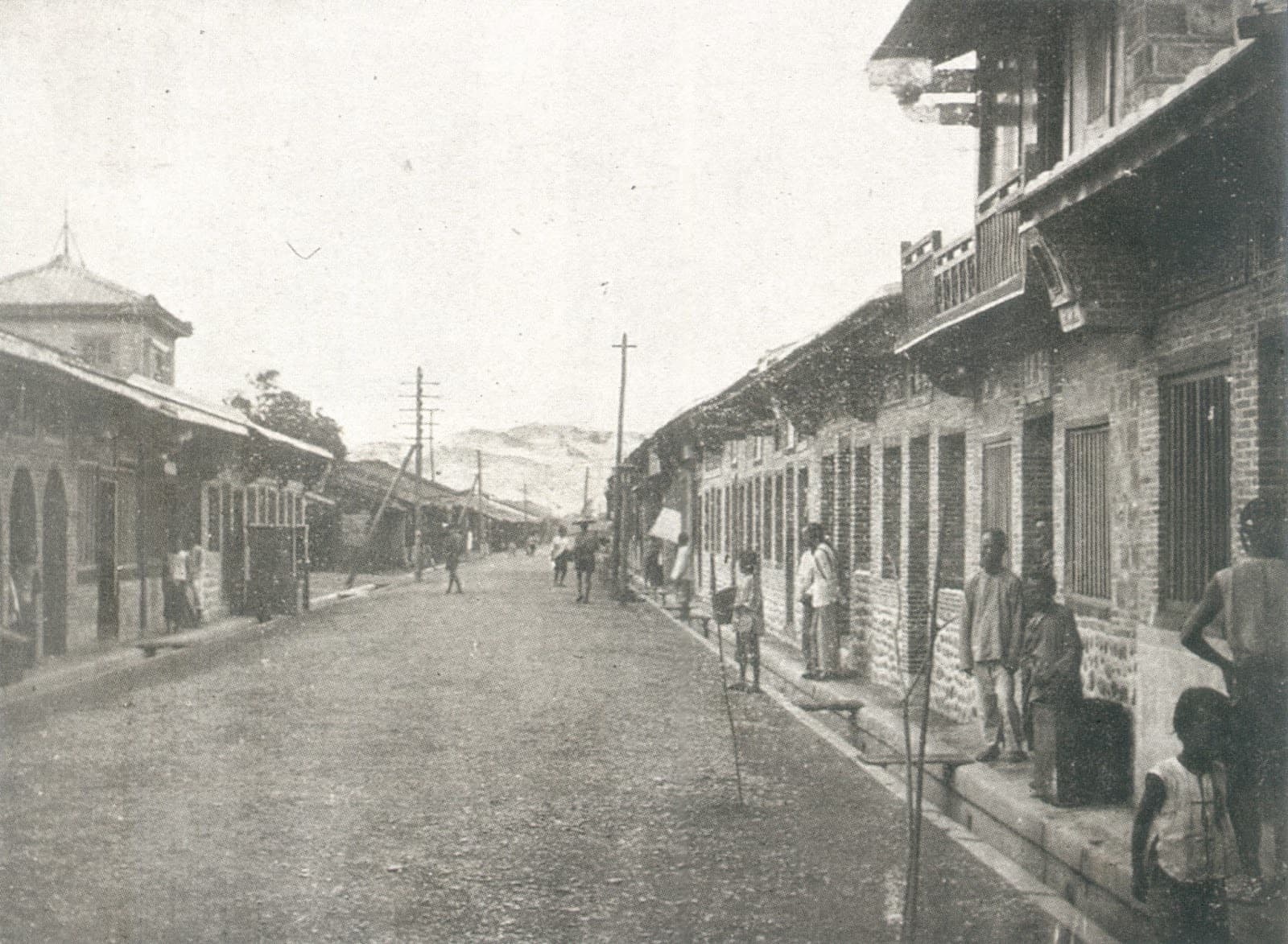
A street in Gilan around 1890. Wu Sha led settlers from Zhangzhou, Quanzhou and Guangdong into Kavalan in 1796 and threw up an earth stockade — the place that became Toucheng.
Public domain; photographer unknown
Isle of Time