


Crossing the Black Ditch
In the late seventeenth century along the Fujian and Guangdong coast, deciding whether to cross to Taiwan was a deadly gamble with one’s life as the stake.
The Qing Empire had just defeated the Kingdom of Tungning ruled by the Zheng family. Although Shi Lang persuaded the Kangxi Emperor to incorporate Taiwan into the empire, he soon drafted strict migration restrictions known as the “Taiwan Crossing Ban.” The government’s logic was simple: Taiwan was too distant and too chaotic. The safest approach was to isolate it through rigid population controls. Migrants were forbidden from bringing families, many Hakka from Guangdong were barred entirely, and anyone wishing to cross the sea needed an official travel permit issued by the authorities.
But frontier isolation policies could not overpower hunger. Inland Fujian and Guangdong were overcrowded, farmland was scarce, and famine struck repeatedly. For many poor villagers, staying home meant starvation anyway, while rumors painted Taiwan as a fertile land where hard work could buy survival. The economic pull was far stronger than fear of the law. As the scholar Lan Dingyuan observed, the harsher the prohibition became, the greater the profits hidden beneath it. Since legal permits were difficult to obtain, a vast underground smuggling network emerged instead. Naval patrol officers, corrupt officials, and ruthless traffickers formed a system built on shared interests, transporting fugitives and desperate unmarried laborers — later commonly called “Luohanjiao” — onto illegal boats bound for Taiwan.
The journey usually began in darkness. Under the shouts of traffickers, men climbed silently onto fragile wooden sampans in the middle of the night. To evade Qing naval patrols, captains often forced everyone into the cargo hold before departure, sealing the hatch shut with planks and iron locks.
Once the vessel began violently rocking, the suffocating hold quickly filled with the stench of sweat and vomit. Everyon…
Once the vessel began violently rocking, the suffocating hold quickly filled with the stench of sweat and vomit. Everyone understood they had entered the “Black Ditch” — the dangerous waters now known as the Taiwan Strait. The traveler Yu Yonghe described the region in Notes from a Journey Across the Sea as waters so dark and deep they terrified even experienced sailors. Under such extreme maritime conditions, illegal migrant ships were dangerously overcrowded and poorly equipped. Death by suffocation or disease was common. Worse still, if Qing patrols appeared during the voyage, traffickers sometimes threw entire groups of migrants into the sea to destroy evidence of illegal transport. This horrifying practice became known as “releasing the pigeons” or “water burial.”
In the midst of this collective trauma — where death could come at any moment — the migrants’ only comfort was the protection of the gods. In the darkness below deck, men clutched incense ashes and charms dedicated to Mazu or local Wangye deities, praying and crying together. Out of this intense fear of death, the Mazu faith, once centered mainly along the Fujian coast, became deeply rooted in Taiwan. Over time, she transformed from a regional sea goddess into one of Taiwan’s island-wide spiritual centers that transcended ancestral divisions.
After days trapped in a floating hell, survival itself felt miraculous. If the hatch was finally broken open and sunlight poured into the hold, it meant they had lived. One of the fortunate survivors was Lin Xiujun, who later helped develop areas around present-day Banqiao and Tucheng in northern Taiwan. After landing on Taiwan’s muddy shores, he leased land from Indigenous communities, organized reclamation enterprises, built irrigation systems such as the Daan Canal, and eventually rose to become a powerful local landholder.
Stories of successful settlers like Lin Xiujun spread back to the mainland, drawing wave after wave of young men willing to risk crossing the Black Ditch. As for those who lost the gamble — drowned at sea or left to die anonymously by the roadside — surviving migrants often buried them collectively out of mutual solidarity. Over time, these graves evolved into the countless shrines dedicated to wandering spirits found throughout Taiwan, such as temples honoring the “Youying Gong” or “Wan Shan Tong Gui.” Sociologically, these spirit cults functioned as psychological mechanisms that helped stabilize early immigrant society by comforting restless souls and easing communal fear.
This chapter of Taiwan’s migration history emerged from the tension between Qing isolation policies, the profits of smuggling networks, and the desperate survival instincts of ordinary people. The Taiwan Strait and the migration bans acted like a brutal filter. Cruel as they were, they also selected for settlers with extraordinary resilience and adaptability. These survivors, rooted in an unfamiliar land through blood, labor, and tightly bound local faith communities, gradually transformed the remote island once dismissed by the Kangxi Emperor into the prosperous and commercially vibrant society that Taiwan would later become.
A permit had to be applied for from the magistrate of one's home district, with a guarantor and proof of property. He had neither. What remained was to find a broker: half the silver paid up front, then aboard at a quiet stretch of shore at midnight, the hold packed with forty or fifty people. The channel they crossed was called the Black Ditch, its water dark and its current fast — three days with the wind behind you, and with the wind against you nobody could say. Once aboard, what you feared was not the weather but the boatmen. One practice was called setting free: the boat stopped at a sandbar near the coast and the passengers were driven off with the assurance that Taiwan lay just ahead, when it was a bar exposed only at low tide, and the rising water took all of them. Another was called flooding: when a boat leaked, people went over the side to lighten it. The saying at the time was that six died, three stayed and one turned back. Those who landed alive had no field, no wife and no household registration, and the official papers called them the bare sticks. Some won a plot of land in a few years; some laboured in the villages all their lives, and when they died their fellow villagers put together the money to bury them in the common graveyard.
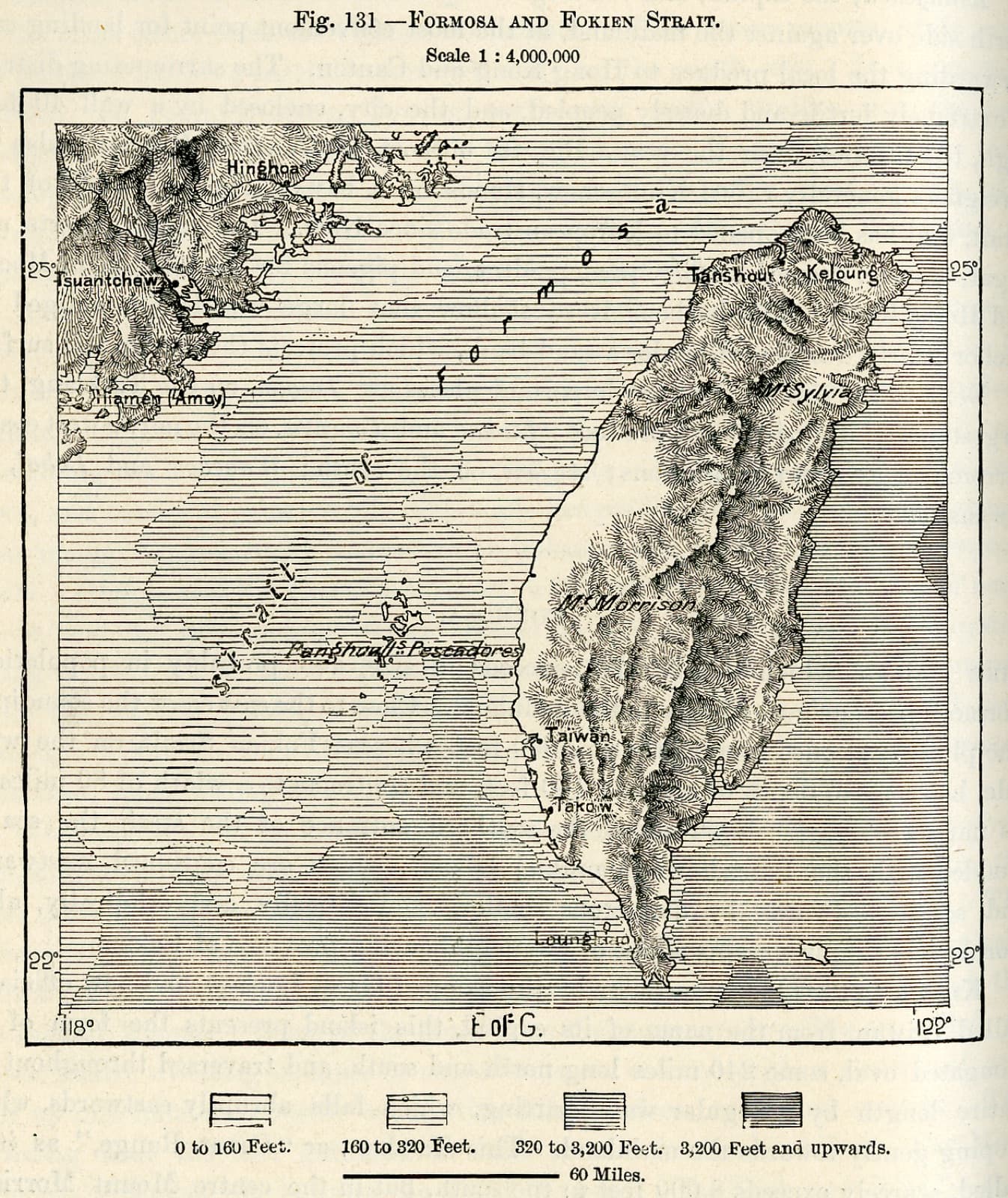
A chart of the strait between Fujian and Taiwan, 1884. From 1684 the Qing forbade migrants to bring their families; the ban was lifted and reimposed for more than a century, and those who crossed were mostly single men.
Élisée Reclus, *The Earth and Its Inhabitants: Asia*, vol. 2
Isle of Time