


Chiang Kai-shek's Diary
Chiang Kai-shek's diary is an invaluable primary source for studying post-war Taiwan history. In these private notes, we glimpse the national leader's true thoughts on Taiwan affairs — from his expectations for Taiwan's "retrocession," to his dissatisfaction with Chen Yi's governance, to his reflections and responses following the February 28 Incident.
The Chiang revealed in the diaries alternates between empathy for the Taiwanese people and the cold calculations of an a…
The Chiang revealed in the diaries alternates between empathy for the Taiwanese people and the cold calculations of an authoritarian ruler. These diary entries provide a unique window into the inner world of the decision-maker, revealing the logic of power behind historical tragedy.
This volume curates key Taiwan-related entries from Chiang Kai-shek's diary, accompanied by historical context, to reconstruct this critical period that determined Taiwan's fate.
In March 1947 Chiang Kai-shek was handling three things at once: civil war in north China, the aftermath of the constitution in Nanking, and an island acquired barely eighteen months earlier that had suddenly gone out of control. Taiwan therefore appears in the diary always as a square on a national board. On March 5 he decided to send the 21st Division; on the 7th, receiving Chen Yi's alarm, he wrote that mobs had seized the moment when the garrison was transferred away to gather and make demands; at the memorial-week address on the 10th he attributed the affair to Communist incitement and to gentry kept by the Japanese. From where he sat these judgments were coherent: what a regime at civil war fears is not protest but the loss of its rear. The same diary carries another hand as well. On March 13 he wired Chen Yi to forbid reprisals by military and civil personnel on pain of being charged with disobeying orders; on the 17th he sent Defense Minister Pai Chung-hsi to Taiwan to pacify and console; of Chen Yi himself he wrote that the man had misjudged his people and mishandled the affair, and never gave him Taiwan again. Sympathy and troop dispatch coexist without contradiction — in his logic, sending troops restored order and forbidding reprisals preserved legitimacy, two hands of a single statecraft. That is where the diary's value lies: it lets you watch a decision-maker hold local officials responsible and put an army on ships within four days, and see no inconsistency in himself.
Selected Entries from Chiang Kai-shek's Diary
October 25, 1945
The surrender ceremony in Taiwan was held successfully. Taiwan has been under foreign rule for over fifty years since the First Sino-Japanese War. Its retrocession today is truly a great national celebration. However, the takeover work is immensely complex and must be handled with utmost care.
April 1946
There are many shortcomings in Taiwan's administration. Chen Yi's personnel appointments are inappropriate, and economic controls have provoked public resentment. This should be reviewed and improved, but given the current focus on the mainland military situation, Taiwan affairs are difficult to attend to for now.
February 28, 1947
Severe unrest has erupted in Taipei. The cigarette monopoly crackdown bloodshed has triggered large-scale conflict. The severity of the situation exceeds expectations. Ordered Chen Yi to restore order immediately, but must not use excessive force.
March 2, 1947
The situation in Taiwan continues to deteriorate, with riots spreading to major cities. Taiwanese compatriots were deeply influenced by Japanese enslaving education, combined with Chen Yi's poor governance, leading to an explosion of public anger. Deeply pained by this.
March 5, 1947
The Taiwan incident grows increasingly complex. Local gentry have formed the "228 Incident Settlement Committee" demanding political reform. Some demands are reasonable, but ambitious agitators are exploiting the situation to attempt to overthrow the government.
March 8, 1947
Reinforcement troops have arrived in Keelung. Military action was unavoidable to restore social order. However, after suppression, we must show magnanimity and soothe the people's hearts, otherwise irreparable wounds will remain.
March 10, 1947
Order in Taiwan is gradually being restored, but reports of excessive killing by the military are deeply disturbing. Ordered strict investigation of military discipline and punishment of offending soldiers. The lesson of this incident is that governance must put the people first.
March 13, 1947
Decided to replace Chen Yi and appoint Wei Tao-ming as Chairman of the Taiwan Provincial Government. Chen Yi's maladministration caused this tragedy, and his responsibility is undeniable. Taiwan's administrative system should undergo comprehensive reform to demonstrate sincerity.
March 17, 1947
Post-incident relief work in Taiwan is urgent. Dispatching Bai Chongxi to Taiwan on a pacification mission, hoping to calm the people. Must deeply reflect on the root causes of this incident and improve governance policies toward Taiwan.
April 1947
The pain of the Taiwan incident must not be easily forgotten. Henceforth, governing Taiwan should be based on benevolence and respect for the feelings and interests of the local people. However, with the nation facing both internal and external crises, whether this intention can be carried through remains uncertain.
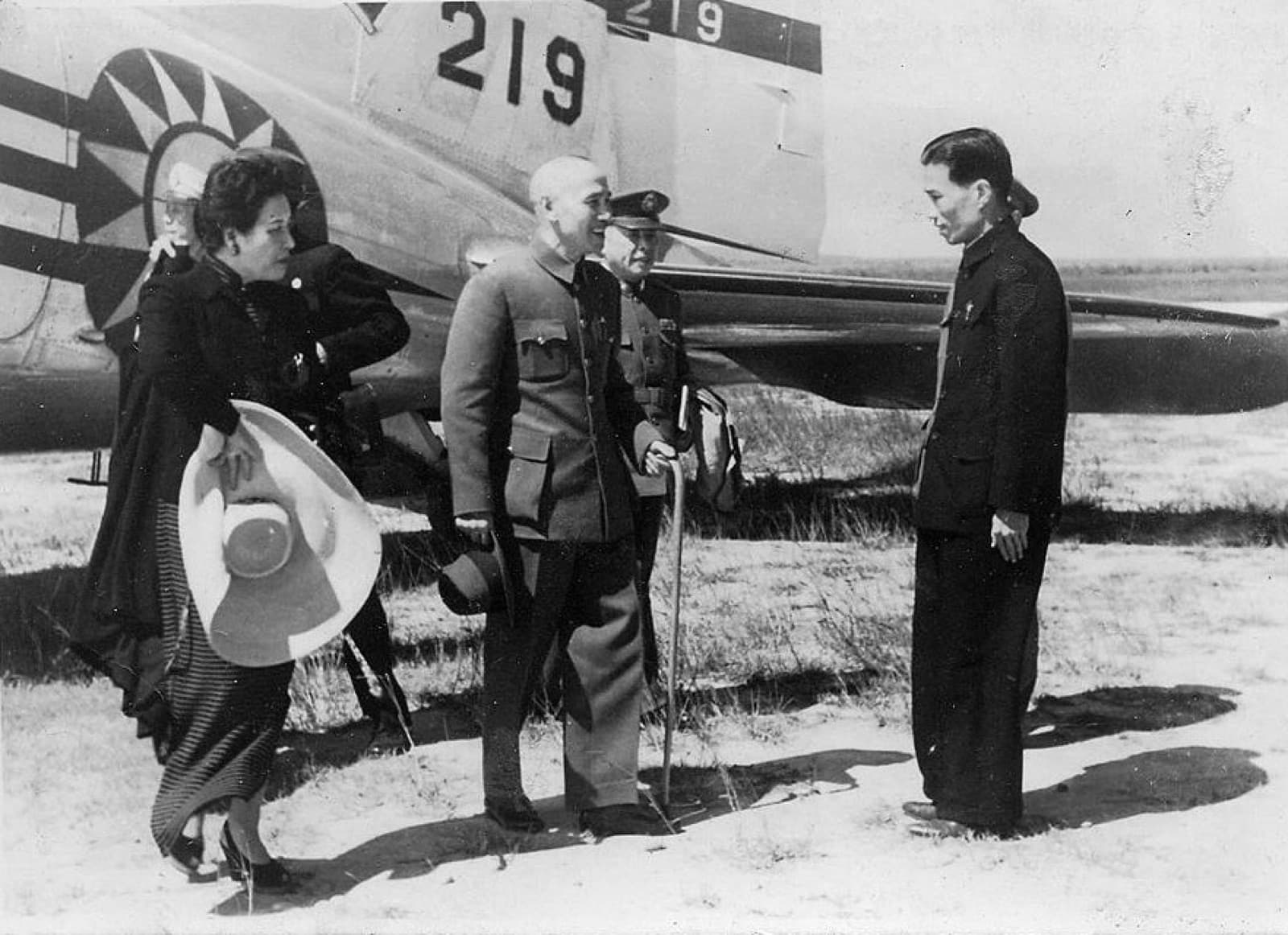
Chiang Kai-shek and Soong Mei-ling beside an air force C-47 in Taiwan, October 1946 — his first visit. His diary records both his hopes for the island and his irritation at Chen Yi's administration.
Photographer unknown; public domain
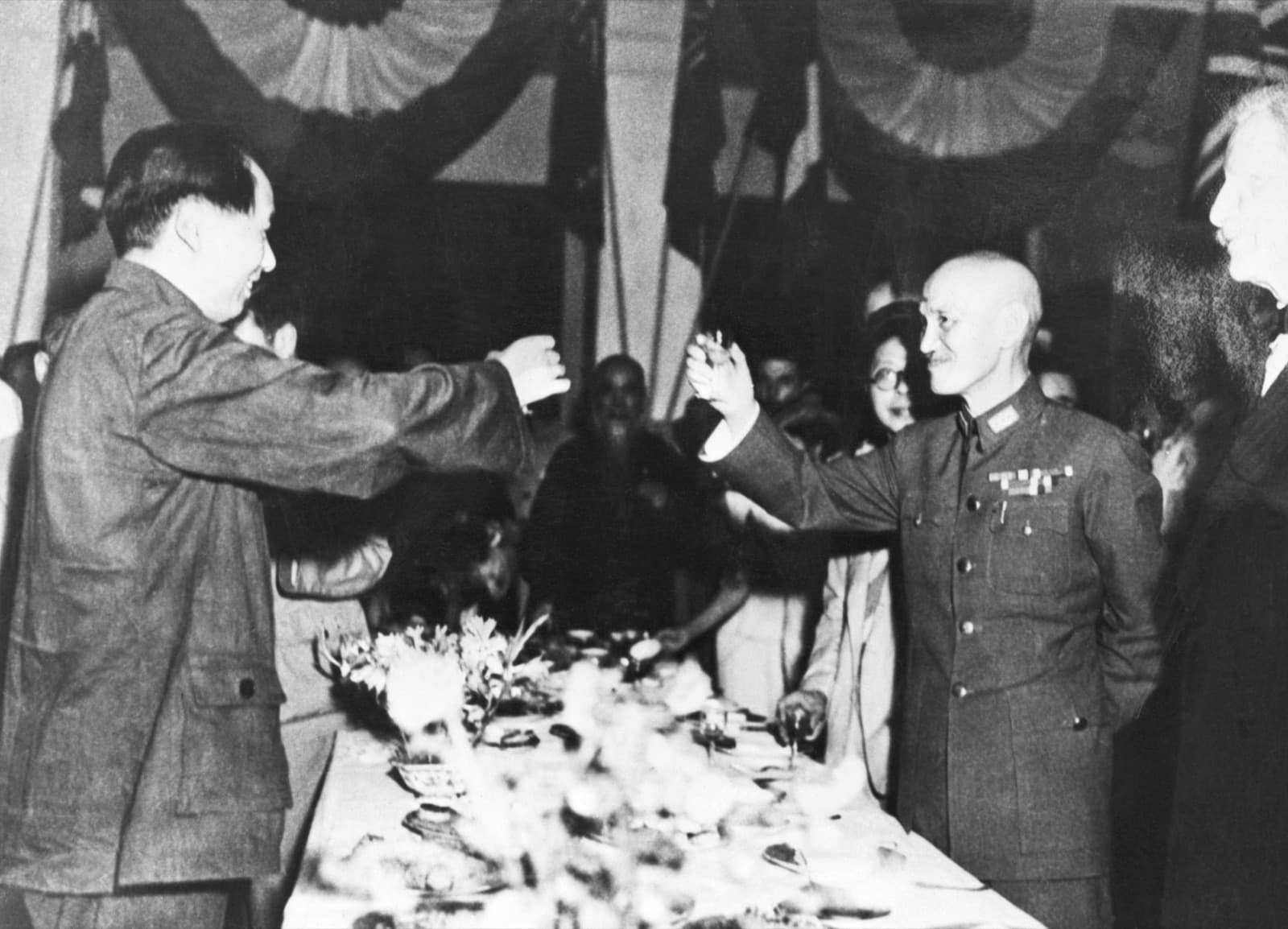
Chiang Kai-shek with Mao Zedong at Chongqing, 1945. Taiwan is never the subject of the diaries; the civil war is. In his field of view the island was a supply base for that larger war.
Photographer unknown; public domain
Isle of Time