


Wartime Mobilization
When full-scale war with China broke out in 1937, Taiwan's fate was utterly rewritten. No longer merely the colonial agricultural base of the Japanese empire, it was pushed forward as a frontline springboard for the 'southward advance' into Southeast Asia. Beginning with the last military Governor-General, Kobayashi Seizo, who proclaimed the threefold line of 'imperialization, industrialization, and use as a southward base,' the whole island was progressively remade into an indispensable part of the empire's war machine. The eighteenth Governor-General, Hasegawa Kiyoshi, who succeeded him in 1940, was the key figure who drove this line to its extreme. A Japanese navy admiral by background, he governed Taiwan in the crucial years when the Pacific War broke out in full, and in 1941 he founded the Kominhokokai (Imperial Subjects Public Service Association), enrolling the whole island's population from the top down in a service organization that mobilized manpower, materiel, and spiritual energy in support of the front. Compared with his predecessor he took a somewhat more conciliatory cultural stance, courting the Taiwanese gentry under the slogan of 'Japan and Taiwan as one' in an effort to win their full commitment to the war.
The human cost of mobilization was staggering. Beginning as 'military laborers' (軍伕) tasked with construction and logistics, Taiwanese men were progressively drawn deeper into the war. From 1942, the colonial government introduced a volunteer-soldier system for Taiwanese, recruiting army and then navy volunteers — later turned into outright conscription — and sending Taiwanese youth to the battlefields of the South Seas. Over 200,000 Taiwanese served in the Japanese military across the Pacific theater, from the jungles of Burma and New Guinea to the Philippines and Hainan Island, and more than 30,000 never returned. Thousands of indigenous youth were enrolled as 'Takasago Volunteers' (高砂義勇隊), prized for their jungle survival skills and deployed in some of the war's most brutal campaigns. The Amis man Suniuo from Taitung — known by the Japanese name Nakamura Teruo and the postwar Chinese name Li Kuang-hui — embodied this most symbolic tragedy: sent with the Takasago Volunteers to the Indonesian island of Morotai in 1943, he became separated from his unit when the war ended and survived alone in the jungle for nearly thirty years, only to be discovered in 1974, stunning the world and standing as an epitome of the Taiwanese soldiers who were mobilized and then forgotten.
The war also penetrated the realms of spirit and culture. The Imperial Subjects Public Service Association drove wartime mobilization into every household and village: people were required to worship at Shinto shrines, to revere the Emperor's official portrait, and to set up a 'kamidana' household altar; schools enforced the everyday use of the 'national language' (Japanese), encouraged people to adopt Japanese surnames, and rewarded model 'national-language families.' Students were organized into 'student soldiers' and labor service corps, boy workers were recruited to travel to Japan's military factories to build aircraft, and women were enrolled in the 'Patriotic Women's Association' to sew uniforms, donate gold ornaments, and see departing soldiers off to the front. Amid this layered penetration, the war was no longer merely a distant battlefield but the whole of daily life. In 1938, the Atayal girl Sayun of Yilan slipped and drowned while helping to escort her departing Japanese teacher to the front; what had been a simple mountain accident was embellished by the Governor-General's Office into a moving legend of a 'patriotic maiden' devoting herself to the nation, honored during Hasegawa Kiyoshi's tenure with the presentation of the 'Bell of Sayun' and turned into a representative case of wartime mobilization propaganda. In 1943, Li Xianglan (whose real name was Yamaguchi Yoshiko), a film superstar famous across China, Japan, and Manchukuo, starred in the state-policy film The Bell of Sayun, adapted from Sayun's story; with her sweet image and singing she carried this mythologized tale across the whole of East Asia, making film and stars too a part of the empire's propaganda machine.
The burden of the wartime economy likewise fell on Taiwanese shoulders. An agriculture once centered on the export of ca…
The burden of the wartime economy likewise fell on Taiwanese shoulders. An agriculture once centered on the export of cane sugar and rice was forcibly redirected toward military production; sugar mills, salt fields, and mines were absorbed into a controlled economy, with goods, labor, and capital all marshaled by the Governor-General's Office. Under the slogan of 'increase production to repay the nation,' the rationing system grew ever harsher, and people queued for rice, sugar, cloth, and fuel as the shadows of the black market and hunger gradually settled over the island. The war also left women with wounds that are hard to speak of — some Taiwanese women were sent overseas through deception or coercion to serve as 'comfort women' for the Japanese military, a history long buried in silence and only bravely uncovered by survivors decades after the war. For many Taiwanese families, wartime mobilization meant fathers and brothers who never came home, youth that was conscripted away, and homes reduced to ashes in air raids.
On the home front, Taiwan's factories were converted to produce munitions, aircraft parts, and fuel. Its airfields launched bombing sorties against Allied positions. Food rationing grew severe as agricultural output was requisitioned for the military. In 1944–1945, Allied bombing raids devastated Taipei, Taichung, Kaohsiung, and other major cities, destroying infrastructure that had taken decades to build. When Emperor Hirohito announced Japan's surrender on August 15, 1945, Taiwan entered an uncertain interregnum — its people exhausted by war, its cities in ruins, and its future about to be decided by powers that understood little of the island's complex colonial experience.
What wartime mobilization left behind was a collective memory full of contradiction and trauma. Hasegawa Kiyoshi won cooperation through conciliation, Sayun was molded into a patriotic maiden, Li Xianglan lent her songs to the empire's propaganda, and Suniuo walked alone through nearly thirty years in the jungle — one and the same era, yet refracting the utterly different fates of the ruler, the propaganda machine, and the mobilized. After the war, these Taiwanese soldiers of the Japanese army, conscripted laborers, and wounded women were often forgotten amid the change of regimes, their sacrifices neither acknowledged by the old empire nor easily tolerated by the newly arriving power. Wartime mobilization was not merely a single page in Taiwan's being swept into the Pacific War; it laid bare, more profoundly, the helplessness of a colony under the empire's war regime, and the countless individual stories that were jostled by the tides of history yet long kept silent.
The terms of recruitment were attractive: boys who had finished or were still in higher elementary school would work at a naval arsenal in Japan, study part-time, and after three years hold a technical school qualification. From 1943 some eight thousand four hundred Taiwanese boys sailed, the youngest thirteen, most of them fifteen or sixteen. Their destination was the Kōza naval arsenal at Zama in Kanagawa, riveting fuselages and machining parts for the Raiden fighter. What the schooling amounted to became clear on arrival: ten hours of work a day, classes in the evening, dormitories without heating in winter, and soybean residue mixed into the ration. From 1945 the air raids came often and the plant was dispersed; some died in bombing, others of malnutrition and tuberculosis, and the final count of the dead ran past sixty. The war ended with them in a foreign country and repatriation dragged on into 1946. Those who reached Taiwan found their qualifications unrecognized and their Japanese something to be put away. Their reunion association did not meet openly until the 1980s.
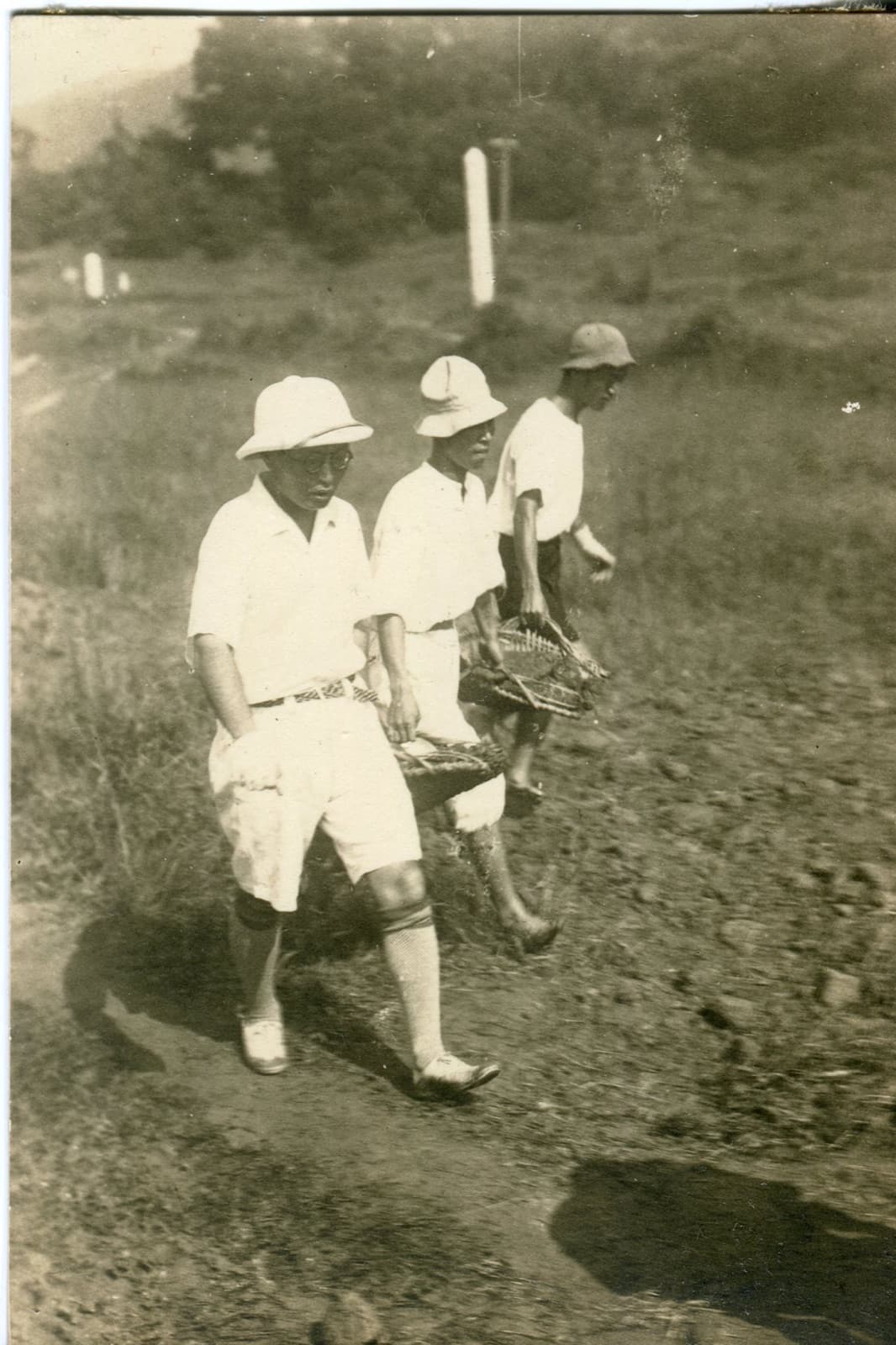
Students of Taihoku High School on wartime labour service, 1940. Timetables in secondary schools and above were cut through with labour and drill, and pupils were folded into production and air defence.
Public domain; photographer unknown
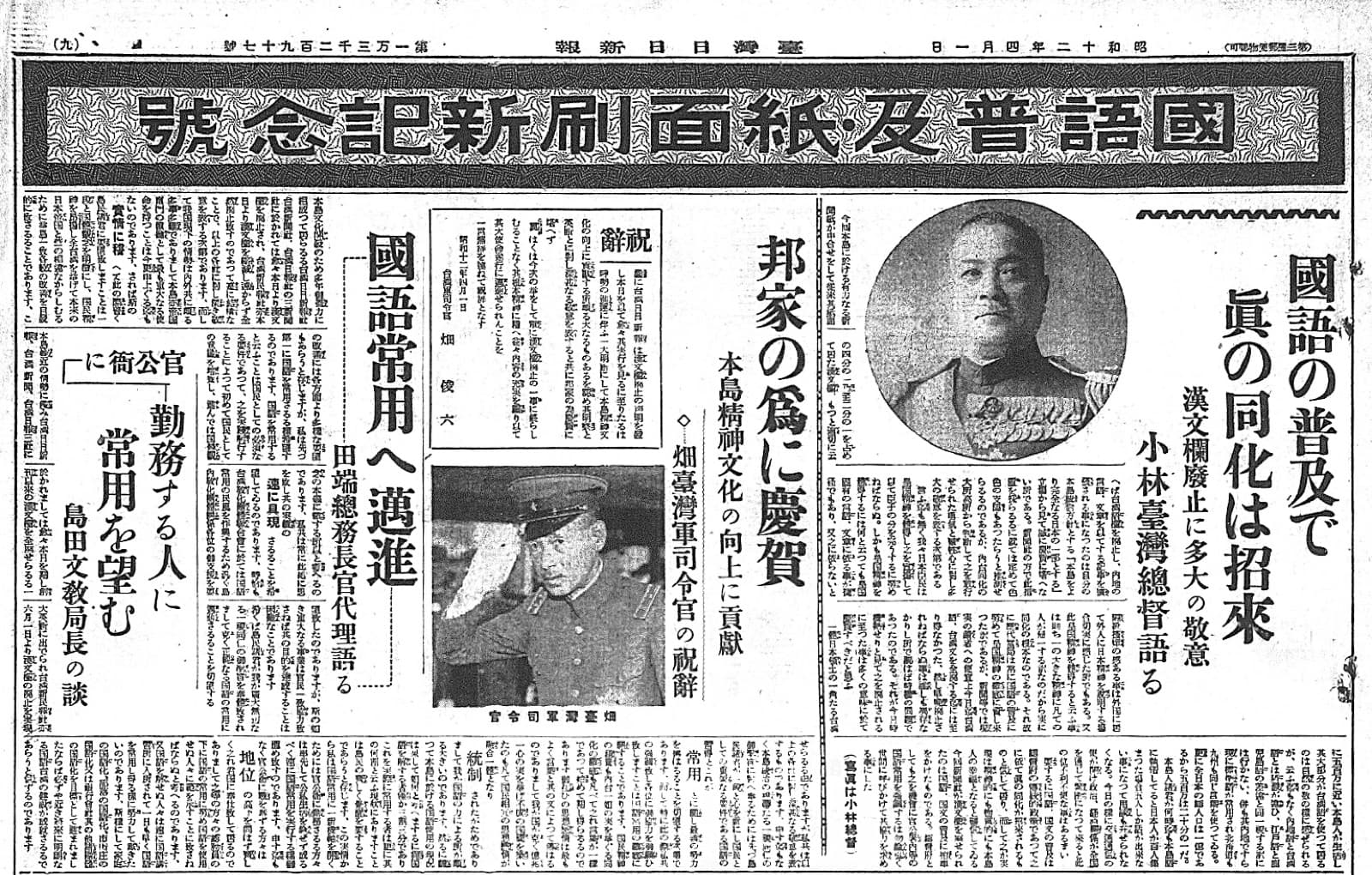
A Japanese-language newspaper page from Taiwan, 1937. After full war with China broke out, censorship tightened on the island and the press became part of the mobilisation apparatus.
Taiwan Memory Expedition archive
Isle of Time