

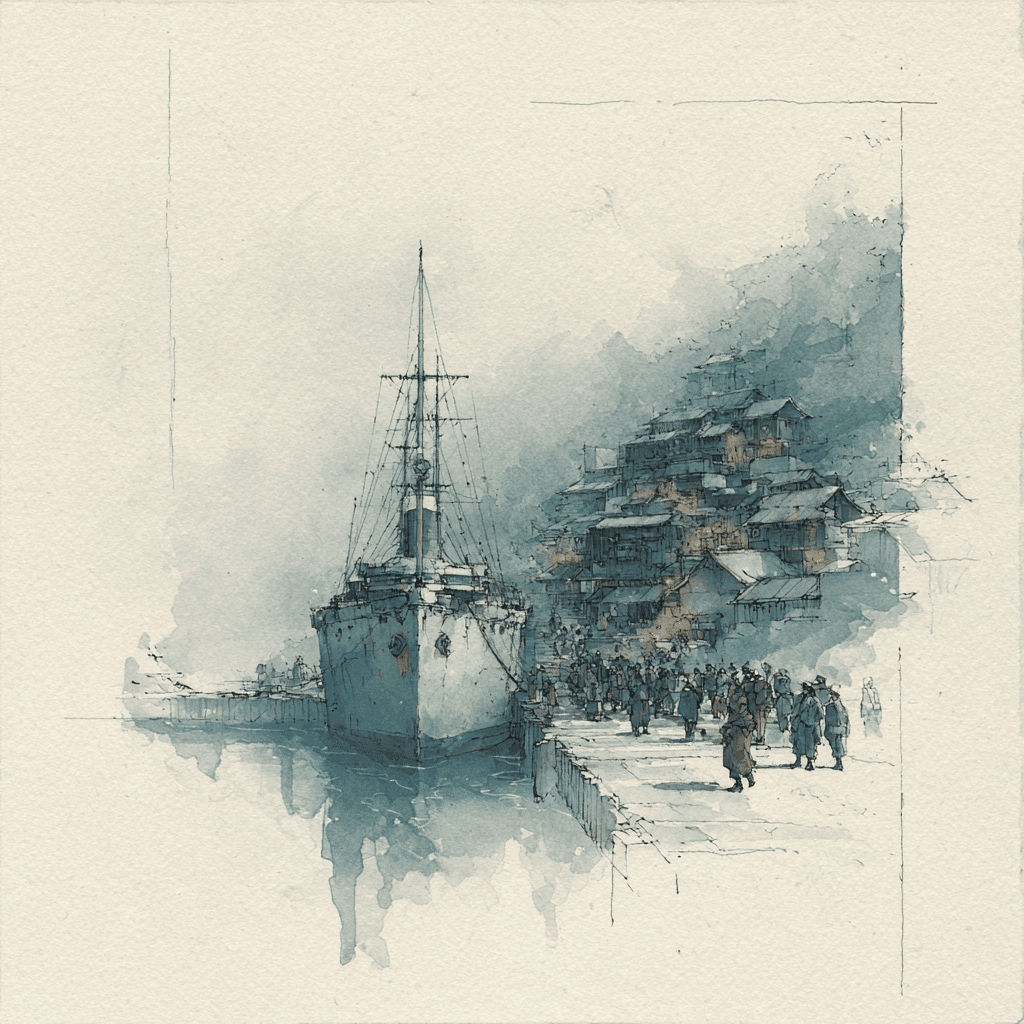
March at the Port of Keelung
On the afternoon of 8 March 1947 the ships of the reorganised 21st Division came alongside at the Port of Keelung. These were the reinforcements Chen Yi had asked Nanjing for; they had sailed from Shanghai and were two days out. In the ten days before, the clash in Taipei had spread into settlement committees and armed standoffs across the island. In the ten days after, the membership lists of those committees became the lists for the arrests.
Keelung was the first port. The troops began firing as they came off the wharf, and no reason had to be given on the spot. There were crowds in the harbour district: dock workers, passengers waiting for sailings, students who had come back down from Taipei. The eyewitness accounts do not agree in every detail. What they share is this: the shooting happened on the wharves, the bodies went into the water, and the sea pushed some of them back to the shore.
The passage most often quoted is by the American vice-consul George Kerr, who set down Keelung in March in his despatches and later in his book: bodies afloat, and men tied together. Taiwanese oral accounts supply further detail — wire run through the palms of the hands to string several men into a line, then pushed off the quay. These accounts cannot be checked one against another, and no official document has ever conceded them.
Among the dead with names attached, the best documented is Yang Yuan-ting, deputy speaker of the Keelung municipal counc…
Among the dead with names attached, the best documented is Yang Yuan-ting, deputy speaker of the Keelung municipal council. He had spent the days of the incident going between the parties and pressing for the release of arrested townspeople. He was taken away around 10 March and his body was recovered at the harbour's edge. He was thirty-nine.
Shih Hung-hsi, commandant of the Keelung fortress, held the harbour district and the town. After 8 March came martial law, the village sweeps and the household checks, one after another; Keelung Middle School, the harbour bureau and the municipal council were all on the lists. By the middle of March resistance in Keelung was finished. What continued for months afterwards was arrests.
The telling of the February incident has long been centred on Taipei: the monopoly bureau, the Tianma tea house, the office of the administrator-general, the park. That is where the thing began. What decided how it ended was the ports — the suppression started wherever the reinforcements came ashore. Keelung, Kaohsiung and Tainan each went through their own version of it in the second week of March. What differs is how much of the record survived.
The harbour is still the most conspicuous thing in Keelung, and cruise ships tie up where the troopships did. There is a memorial at the quayside. It carries no death toll, because nobody can arrive at one.
The dock workers had not come to protest, they had come to work. The ships entered on the afternoon of 8 March and the quayside had on it, as on any day, men waiting to unload, passengers waiting to sail, stalls selling food. The troops coming ashore did not clear the ground first. After the first volley those who could run made for the warehouses and the alleys, and those who could not stayed where they were. Over the following days things came up on the water, and the tide carried them in among the rocks along the shore, and the families identified them by their clothes. Keelung people telling this generally do not use the word massacre. They say the eighth of March, and then they stop.
Isle of Time