


The Sinckan Script
In the early seventeenth century, the plains of Taiwan had no written language.
At least, not in the sense understood by the outside world.
For the Siraya people who lived there, language was alive—but it lived only in speech. They had stories, myths, and histories of their own. Elders gathered around night fires to recount how their ancestors survived great floods. Hunters passed down knowledge of forests and rivers to the young. Ritual specialists remembered the songs and prayers of every ceremony.
But all of it existed only in memory.
When the speaker died, part of history vanished with them.
In the 1630s, the Dutch arrived from a distant continent on the other side of the world.
For the Dutch East India Company, religion was never the primary mission. Trade and governance came first. Yet colonial officials soon discovered that ruling dozens of Indigenous communities required more than weapons and ships. They needed communication. They needed law. They needed contracts that could be understood beyond spoken negotiation.
And so, missionaries were sent to Sinckan village.
Sinckan—located in the heart of what is now the Tainan plains—was one of the most important Siraya settlements of the time. Its population was large, and its relationship with the Dutch was relatively cooperative. It became the center of early missionary activity.
At first, communication between the two worlds resembled an extended guessing game.
The missionaries pointed toward the sky and asked what it was called.
The Siraya responded.
They pointed at rivers, trees, birds, and the sun.
Day after day. Year after year.
Slowly, almost imperceptibly, something unprecedented began to take shape.
It was as if a writing system was being born from nothing.
The missionaries discovered that the Latin alphabet could be adapted to represent most of the sounds of the Siraya language. From this realization came dictionaries, catechisms, and teaching materials. Children were brought into mission schools, sitting on rough wooden benches, learning for the first time how to place their spoken language onto paper.
It was an extraordinary scene.
European letters—shaped by centuries of Old World history—were now being used to capture the voice of Taiwan’s Indigenous language.
At the time, few could have realized what was happening.
But this became the first large-scale written record of a native language in Taiwan’s history.
Soon, a small group of literate Siraya speakers emerged in Sinckan.
They learned to write their names on paper, to record transactions, and to read religious texts written in their own language. For many, it felt like a form of magic. What had once existed only in oral tradition could now survive across time, preserved in ink.
The Dutch were satisfied.…
The Dutch were satisfied.
Literacy made governance easier. Written language created intermediaries between colonial authority and Indigenous society. It made administration more stable, more predictable, more controllable.
But history is rarely so obedient.
In 1662, Koxinga captured Fort Zeelandia and expelled the Dutch from Taiwan. Missionaries left the island. Churches fell silent. Schools disappeared. By all logic, the Sinckan script should have vanished alongside colonial rule.
It did not.
For more than a century after the Dutch departure, Siraya communities continued to use this writing system.
They wrote contracts in Sinckan script.
They recorded land transactions.
They documented debts and repayments.
They managed family inheritances.
In documents unreadable to Qing officials, they inscribed their language line by line, preserving a legal and cultural world of their own.
Even into the nineteenth century, such manuscripts continued to appear.
When historians later examined these faded pages, they found something astonishing.
The Dutch empire had long vanished from the island—but the writing system it introduced remained alive.
The alphabet no longer belonged to its creators.
It had become something else entirely.
It had become Siraya writing.
Today, we call it the Sinckan Manuscripts.
It is not only the earliest extensively preserved writing system of Taiwan’s Indigenous languages—it is also one of the most unusual survivals in the island’s history.
A group of European missionaries created a tool to translate an oral world into text.
And in the end, it was the very people once subjected to colonial rule who preserved it, expanded it, and carried it forward long after the empire that introduced it had disappeared.
Empires fade. Fortresses collapse. Governments change.
But sometimes, a page filled with borrowed letters outlives every power that ever tried to control it.
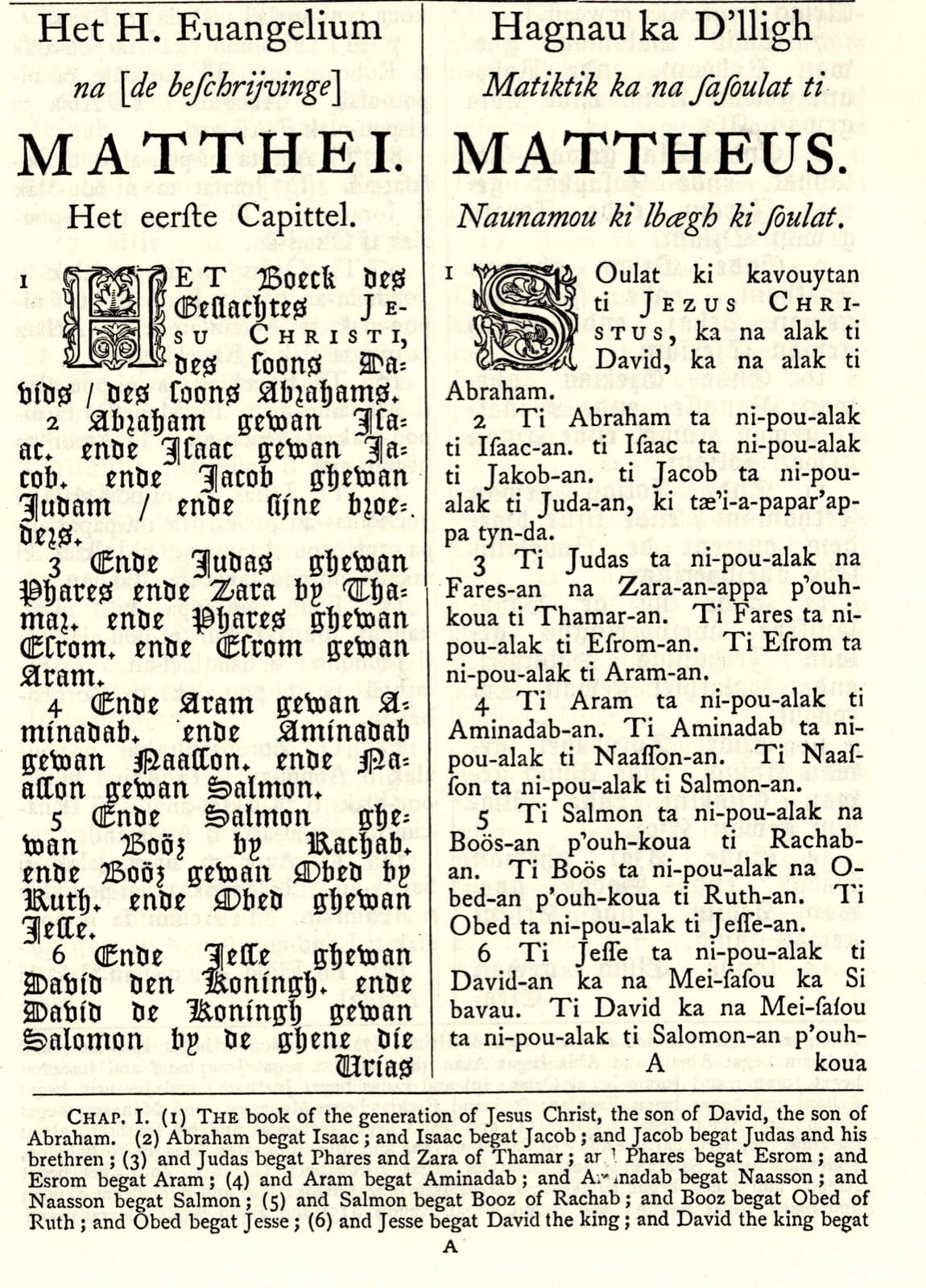
The Gospel of Matthew in parallel columns of Sinckan and Dutch. Daniel Gravius had it printed in 1661, spelling Siraya in roman letters — the first Austronesian language written down. This is William Campbell's 1888 reprint.
Reprinted by William Campbell, 1888
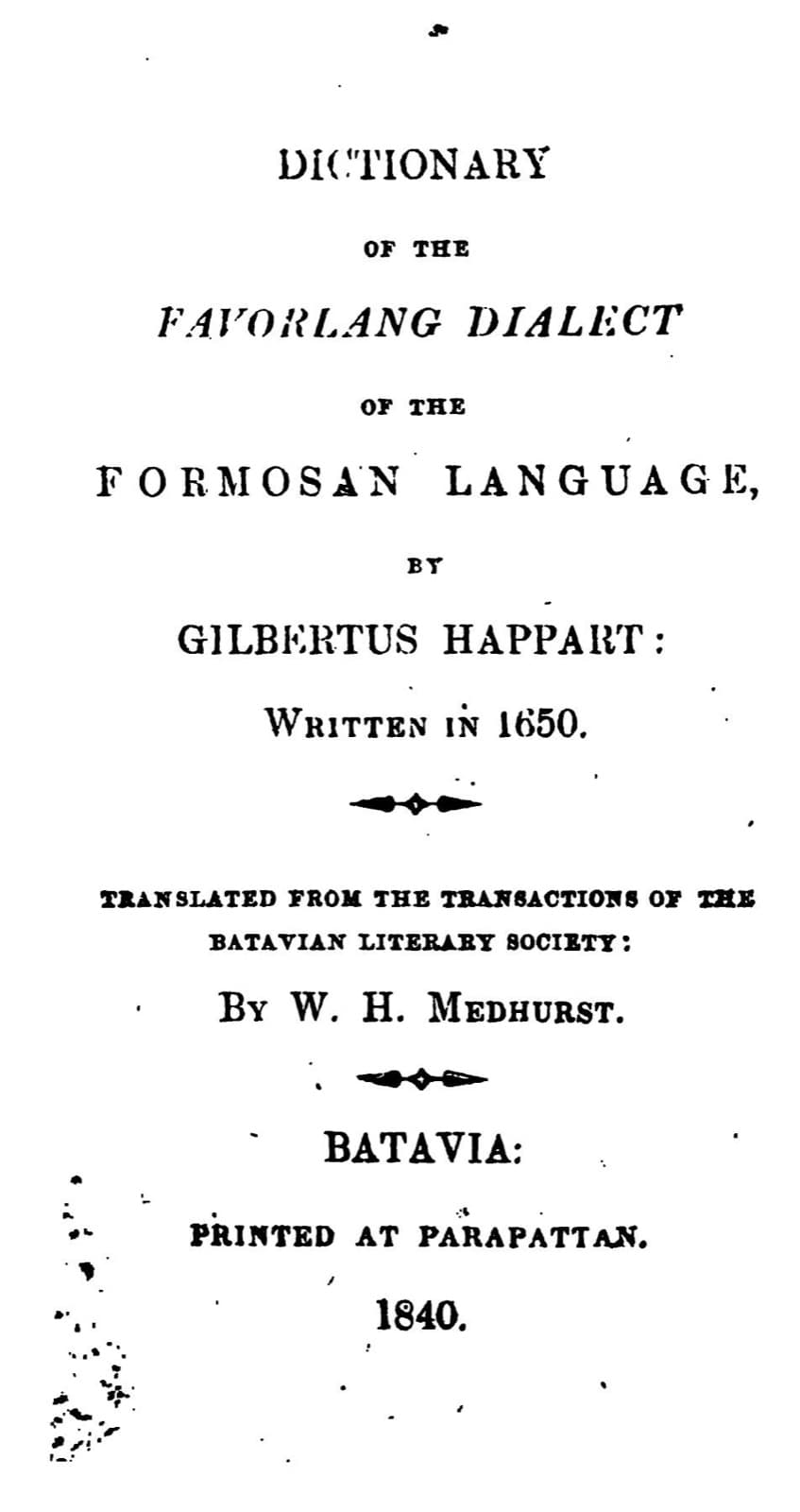
The title page of a Favorlang dictionary, compiled by the Dutch minister Gilbertus Happart around 1650 in what is now Yunlin and not printed until Medhurst published it in Batavia 190 years later. By then no one spoke it.
Compiled by Gilbertus Happart; published by W. H. Medhurst, Batavia, 1840
Isle of Time