

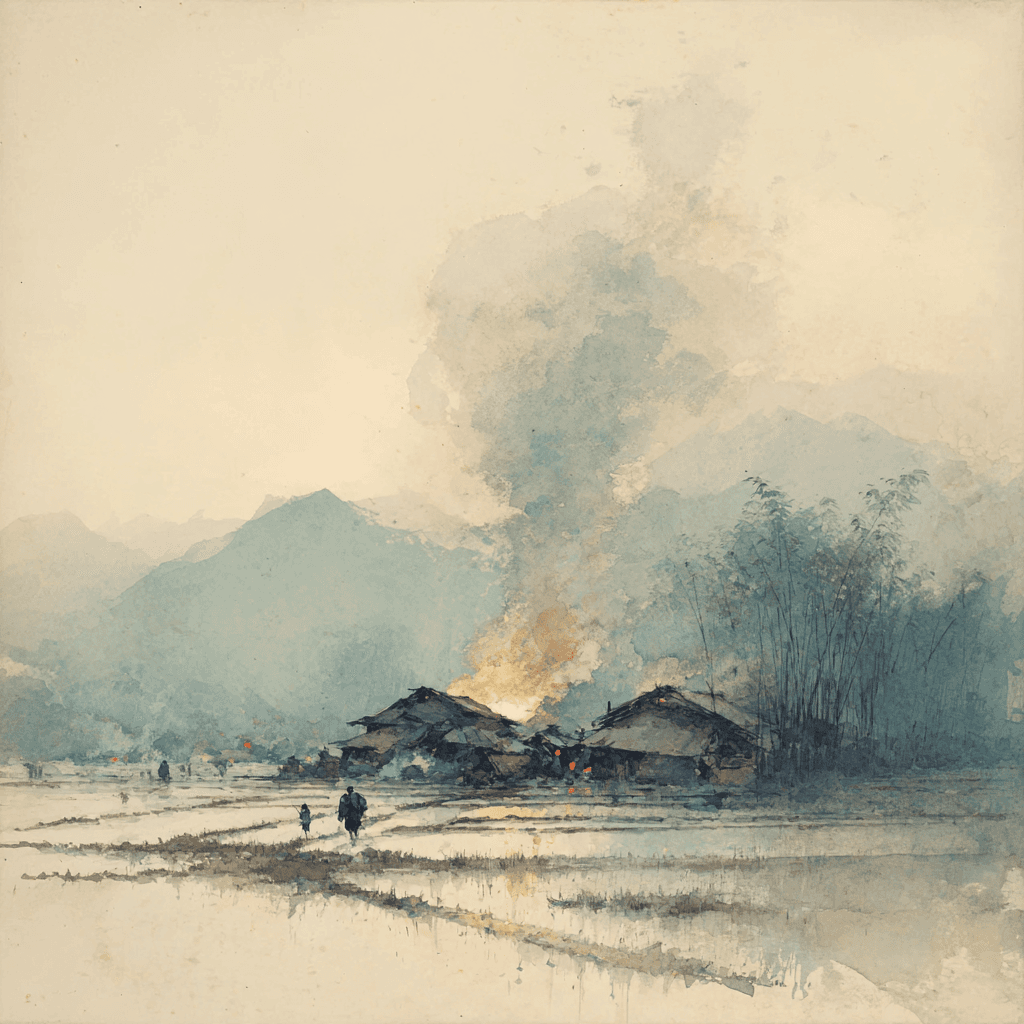
The Yunlin Massacre
Between June 19 and June 22, 1896, Japanese troops burned their way through the villages of Yunlin, one settlement at a time. The Governor-General's own tally afterwards was 4,925 houses in 56 settlements; another report put it at 4,947 in 55. The area covered what are now Douliu, Dounan, Gukeng, Dapi, Citong and Linnei, along with Zhushan across the Zhuoshui River in Nantou. The worst hit was Angukeng, where 505 households burned.
It had begun a year earlier. After the battle of Baguashan in August 1895, the militia of central Taiwan scattered into the hills with their guns. Dapingding, in the mountains east of Yunlin, was one of the places they gathered: steep country, reachable by only a few paths. Jian Yi, from Meikeng, was among the first leaders to go up. Ke Tie, from Angukeng, was twenty that year and known as Tiehu, the Iron Tiger. On June 14, 1896, Jian Yi set out offerings on the mountain and made sacrifice to heaven, declared the reign name Tianyun, raised a banner reading "serving the Qing, campaigning against the Japanese," took the title of Nine Thousand Years, and renamed Dapingding Tieguoshan — Iron Country Mountain, hard as iron, not to be taken. More than a thousand men came up to join him.
In mid-June, patrols of the Japanese Second Brigade were ambushed repeatedly inside Yunlin, and Lieutenant Nakamura Michiaki was killed. The regiment garrisoned at Taichung moved out. Matsumura Yunoshin, head of the Yunlin subprefecture, left behind a sentence that has been quoted ever since: there are no good civilians within Yunlin's jurisdiction. The sentence did administrative work. It cancelled the duty to distinguish, and made the whole subprefecture a field of operations.
For four days the troops worked their way from village to village, burning and killing. Japanese accounts did not hide i…
For four days the troops worked their way from village to village, burning and killing. Japanese accounts did not hide it: wherever the campaign reached, there was a mountain of flesh and a river of blood, no distinction between civilian and bandit, between the guilty and the innocent. There is still no reliable death toll. One later Japanese study gives 6,000; Imamura Heizo, who marched with the troops, wrote of more than ten thousand in his diary; the local historian Liu Chih-wan estimated over thirty thousand. Takano Takenori, chief justice of the colony's High Court, investigated in person and reported more than seventy villages and over three hundred unarmed people killed, along with a long record of rapes.
The news left the island by way of Hong Kong. On July 4 the China Mail reported that the troops had "burned down dozens of villages and butchered the inoffensive inhabitants," and The Times of London followed. The timing was bad for Japan. Military rule in Taiwan had ended only that April 1, replaced by civil administration, and the Anglo-Japanese Treaty of Commerce and Navigation signed in 1894 would not take effect until 1899; Japan was still proving to the powers that it belonged among the civilized states. On September 2, Matsumura was dismissed and stripped of his decorations. The following March, the incoming governor-general Nogi Maresuke petitioned to have his rank restored; he was later posted to Hokkaido.
The Governor-General's Office then did two things. It removed the name Yunlin from the administrative map, replacing it with Douliu. And it changed method: in 1898 Kodama Gentaro and Goto Shinpei took office and issued, in the same year, the Hoko household-registration ordinance and the Bandit Punishment Ordinance, trading armed sweeps for registration, collective liability and induced surrender. Ke Tie came down on March 23, 1899 and accepted terms that did not require him to disarm — he still held 600 rifles and 30,000 rounds. He died of illness on February 9, 1900, aged twenty-four.
At nine in the morning on May 25, 1902, surrender ceremonies were held simultaneously at six places: Douliu, Linqipu, Kantoucuo, Tuku, Talibu and Xiahukou. The 266 men who came were leaders and followers who had given up their weapons, and the subprefecture heads presided. When the ceremonies ended, machine guns were turned on the halls. Two hundred sixty-five died on the spot. The one survivor was Jian Shuishou, who had left early — after Ke Tie's death, Tieguoshan had passed to him.
He was twenty when he went up the mountain, a farmer's son from Angukeng. Guns left behind by the collapsing Qing garrisons of 1895 were scattered across central Taiwan, and whoever picked one up was a man with a gun; the arsenal at Dapingding was jingals and matchlocks plus those salvaged rifles. He stood by at Jian Yi's sacrifice on June 14, 1896. The reign name, the banner, the title of Nine Thousand Years — all of it was Jian Yi's protocol, the same protocol Taiwanese uprisings had used for two hundred years. What was different this time was the adversary: an army fresh from the war with China. In Japanese documents he has no name, only a category: bandit. In November 1897 he gathered five hundred men again on Chukou Mountain, and on December 11 the army brought in garrisons from Yunlin, Chiayi and Taitung with an artillery detachment to take it. On March 23, 1899 he accepted terms and came down, and the terms did not require disarmament — 600 rifles and 30,000 rounds remained on the mountain, the Governor-General's Office knew it, and signed anyway. That was the arithmetic of induced surrender: leaving him his guns cost less than another campaign. He died of illness on February 9 the following year, aged twenty-four, ten and a half months after coming down.
Isle of Time