


Awakening the Taiwanese Soul
In the Taiwan of the 1920s, as the armed resistance and outlaw legends of the dark night fell silent one after another under Japanese police pressure, a different revolution erupted — one without bloodshed, without weapons, yet striking far deeper at the heart of imperial rule. This "revolution of identity" exploded into the streets of Dadaocheng and the scent of tea. It was a golden age of global ideological currents, in which the Taiwanese subjective consciousness finally opened its eyes after a long dark night. Taiwan had stepped out of the wild disorder of the Qing era, only to fall into institutional discrimination as "second-class subjects" under the Government-General.
The storm-center of this spiritual awakening was led by two historical giants of radically different character and origin who came together for a shared ideal. One was Lin Hsien-tang, master of the "Wufeng Lin family," scholarly and grave in bearing — Taiwan's most prestigious magnate, the embodiment of the warmth and stability of the traditional Taiwanese gentry. The other was Chiang Wei-shui, a fiery young doctor from Yilan who had opened the "Da-an Hospital" in Dadaocheng. His eyes burned, his words cut, and through his veins ran the rebellious revolutionary blood of the grassroots.
When the two met in Taipei, they sensed sharply that against a Japanese empire armed with modern aircraft and cannon, mere physical violence was useless sacrifice. If the Taiwanese were ever to rise, the only true battlefield was not in the mountains and forests, but in the mind. The Qing officials who had fled in shame in 1895 had left the Taiwanese no dignity. This time, the Taiwanese would reclaim sovereignty through their own knowledge. On 17 October 1921, Lin Hsien-tang and Chiang Wei-shui called together a thousand impassioned intellectuals and young students from across the island and formally founded the "Taiwan Cultural Association" in Dadaocheng, Taipei.
For this cultural enlightenment movement, Chiang Wei-shui composed a famous medical diagnosis that history would never forget — the "Clinical Lecture." In this peculiar piece of writing, Chiang treated "Taiwan" as his patient, diagnosing the island with acute "intellectual malnutrition." The only prescription he wrote was not drugs or a scalpel, but "education, newspapers, libraries, cultural lectures, and reading societies." He cried out that only by lifting the level of Taiwanese knowledge could the island's soul finally stand on its own feet.
The climax of this struggle was the miracle that quickly followed: "cultural lectures" and "reading societies" lit up like stars across Taiwan's horizon.
The young students of the Cultural Association walked the towns and villages of western Taiwan on foot through blazing sun and bitter wind. At temple gateways, beneath great trees, on grain-drying yards — wherever sunset arrived, they would drag a few benches over, hang a single oil lamp, and call out loudly to the Taiwanese farmers and laborers who had bled and sweated in the fields all their lives. Standing on benches, they spoke in the most down-to-earth Hokkien and Hakka, explaining with fierce passion to the illiterate poor what world human rights were, what freedom and equality meant, and why the Taiwanese should never accept being second-class slaves on their own soil.
This sweeping spiritual baptism touched every raw nerve of the Government-General's authoritarian system. The Tokkō (Spe…
This sweeping spiritual baptism touched every raw nerve of the Government-General's authoritarian system. The Tokkō (Special Higher Police) began trailing every lecture as if by shadow. In black uniforms with police sabers at the hip, they sat sullenly in the front row with notebooks in hand. Whenever a speaker reached an impassioned passage and mentioned "freedom" or "the rights of the Taiwanese," the Japanese officers would leap to their feet, shouting in shrill, severe Japanese: "Surveillance! Unstable! Stop!"
But this did not frighten the impassioned Taiwanese — instead it gave rise to scenes of dark, witty humor. Each time the police shouted "Stop!," the crowd, far from dispersing, erupted in thunderous applause and laughter. The speaker would smile faintly, deftly switch to a near-synonymous tongue-twister of a topic, and keep dancing along the legal tightrope just out of the officers' grasp.
Meanwhile, from the rear, Lin Hsien-tang used his vast wealth and prestige to launch the more-than-a-decade-long "Petition Movement for the Establishment of a Taiwanese Parliament." A group of Taiwanese intellectuals donned Western suits and top hats, carried petitions bearing the signatures of tens of thousands of their countrymen, and again and again crossed the sea to the Imperial Diet in Tokyo, openly pressing on the colonial motherland the democratic demand that "the affairs of Taiwanese must be governed by Taiwanese themselves." It was a brilliant era in which Taiwanese pushed the legal system of the Japanese Empire into a corner with pens and words, displaying immense moral spine.
The whirlwind reached its peak around 1927. Though the Taiwan Cultural Association soon faded amid a bitter left-right ideological split, Chiang Wei-shui did not stop. He founded the first legal political party in Taiwanese history — the "Taiwan People's Party" — and threw his support behind the "Taiwan Federation of Labor Friends," pushing the cultural enlightenment movement into concrete class struggle.
Sadly, the revolutionary who had burned his life away never saw the island's final outcome. In 1931, at the age of only forty, Chiang Wei-shui died of typhoid fever at his Da-an Hospital. On the day of his funeral, the tea houses of Dadaocheng closed, the shops shuttered, and tens of thousands of tear-streaked Taiwanese walked into the streets unprompted to escort his coffin. The "Mass Funeral," as history would call it, was Taiwan's deepest tribute to its spiritual teacher.
The 1920s cultural whirlwind led by Lin Hsien-tang and Chiang Wei-shui was the most beautiful and proudest chapter of spiritual awakening in Taiwan's Japanese era. Through fourteen years of peaceful struggle and cultural baptism, they uprooted the ancestral feuds that had drained Qing-era Taiwan of its strength, forging a "Taiwanese identity" that crossed class and ethnic lines.
It was the ancestors gathered at temple gates to hear lectures and bent over world maps in reading societies who, with passion and pens, poured into Taiwan the soul of modern democracy, liberty, and selfhood. This spark of spirit, though it sank underground in the dark years of the Second Sino-Japanese War and the Kominka campaign, never went out. In the end, it became the most original and unshakable century-long foundation on which modern Taiwan made its way to a free and democratic society.
In the single year of 1926 the Cultural Association held more than three hundred lectures across Taiwan, with attendance totalling over a hundred and ten thousand. The venues were temple courtyards, school halls and theatres; admission was free and proceedings began at seven in the evening. The subjects were mixed: hygiene and infectious disease, elementary law, world geography, the position of women, crop varieties. Most of the audience were farmers and small traders, and sometimes the reason for coming was simply that something was happening. Reading societies were set up in public halls and rented shopfronts, subscribing to the Taiwan Minpao and a few Japanese papers, where the literate read aloud to those who were not. In that decade it was the most effective means of transmission there was — fewer than three in ten Taiwanese could read in the 1920s. The association's film unit toured the countryside with a projector showing documentaries such as an account of polar exploration, accompanied by a live narrator; the narrators would work in remarks of their own, and return to the plot when police were present. The standing feature of a lecture was two observing officers seated below, and the hiss from the floor when a speaker was ordered to stop.
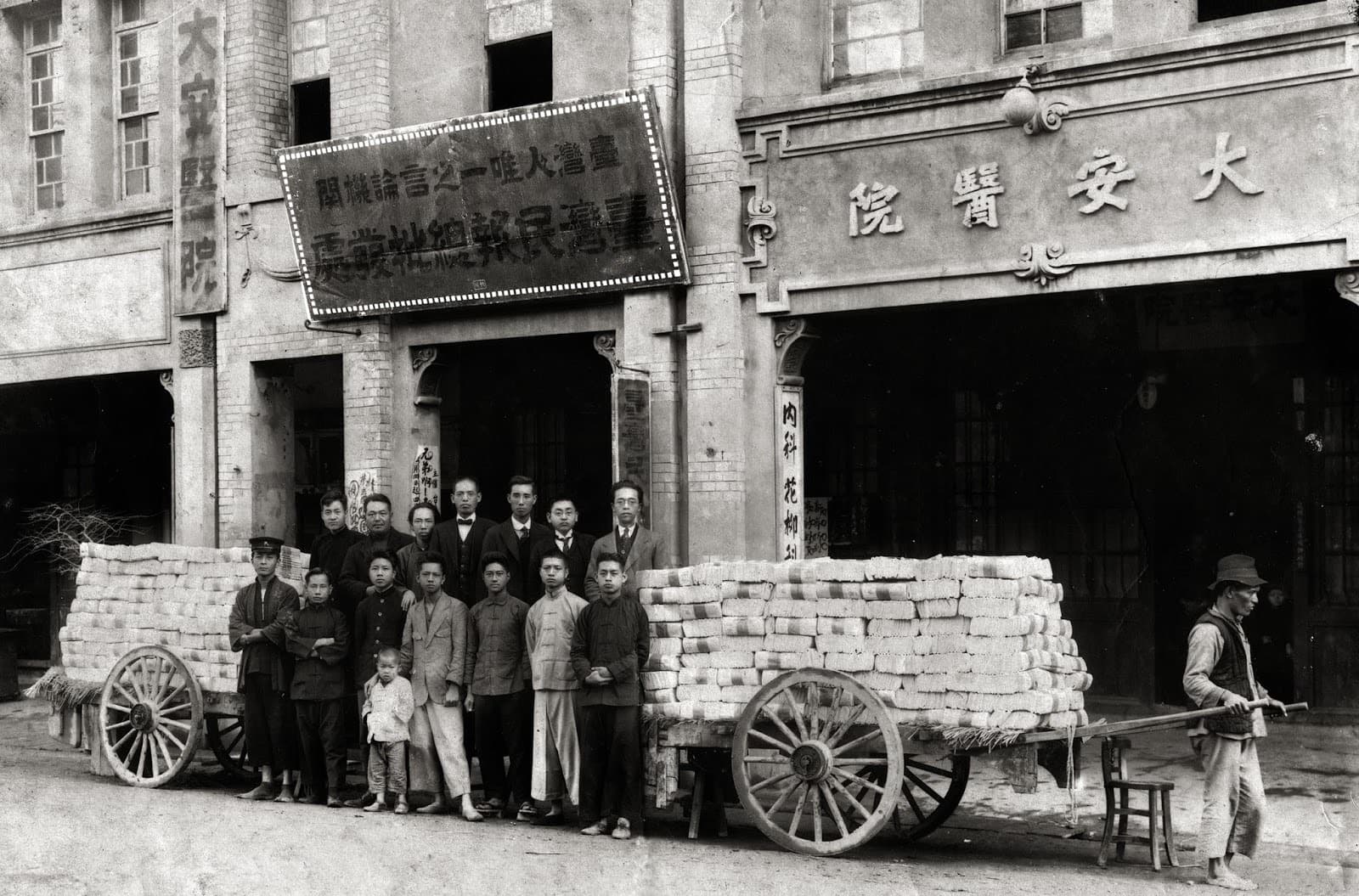
Staff of *The Taiwan Minpao* outside the paper's office, 1925. It was printed in Tokyo and shipped back, because a press on the island would not have cleared the censor. The bundles on the carts are copies waiting to go out.
Public domain; photographer unknown
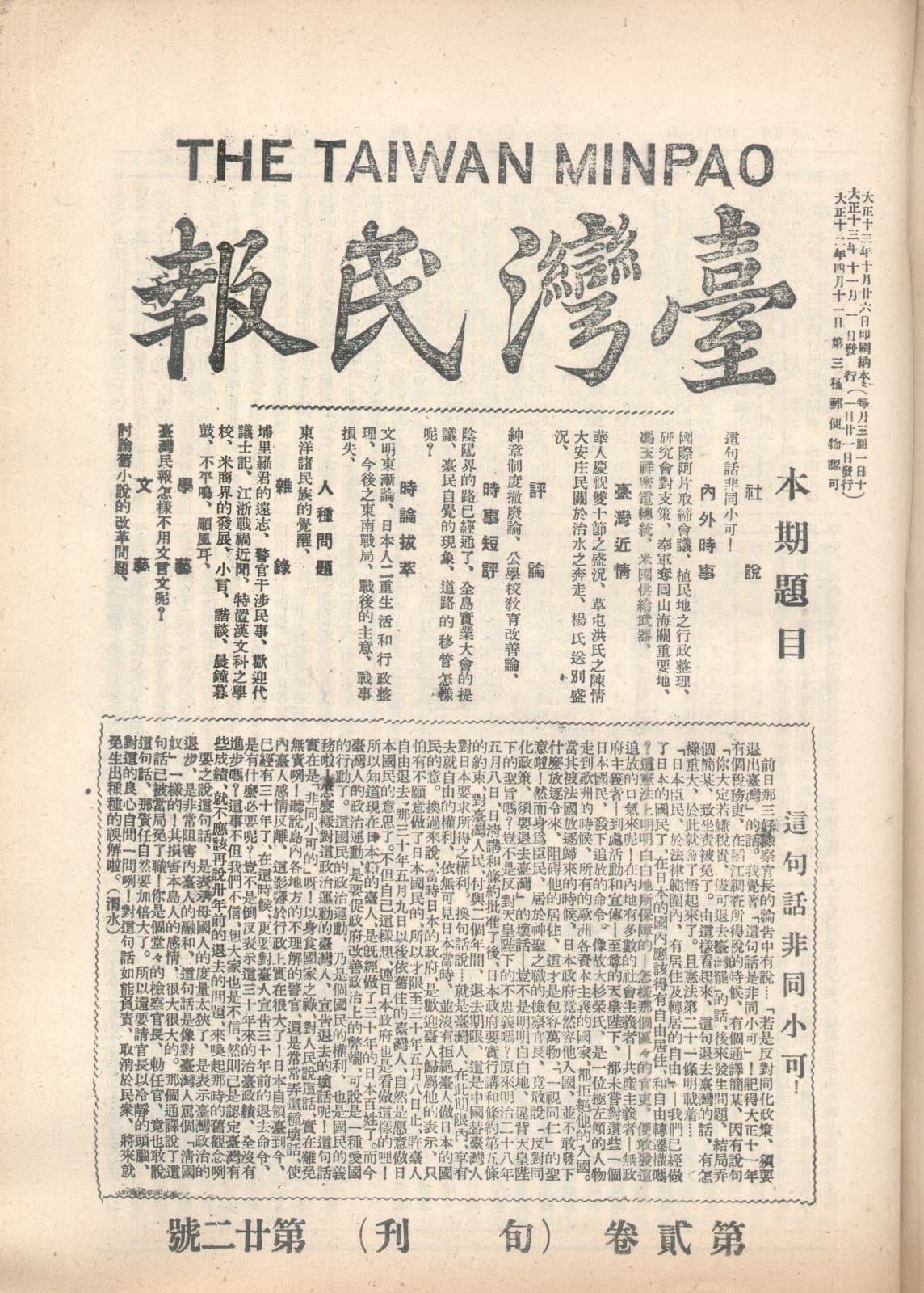
Front page of *The Taiwan Minpao*, 1 November 1924. It called itself the only organ of Taiwanese opinion, written in vernacular Chinese for islanders who could read the characters.
*The Taiwan Minpao*
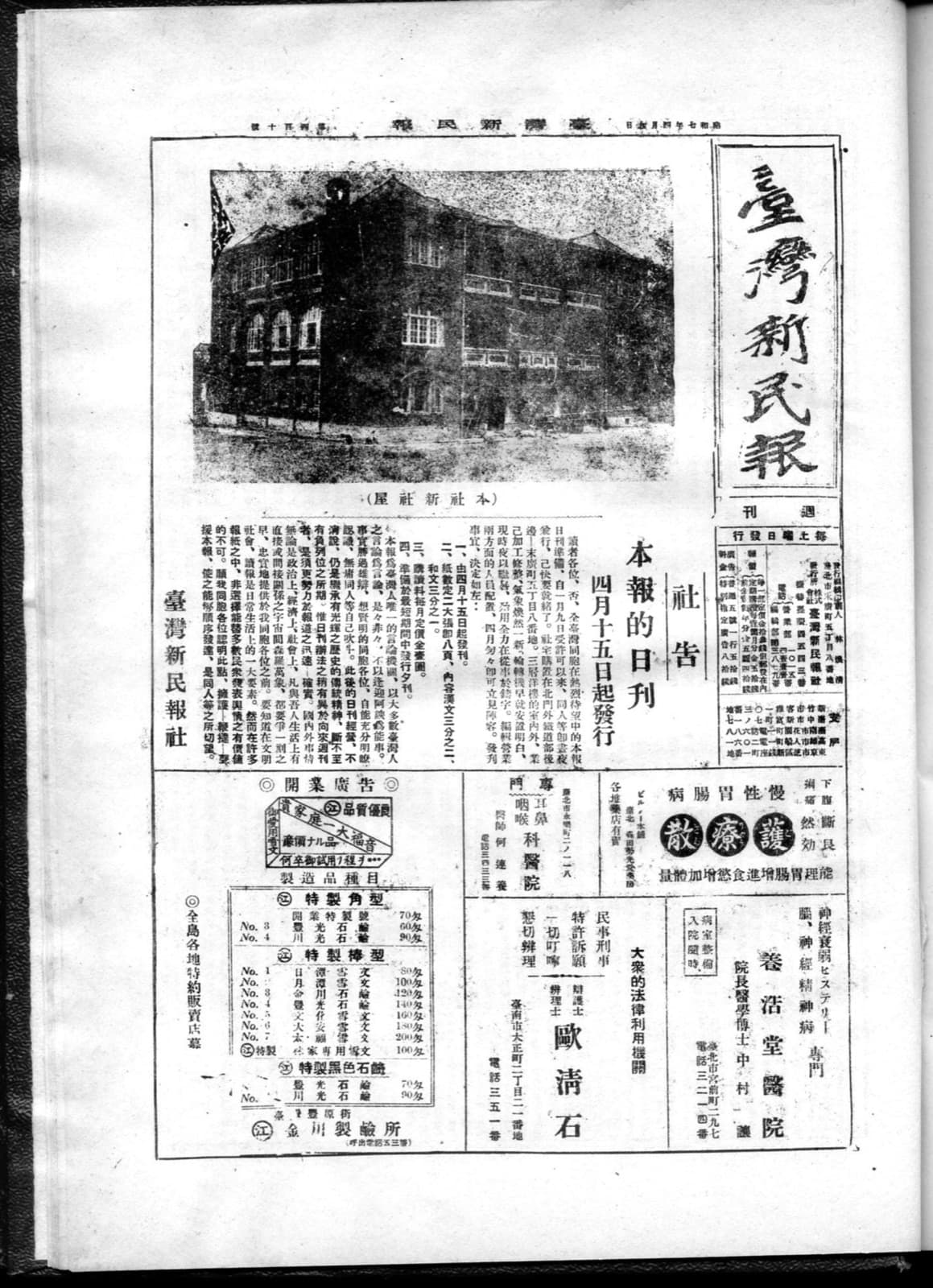
*The Taiwan Shin Minpao* after it became a daily, 1932. It took ten years of petitioning before the Government-General allowed the change from a weekly.
*The Taiwan Shin Minpao*
Isle of Time