


The Chih-ching Incident
The Taiwan of the early 1920s stood in an unusual political season. In the wake of the First World War, the ideals of national self-determination and constitutional politics swept across the globe and quietly crossed the strait as well. A generation of Taiwanese intellectuals, schooled in the new learning, was no longer content to live under the Governor-General's unchecked rule. Instead they sought, within the seams of the system, to win a measure of voice for the island's six million people. The stage they chose was not the street with its blades and guns, but the assembly hall and the petition — a struggle waged in the language of law.
Out of this current the parliament petition movement took shape. Its advocates argued that since Taiwan had been folded into the empire, it deserved an elected assembly, chosen by Taiwanese and empowered to deliberate the island's budget and laws, rather than leaving legislative and executive authority wholly in the Governor-General's hands. To give the cause a formal and lasting body, in February 1923 activists in the petition movement founded the League for the Establishment of a Taiwan Parliament, a formal political organization to press their demands. They hoped that lawful association would gather scattered petitioning into an organized civic movement with a charter and a purpose.
The colonial authorities, however, were deeply alarmed by this openly constituted political body. In the eyes of the Governor-General's Office, a standing organization led by Taiwanese and publicly challenging the structure of rule was far more threatening than any single petition. The authorities first refused to register the League in Taiwan; unwilling to be turned away, the activists moved to Tokyo and re-founded the League in the imperial capital, seeking to exploit the relatively looser space for association in the metropole so that the organization might survive. This maneuvering between Taiwan and Tokyo revealed both the movement's resilience and the coming of a head-on collision.
The collision finally broke in deep winter. In the early hours of 16 December 1923, while the island still slept in darkness, the Governor-General's Office launched a coordinated, island-wide sweep, arresting and searching dozens of movement leaders under the Public Order Police Law, seizing documents and interrogating those involved. It was a carefully staged operation meant to intimidate — the authorities wanted everyone to understand that crossing the line of political association would carry a price. The episode took its name, the Chih-ching Incident, from that very Public Order Police Law that served as its legal basis.
Among those hauled in were Chiang Wei-shui and Tsai Pei-huo, the movement's two best-known figures. The former was an ac…
Among those hauled in were Chiang Wei-shui and Tsai Pei-huo, the movement's two best-known figures. The former was an activist who wielded a physician's pen to diagnose the ailments of "the island of Taiwan"; the latter a tireless organizer who moved for years between cultural work and petitioning. Together with the other detainees, they formed the backbone of the Taiwanese national movement of the day. What the government intended as a warning — a single sweep to smother the movement's heat — instead produced the opposite effect. The arrests did not silence the cause; they built for it a stage unlike any before.
The public trials of 1924 and 1925 became a national sensation. The courtroom, meant by the authorities as a place to convict, was turned by the defendants into a lectern. Before packed galleries and a rapt press, they set out, point by point, the legitimacy of a Taiwanese assembly and argued openly for the political rights of the Taiwanese people. The twists of the proceedings only heightened the drama: the defendants were first acquitted, and then, after the prosecution appealed, the verdict was reversed on appeal, and several defendants received short prison terms. The sentences were light, yet the process held the whole island's gaze.
The moral victory the trials handed the movement, however, was far larger than the sentences themselves. Day after day the newspapers carried the words spoken in court, delivering the defendants' arguments into countless Taiwanese homes; a trial meant to suppress became instead a pulpit from which political ideas were preached across the island. The composed, unbowed bearing of the accused let many who had watched coolly from the sidelines feel, for the first time, that "Taiwanese too have the right to speak" was no empty phrase.
The Chih-ching Incident thus became the first great political trial in Taiwanese history, a moment when the language of law and rights was spoken aloud in a colonial court. It shifted the form of resistance from force toward reason and public opinion, and it steeled a whole generation of activists — the names that walked out of that courtroom would carry the nerve and experience the trial had earned them into the cultural and political struggles still to come.
On the morning of 16 December 1923 searches were made across the island at the same hour, and he was taken from the Dai-an Hospital in Dadaocheng. The charge rested on Article 8, Paragraph 2 of the Peace Police Law: political association without permission. The League for the Establishment of a Taiwanese Parliament had been banned in Taipei the previous year, so its members had registered in Tokyo instead. The prosecution called that evasion; the members held that registration in Tokyo was lawful in the first place. In custody he wrote a prison diary in which he called the gaol a university and his cell number a student number, recording each day what he had read. The court of first instance acquitted him in 1924; on appeal that October he was given four months, and he began serving in February 1925. On the day of his release the streets of Dadaocheng were loud with firecrackers and the crowd waiting for him stretched for blocks. That was the real outcome of the case. One line from his diary — that compatriots must unite, and that in unity there is strength — was afterwards printed in a great many places, including his own death notice. He died of typhoid in 1931, at forty.
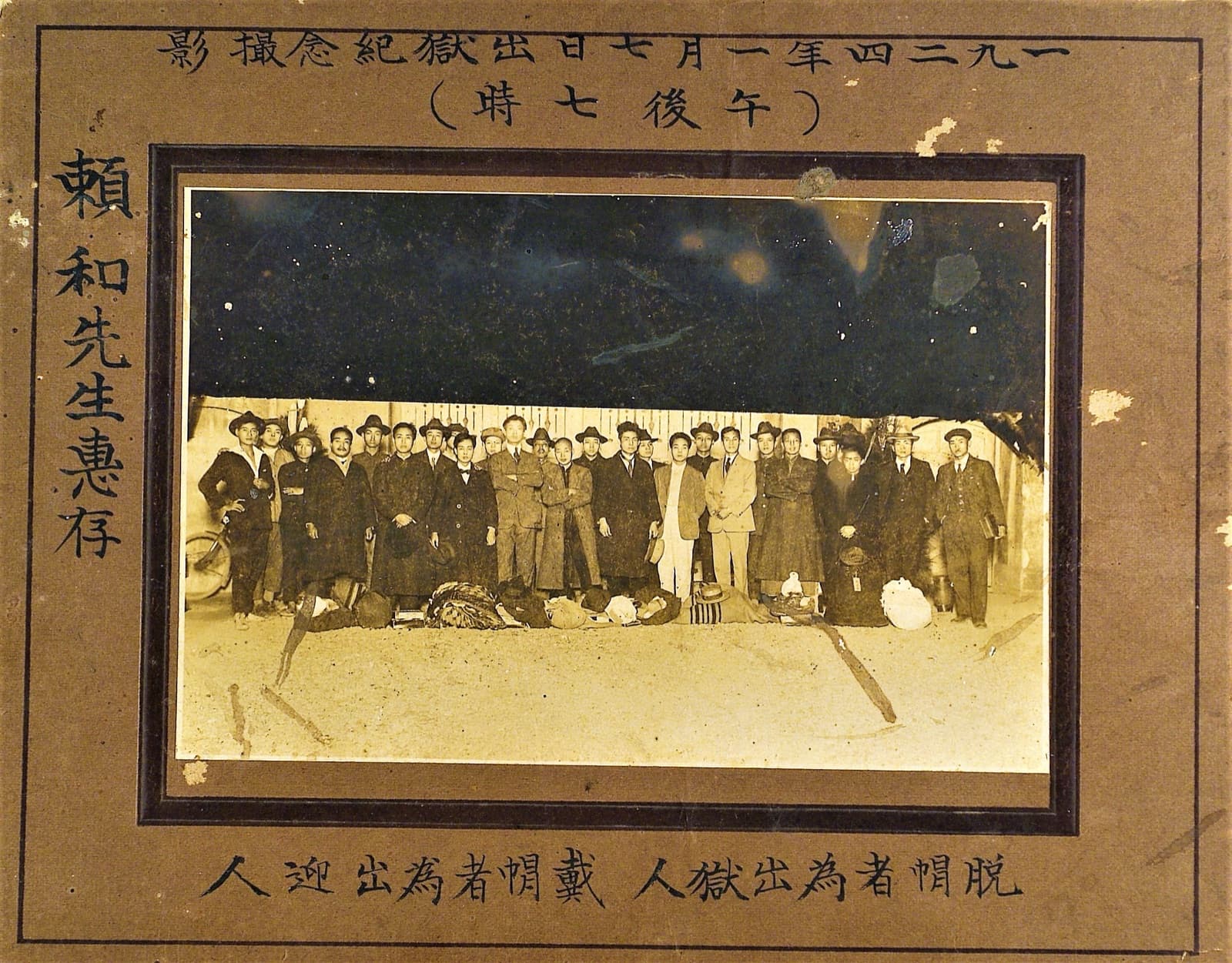
Released prisoners of the Chih-ching case, 1924. Chiang Wei-shui and others were charged under the Peace Police Act for organising the parliament league; they posed at the gate after several months inside.
Lai Ho Memorial Museum
Isle of Time