


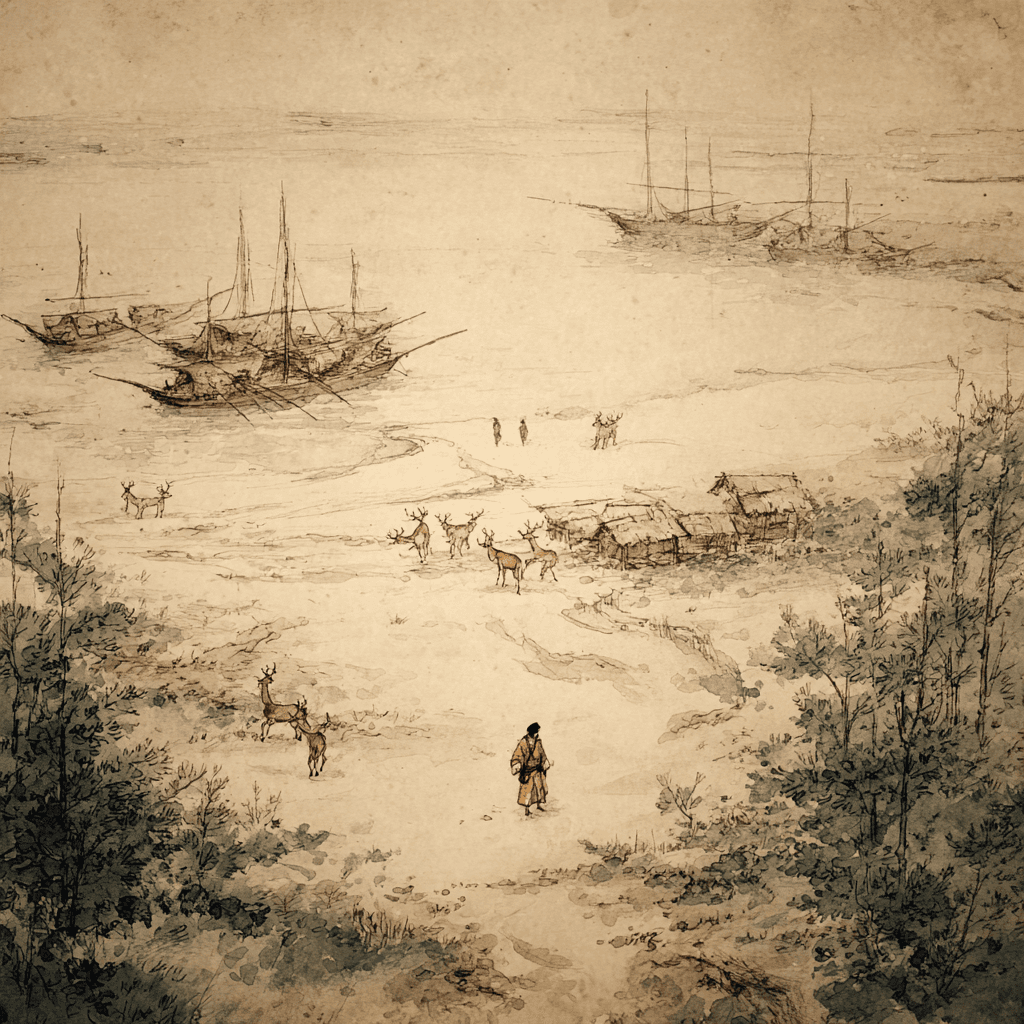
Before the Dutch arrived, the southwest coast of Taiwan was far from quiet. Every winter fishing boats from Zhangzhou and Quanzhou followed the mullet across, merchants came ashore to trade with the villages for deerskins, and pirates and wokou raiders used the coast to hide from government troops. In 1574 the pirate Lin Feng attacked Manila with sixty or seventy warships, three thousand men and four hundred Japanese soldiers. When he failed, he fell back to Wanggang. In September the following year he raided the fishing boats around Chihkan for the third time, for close to a month, before returning to Guangdong. In December the Ming commander Hu Shouren crushed him in the waters off Tamsui.
In the winter of the thirtieth year of Wanli, early in 1603, Shen Yourong, the commander at Wuyu, crossed the strait with twenty-four warships in pursuit of wokou and fought his way to Tayouan. He burned and sank six pirate ships, took fifteen heads, and brought back more than three hundred captured men and women. On board was a scholar in his sixties named Chen Di. He spent some twenty days on the island, and when he returned he wrote a piece of just over fourteen hundred characters called An Account of the Eastern Barbarians. It is the earliest surviving record written by a Chinese author who had gone to Taiwan and seen it for himself.
Its first line reads: "Where the Eastern Barbarians began, no one knows. They live on an island in the open sea beyond Penghu." He lists where they lived: "From Wanggang and Jialaowan, through Tayouan, Yaogang, Dagou Island, Xiao Danshui, Shuangxikou, Jialilin, Shabali and Dabangkeng, all are their homes." That stretch of coast is roughly what the Dutch later called the land of the Siraya.
He writes that they had "no calendar and no writing; they count a full moon as a month and ten months as a year." He writes that they lived by village, the men hunting and the women working the fields: "the women always labour, the men are always at leisure." He writes of headhunting, and of deer. Deer appear in the account more than anything else, as food and as goods for trade.
He saw the trade too. "From Huimin, Chonglong, Lieyu and other harbours of Zhangzhou and Quanzhou, men often learn their language and trade with them, exchanging agate, porcelain, cloth, salt, copper hairpins and rings for their dried venison, hides and horn." At the end he set down a worry: "Since they have had dealings with China, they have taken a liking to it, and crooked men cheat them with shoddy goods. They are beginning to see it. I fear their simplicity will fade by the day."
Twenty years later, larger fleets appeared off Tayouan. Later accounts say that around 1621 Yan Siqi of Haicheng in Zhangzhou brought thirteen ships to the Wanggang area, recruited people from Zhangzhou and Quanzhou to farm, and died of illness in September 1625 while hunting near Zhuluoshan, after which Zheng Zhilong took over his fleet. These things are written mainly in Jiang Risheng's Unofficial History of Taiwan of 1704 and Lian Heng's General History of Taiwan of 1920. Scholars still argue over whether he landed at Bengang or Wanggang, and even whether he has been confused with another merchant, Li Dan.
In 1604, the year after Chen Di went home, the Dutch commander Wybrand van Warwijck brought ships to Penghu to demand trade. Shen Yourong went with his warships to talk, and when the Dutch saw fifty Ming warships approaching they withdrew. A stone was later set up on Penghu inscribed: Shen Yourong persuaded the red-haired barbarian Van Warwijck and his men to withdraw. Eighteen years later, the Dutch came back to Penghu.
Chen Di came with the warships, and the Eastern Barbarians he saw were a journey of some twenty days. He wrote down the villages, the deer, the reckoning by the moon, the women in the fields, in careful detail, because all of it differed from the world he knew. The piece runs to just over fourteen hundred characters and was printed in 1603 in Shen Yourong's collection, Farewell Words from the Fujian Sea.
His eye had its limits. He called these people barbarians, and he described a division of labour he did not understand as the men being "always at leisure". But he also noticed the Zhangzhou and Quanzhou merchants cheating them and worried that their simplicity would "fade by the day". It is an outsider's observation, and the earliest that survives.
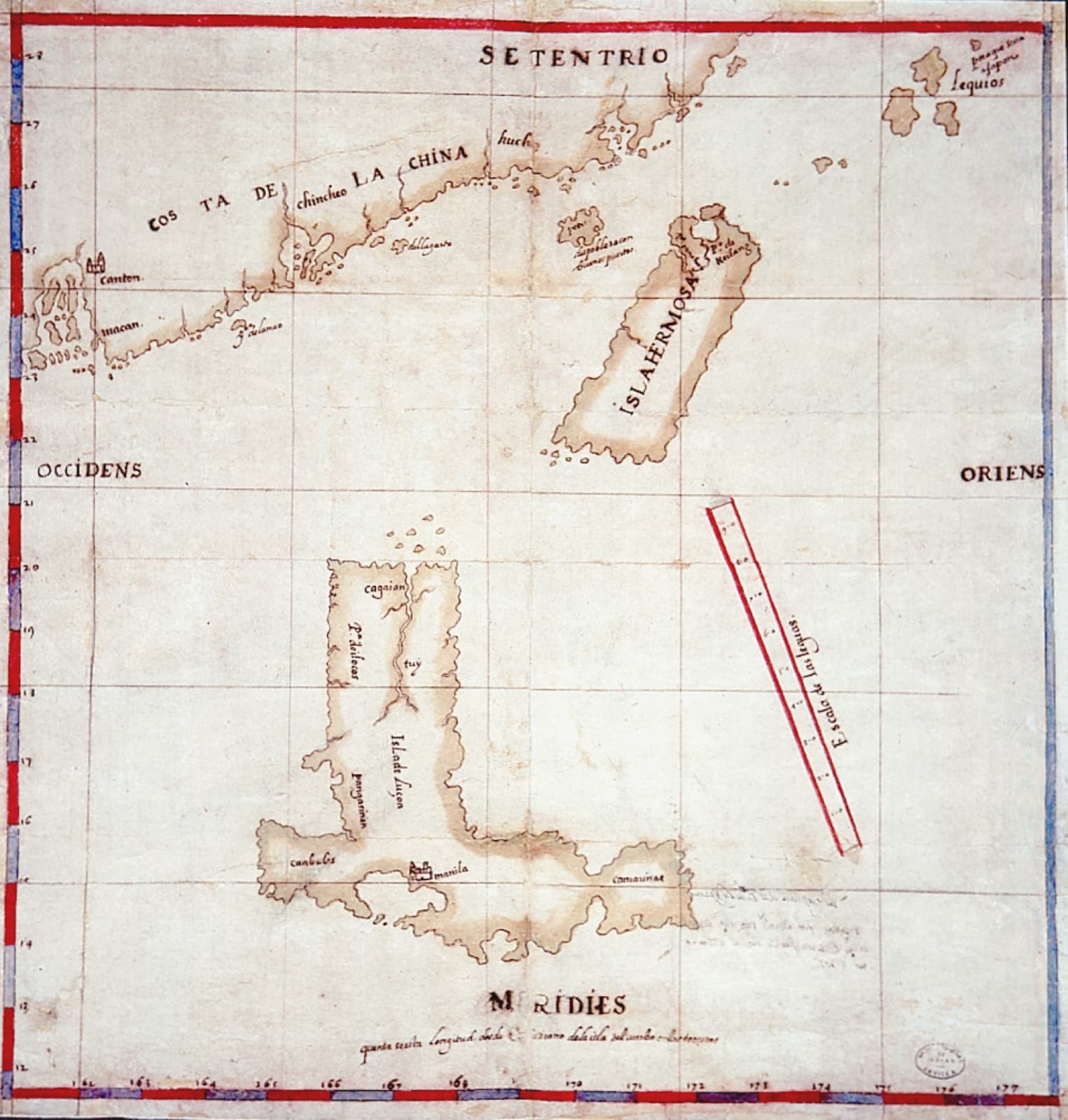
Map of Luzon, 'Isla Hermosa' and part of the China coast, drawn in 1597 by the Spaniard Hernando de los Ríos Coronel. He used it to show the king how easily a foothold could be set up in northern Taiwan, and his preferred site was Keelung. Chen Di's crossing came six years later.
Archivo General de Indias, Seville
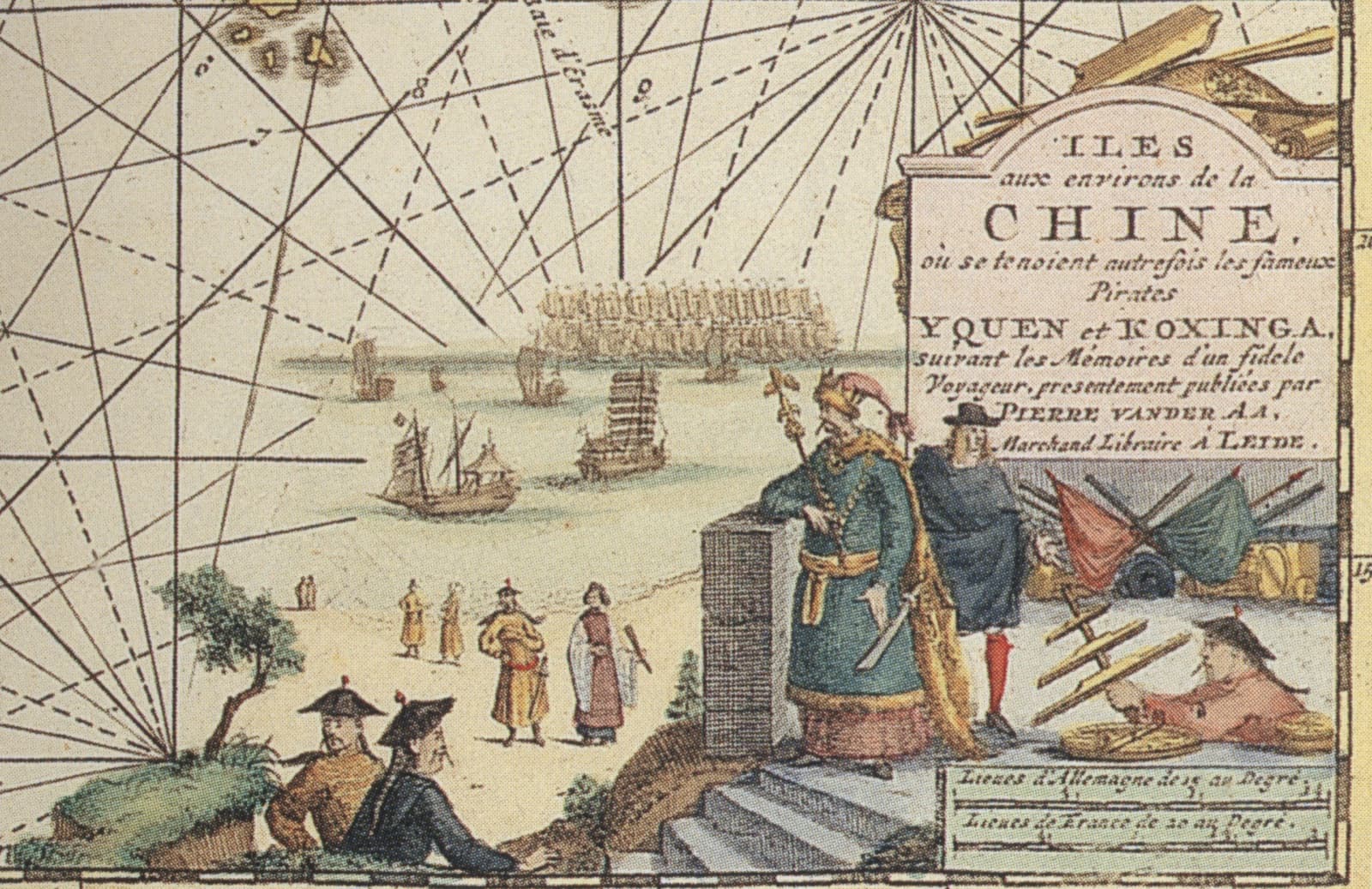
Detail of a map of the islands off China published in Leiden by Pieter van der Aa. The title says these waters were once haunted by 'the famous pirates Yquen and Koxinga'. Yquen was Zheng Zhilong. On European maps, father and son were pirates.
Public domain, published by Pieter van der Aa