


First Steam Locomotive
At the close of the nineteenth century, the Qing Empire stood in the bleak autumn of its decline. Yet on this side of the strait, in Taipei, an unfolding modernization experiment would prove the most radical and forward-looking the empire had ever attempted. Shaken by the Sino-French War, the Qing court in 1885 resolved to elevate Taiwan to provincial status, appointing the open-minded Huai Army general Liu Mingchuan — celebrated for his battlefield exploits — as its first governor.
Liu Mingchuan was an eagle-eyed, iron-willed statesman of remarkable boldness. Standing on the newly built Taipei city wall, looking out across the basin's rice paddies and screwpine groves, he was not planning the cautious routine of a typical Qing official. He envisioned turning Taiwan into the most advanced modernization model province in all of China. He would light the streets with electric lamps, string telegraph lines across the island, and found schools of Western learning. At the very heart of his ambitions — the project most condemned as "heretical" by the conservative bureaucracy — was the construction of Taiwan's first passenger railway.
In the Qing Empire of that era, many conservative ministers regarded the steam train as a demonic apparition. They believed the locomotive's thundering roar would disturb the dragon veins of the empire, its black smoke would offend the gods, and even the iron rails might ruin the geomancy of the land. Liu Mingchuan stood his ground against the court's opposition, facing endless impeachments and constant threats of having his funding cut off. Yet through extraordinary political skill, and with the wholehearted backing of local merchants and gentry — among them the Dadaocheng tycoon Li Chunsheng — he managed to establish the "Taiwan Railway Commerce Bureau" and formally opened the project to international bids.
The difficulty of the engineering surpassed anyone's imagination. Liu's planned first stage ran from Keelung Harbor, over a tangle of mountain ridges, to Taipei, then extended onward to Hsinchu. Between Keelung and Taipei the mountains were steep, the rivers swift, and the terrain treacherous. Taiwan's chronic plagues of malaria and miasma added to the toll. Thousands of Taiwanese laborers and Green Standard soldiers — hoes in hand one day, iron shovels the next — chipped their way inch by inch through rock under blazing sun and pouring rain. The excavation of the "Shiqiuling Tunnel" near Keelung was particularly brutal: poor rock conditions and endless seepage caused repeated collapses, and countless laborers perished from accidents and fever. But Liu Mingchuan did not retreat. He personally inspected the works on site, and after thirty months of grinding labor, the first railway tunnel in Taiwan was finally bored through.
The climax of history arrived in the autumn of 1891.
On that day, Taipei's Dadaocheng railway station (roughly today's Zhengzhou Road in Taipei) was a sea of people, drums and gongs ringing through the air. Tens of thousands of Taipei residents in long robes and skullcaps, joined by curious folk who had traveled all the way from central and southern Taiwan, packed the station grounds shoulder to shoulder. Necks craned, eyes wide with curiosity, tension, and even a flicker of fear.
Suddenly, from far down the rails, came a piercing, brilliant whistle that cut across the entire Taipei Basin skyline. T…
Suddenly, from far down the rails, came a piercing, brilliant whistle that cut across the entire Taipei Basin skyline. Then the ground began to tremble. Through clouds of steam and black smoke, a passenger steam locomotive — manufactured by Germany's Hohenzollern Locomotive Works, its body gleaming with cold steel — pulled slowly into the platform. Named "Tengyun" ("Cloud-Soaring") by Liu Mingchuan himself, the engine breathed white steam in heavy, beast-like exhalations.
When "Tengyun" came to a perfect halt with its wooden passenger carriages trailing behind, the crowd erupted in thunderous cheers and gasps of amazement. Local officials and gentry boarded, and at the conductor's signal, "Tengyun" sounded its whistle once more. The wheels struck dazzling sparks against the rails, and Taiwan's first official railway passengers were carried at the breathtaking speed of twenty or thirty kilometers per hour across the rolling rice fields of the Taipei plain. Farmers and water buffaloes in the paddies, watching this iron beast tear across the earth trailing smoke, stood frozen with disbelief. On that day — October 20, 1891 — the Keelung-to-Taipei railway officially opened, marking Taiwan's entry into the age of modern industrial civilization.
Liu Mingchuan's "Tengyun" was not merely a locomotive; it was a time machine, hauling at full throttle this island — once dismissed and nearly abandoned by the Kangxi Emperor two centuries earlier — into the future of modernity. Thanks to this railway, the coal of Keelung Harbor and the "tea gold" of Dadaocheng could flow in perfect commercial circulation. Thanks to this railway, Taiwan's political and economic axis was permanently riveted to the north of the island.
Sadly, the modernization miracle Liu Mingchuan had single-handedly engineered soon met its historical dusk. In 1891, weakened by factional struggles within the court and by his own failing health, Liu resigned and left Taiwan in disgrace. Just four years later, in 1895, the Qing Empire suffered devastating defeat in the First Sino-Japanese War and signed the Treaty of Shimonoseki, ceding Taiwan to Japan. When Japanese troops marched into Taipei across the very railway Liu had built with his own hands, more than two centuries of Qing rule over Taiwan formally came to an end.
Yet the legacy that Liu Mingchuan and the laborers who shed their sweat and blood at Shiqiuling Tunnel left behind has never vanished. Today, when we sit in sleek, comfortable high-speed or TRA trains and glide effortlessly between Taipei, Keelung, and Hsinchu in mere minutes, every inch of rail beneath us traces its origin back to that locomotive a century ago — to "Tengyun," whistling into the world through clouds of black smoke and tears.
It was the final scene of Taiwan's two-hundred-year Qing chapter — and at the same time, the first proudest cry that Taiwan, armed with technology and an unbending spirit, sent forth to the modern world.
Between Keelung and Taipei stands the ridge at Shiqiuling. The tunnel through it is two hundred and thirty-five metres long, which does not sound far, and it took three years — the rock is unstable sandstone and shale that collapsed as fast as it was dug, and the bore had to be held with timber framing, and when the framing failed the work began again. Most of the labour was soldiers, with local workers hired alongside them and tenants who had lost their land after the cadastral survey. The tools were picks and powder, the light was oil lamps, and ventilation was a bellows worked by hand. Water came in heavily, the men stood in it all day and rotten feet were ordinary. There is no record of the collapses and no count of the dead; the engineering file for this tunnel contains the schedule and the cost. It was holed through in 1890, and above the portal are four characters in Liu Mingchuan's hand about the vault of heaven opening. They are still there. It was the first railway tunnel in Taiwan and the only one built under the Qing. The Japanese laid a new alignment, and no train has passed that portal since.
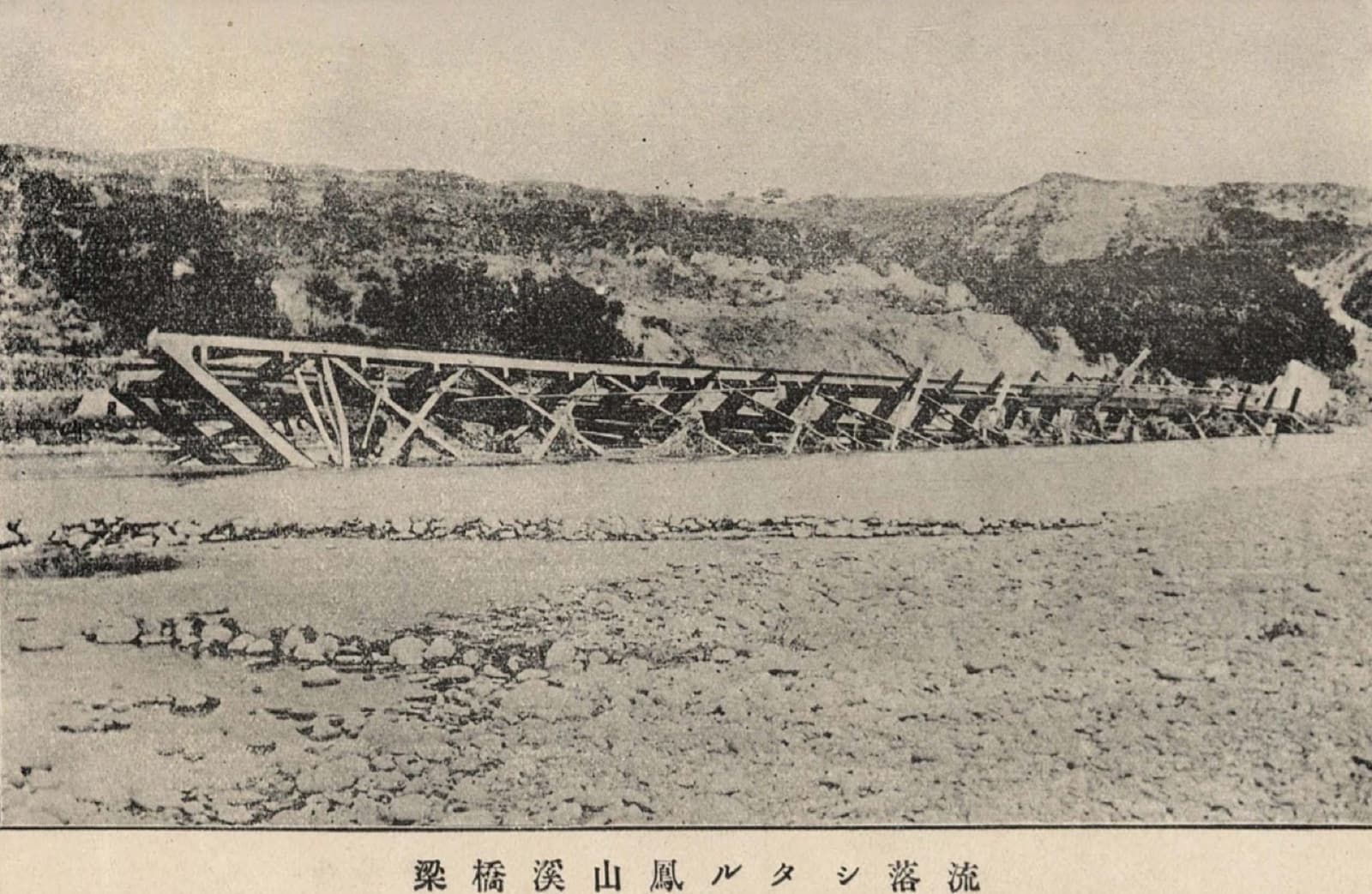
The railway bridge over the Fengshan River, photographed in 1898. The line was built under Liu Mingchuan, reaching Keelung in 1891 and Hsinchu in 1893; its timber piers were carried off by floods almost every year.
*History of Taiwan Railways*, vol. 1, Railway Bureau, Government-General of Taiwan
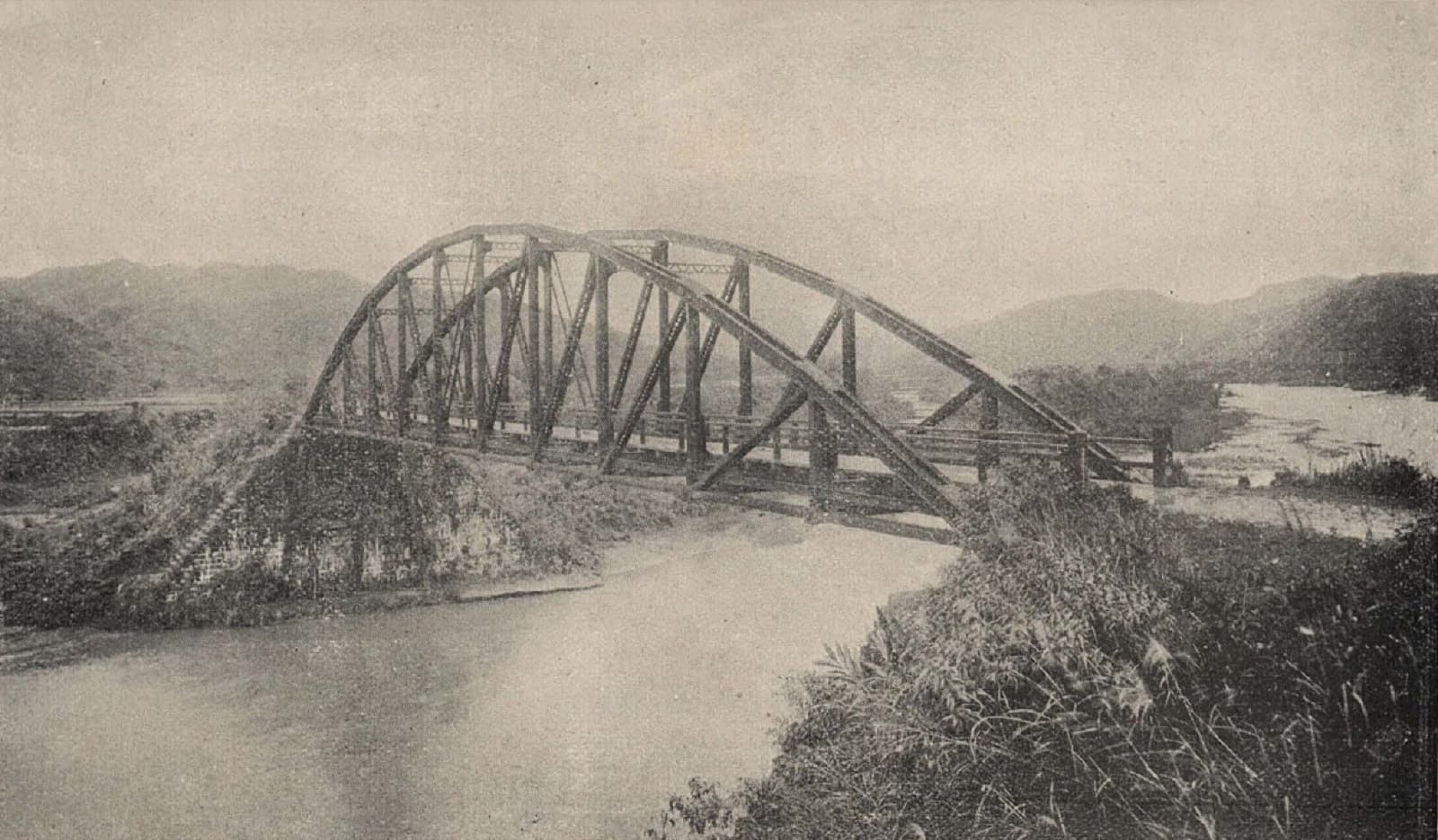
Bridges over the Keelung River near Chidu. The Qing line ran tight and steep, and the Japanese resurveyed almost all of it; only the stretch from Keelung to Taipei still follows the original alignment.
*History of Taiwan Railways*, vol. 1, Railway Bureau, Government-General of Taiwan
Isle of Time