

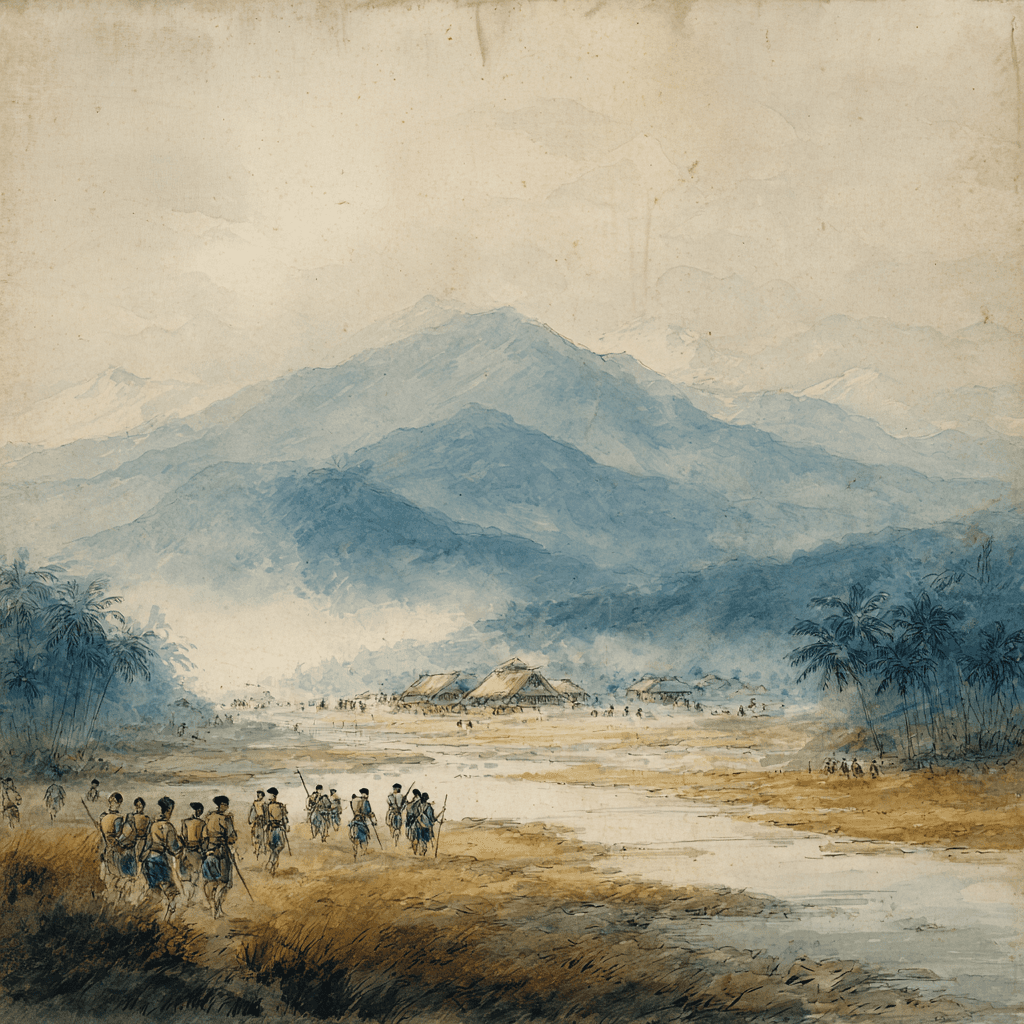
Early in 1638 a company of the Dutch East India Company under Captain Johan van Linga rounded the Hengchun Peninsula, marched north along the coast from Taimali, and came out onto the Taitung plain. What the Company wanted was gold. The information had come from villages along the way, passed on piece by piece: somewhere over the mountains to the east there was a river, and there was gold in the river.
Three powers held the plain at the time. The largest was Pimaba, with a population of about three thousand and a thousand men it could put into the field, six or seven smaller villages attached to it, and groves of areca and coconut palms around its houses. To the south lay Tipol, and along the foothills the Rukai village of Tarouma was pushing down from the central mountains. Van Linga reached an alliance with Magol, the headman of Pimaba. The go-betweens were Chinese traders and interpreters, who could be found in both camps.
The alliance served each side differently. The Company wanted a base and guides for the road north. Pimaba wanted guns. In January 1638 the Company joined forces with the lord of Lonckjouw on the Hengchun Peninsula and took Linauw, at the southern end of the rift valley. In January 1640 it went back, this time with Pimaba warriors, and four to five hundred people were killed or wounded. Linauw and Pimaba did not speak the same language and had been enemies for a long time. Pimaba men had never been able to hold ground in that country, and during the assault some of them broke and ran more than once. After this battle the road from the Beinan River through to the Xiuguluan River lay open.
The Company put up a storehouse at Pimaba and stationed a sergeant there with a few dozen soldiers to hold the goods bought locally or shipped in, and to ask about gold. The junior merchant Maarten Wesselingh had come to Taiwan in 1636 and spent several years travelling the southern mountains, surveying villages and writing reports; it was Wesselingh who sent word that the village of Taccabul was willing to make peace with the Company. In 1641 he was killed in the east.
In 1661 Koxinga's fleet sailed into Tayouan.
The following year the Governor of Formosa, Paulus Traudenius, brought troops across and, together with Pimaba warriors, attacked the villages of Nicabon and Tammalaccauw. When it was over, Tammalaccauw sent five representatives to Pimaba to sue for peace. Traudenius gave a single order: from now on Tammalaccauw would be subject to Pimaba. In February 1642 the army left Pimaba overland and crossed the mountains of Taccabul back to Tayouan. In April 1643 Tipol, which had also been beaten, came to Pimaba and made formal submission.
From then on, when Company residents needed a chief from the mountain villages, they sent Pimaba men to summon him. Tribute from the villages that had submitted was either collected with Pimaba men escorting the collectors or delivered straight to Pimaba. In 1644 the Company began leasing out village trade in the west, selling the right to trade with each village to the highest bidder. That system never came east. Trade in the east stayed in the hands of the one storehouse and its few dozen soldiers.
And the gold. In 1643 Captain Pieter Boon led troops north as far as Tarraboan, and on 11 May he set out back from there by way of Pimaba. Only after the end of 1645 did the Company fix the place where Tarraboan's gold came from. The vein itself was never found, and in time the search was dropped.
In 1661 Koxinga's fleet sailed into Tayouan. Early the next year the eighty-odd officers and men at the eastern post were escorted by Pimaba men all the way to the coast of Pingtung, where they boarded ship and left. The people who escorted them out came from the same village that had marched with them against Linauw more than twenty years before.
For Pimaba, shaking hands with the Company early in 1638 was first of all a matter concerning Linauw. The village had around three thousand people and could field a thousand warriors, with six or seven smaller villages attached to it. It was already the strongest power on the Taitung plain, but it could not push north into the rift valley. Linauw spoke a different language, the two had been hostile for a long time, and Pimaba men could not hold ground in that country. In January 1640 Pimaba warriors marched against Linauw again alongside Company soldiers. Four to five hundred on the other side were killed or wounded, and the road through to the Xiuguluan River was open from then on.
Over the next few years Pimaba gained more than the Company had bargained for. When Tammalaccauw sued for peace in 1642, its five representatives walked to Pimaba to do it. When Tipol submitted in April 1643, the ceremony was held at Pimaba too. If Company residents needed to summon a chief from the mountains, it was Pimaba men who went to call him. Tribute from the villages that had submitted was collected with Pimaba men alongside, or delivered straight to Pimaba. Pimaba warriors went north with the Company's gold expeditions, and for a time their reach extended to Soupra at the mouth of the Xiuguluan River. The Company had one sergeant and a few dozen soldiers in the east. The ones actually running affairs on the plain were Pimaba. When the Company pulled out early in 1662, it was Pimaba men who took the eighty-odd officers and soldiers to the coast of Pingtung.
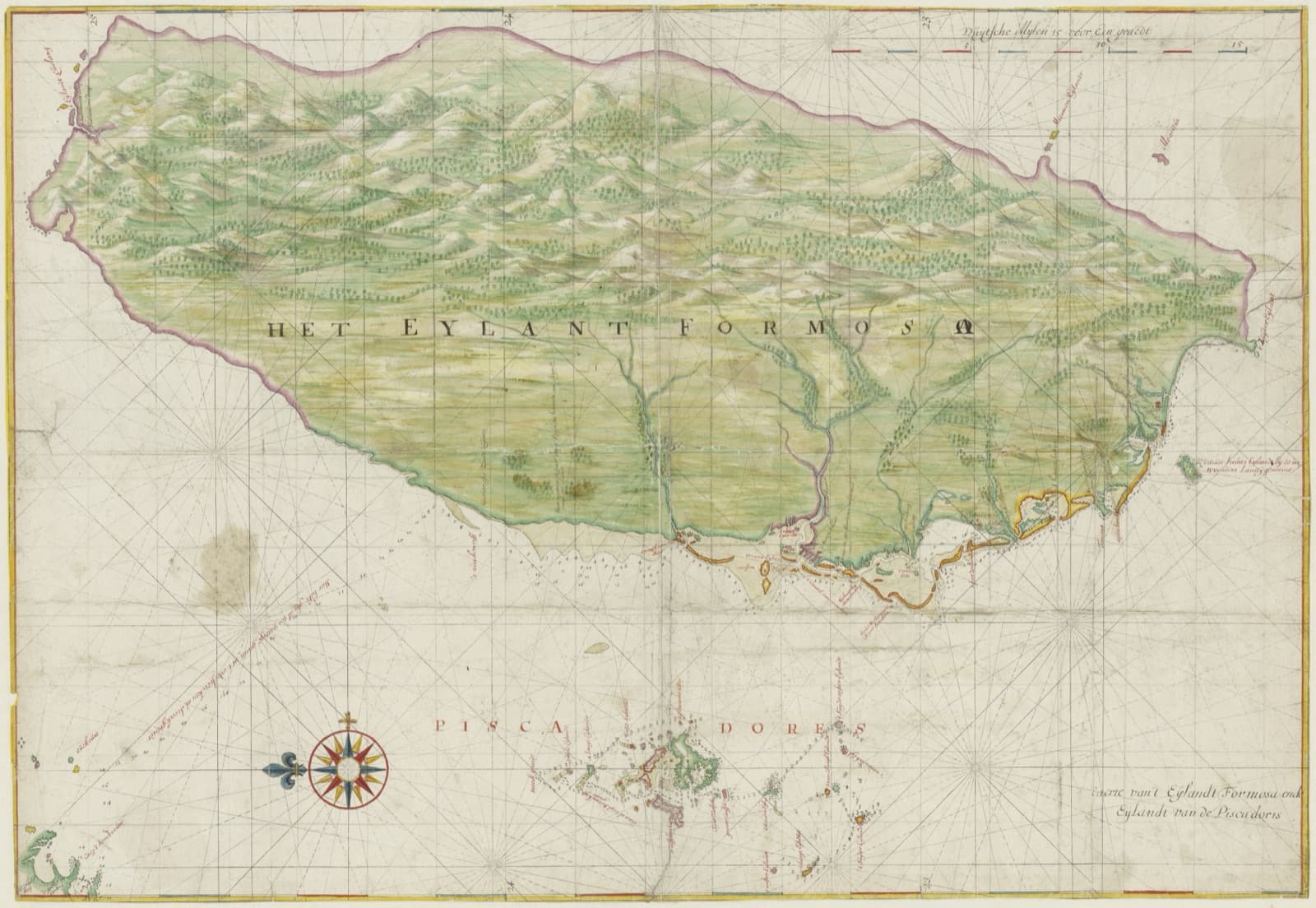
Johannes Vingboons's chart of Formosa and the Pescadores, around 1640. The west coast runs along the bottom edge, with the sandbars and river mouths around Tayouan drawn in detail. The east coast along the top is a bare outline with not a single village marked. These were the years the Company began looking for gold on that side.
Johannes Vingboons; Nationaal Archief, The Hague
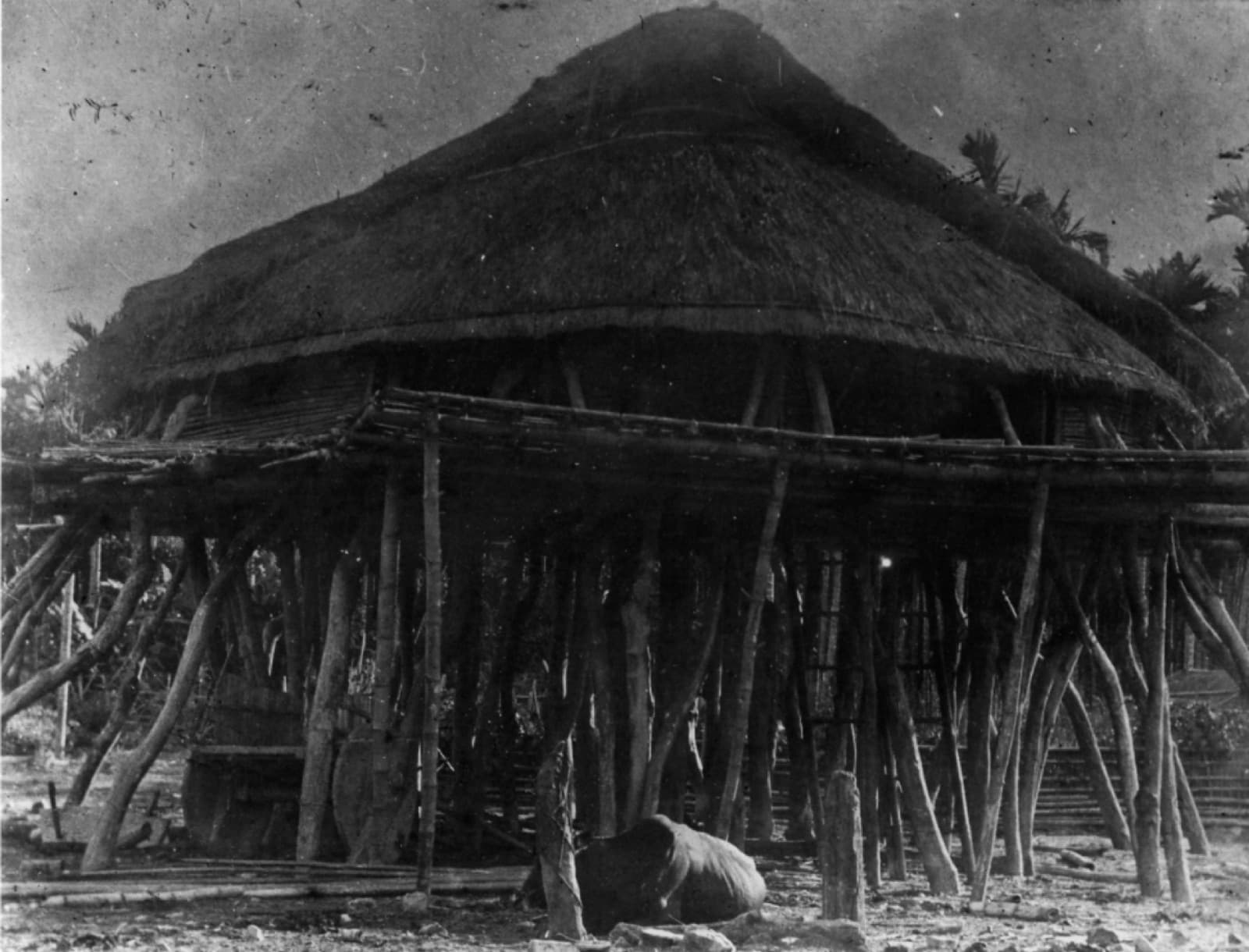
The youths' assembly house at Tipol, photographed by Torii Ryuzo in 1897, a thatched roof on a raised frame of bamboo and timber. Tipol was the village that made formal submission at Pimaba in April 1643 and was then ordered down to the flat land by the river. The photograph was taken more than two hundred and fifty years after that.
Photograph by Torii Ryuzo; Torii Ryuzo photograph catalogue, University Museum, University of Tokyo
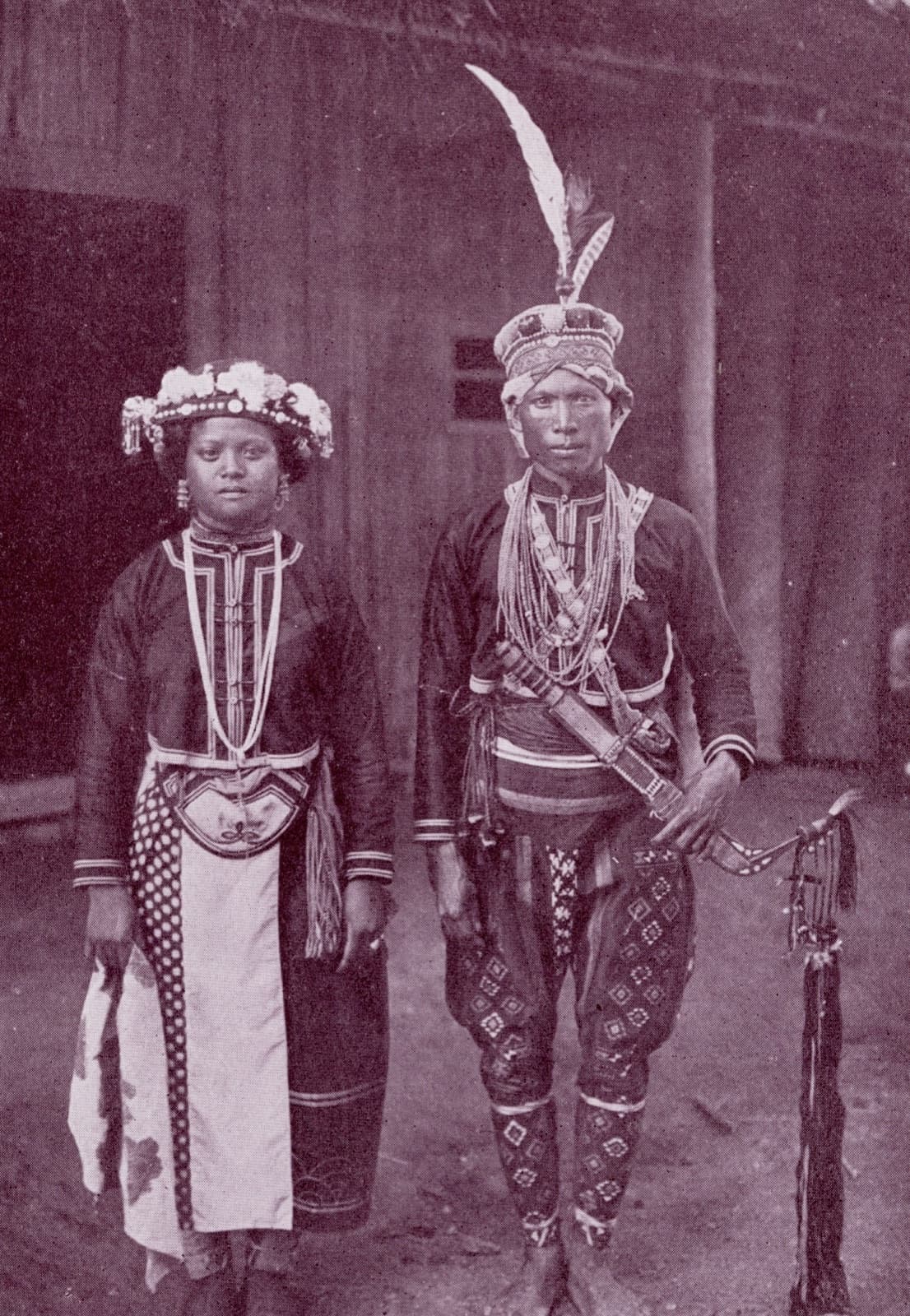
A man and a woman of Pimaba in formal dress, around 1930. The original caption singles out the fine embroidery on the betel bag slung across the man's shoulder and the silver chain on his chest. Three hundred years earlier, this was the village that allied with the Dutch East India Company and summoned the mountain chiefs on its behalf.
Nihon Chiri Taikei: Taiwan, Kaizosha, 1930–31