


Dispatches from the Frontier Sea
By the final years of the Kangxi Emperor's reign, the Qing court was confronting an awkward truth: more than three decades after annexing Taiwan, it still knew almost nothing about the island. Officials rotated in and out on brief appointments, completing their terms and departing for more comfortable postings on the mainland, leaving behind few records of what they had seen. The vast interior remained unmapped. Taiwan, for the purposes of imperial governance, was administered rather than known.
This began to change in 1722, when a small cohort of serious officials arrived with an unusual ambition — to understand the island they had been sent to govern.
Huang Shujing arrived as a censor with a mandate to inspect conditions across the island. He took his mandate seriously. Over two years he traveled the length of the western plains, crossed into frontier zones that most officials avoided, and observed ceremonies of indigenous villages. The result was the Taihai Shicha Lu — the most detailed and systematic account of Taiwan produced during the Qing era. What distinguished his work was genuine curiosity: he wrote about indigenous communities not as threats to be suppressed, but as peoples with their own coherent social structures and ways of life. His ethnographic notes on the tribes he observed remain among the earliest first-hand accounts of Taiwanese indigenous cultures.
Chen Bin served as circuit magistrate during roughly the same period and became Taiwan's first official celebrated speci…
Chen Bin served as circuit magistrate during roughly the same period and became Taiwan's first official celebrated specifically for incorruptibility. In a posting notorious for the enrichment of officials at the expense of the population, Chen refused all customary gifts, used his personal savings to repair public buildings, and funded schools out of his own pocket. Residents erected a living shrine to him while he was still in office — an honor normally reserved for the deceased — and continued to honor it for decades after his departure.
Sun Yuanheng was a poet-official who transformed his Taiwan observations into verse. Hundreds of his poems recorded the textures of frontier life — the flooded paddies of the plains, the morning mist at the mountain boundary, the terror of crossing the Black Ditch. He wrote with the detachment of a classical scholar but with an eye sharp enough to catch what the administrative records missed.
Zhou Zhongxuan, magistrate of Zhuluoshire, oversaw the first systematic compilation of a local gazetteer for the western plains — a comprehensive record of land, population, and history that gave the region a formal written identity within the imperial record-keeping system.
Together, these officials produced Taiwan's first layer of written documentation. Their work was not entirely free of imperial assumptions, but within those limits they looked, listened, and wrote with a seriousness that distinguishes their accounts from the bureaucratic placeholders that came before.
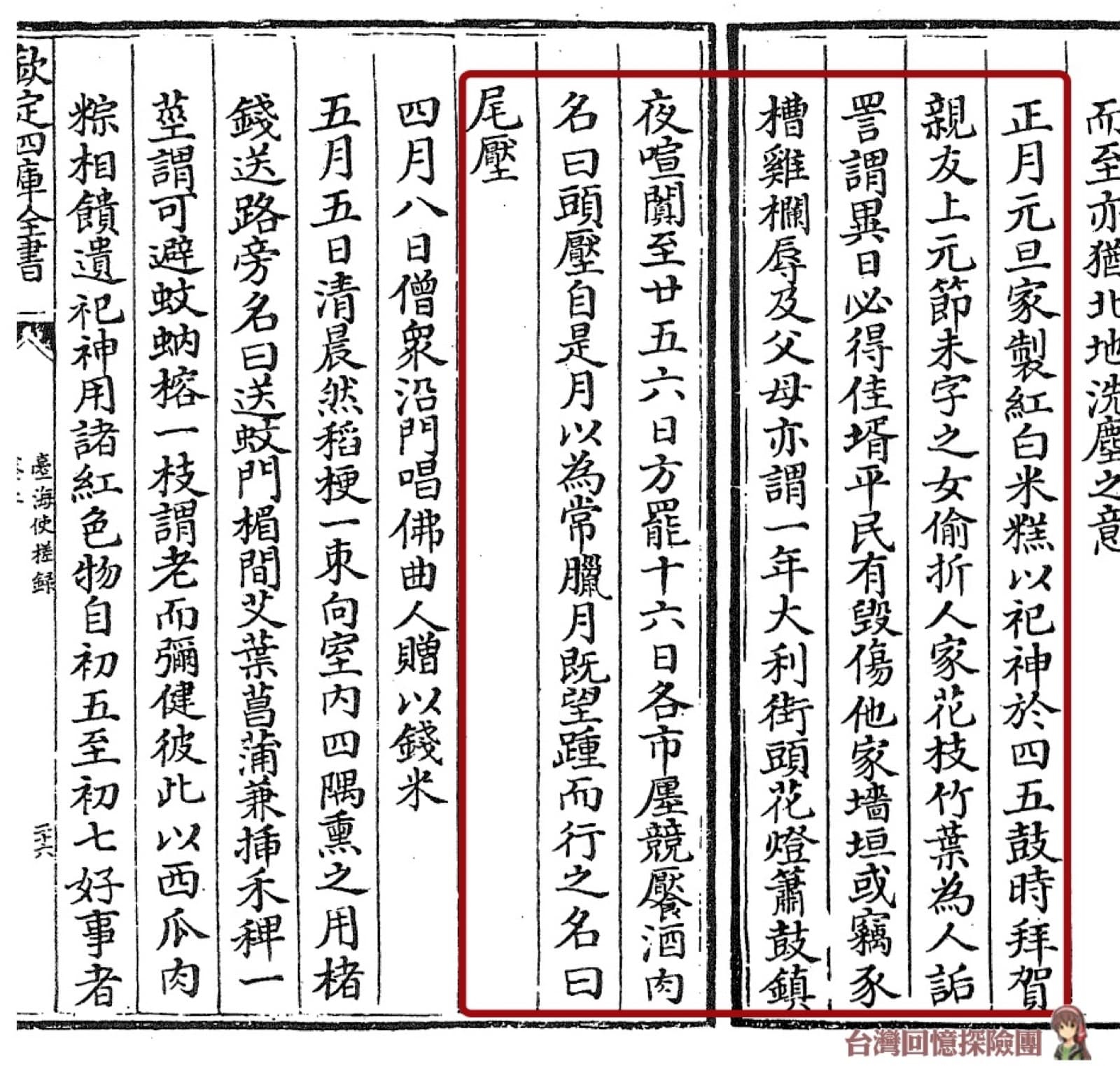
A lantern-festival scene from *Taihai shicha lu*. Huang Shujing came to Taiwan as imperial inspector in 1722 and set down what he saw along the way — festivals, produce, and the customs of the indigenous villages.
*Taihai shicha lu*, by Huang Shujing
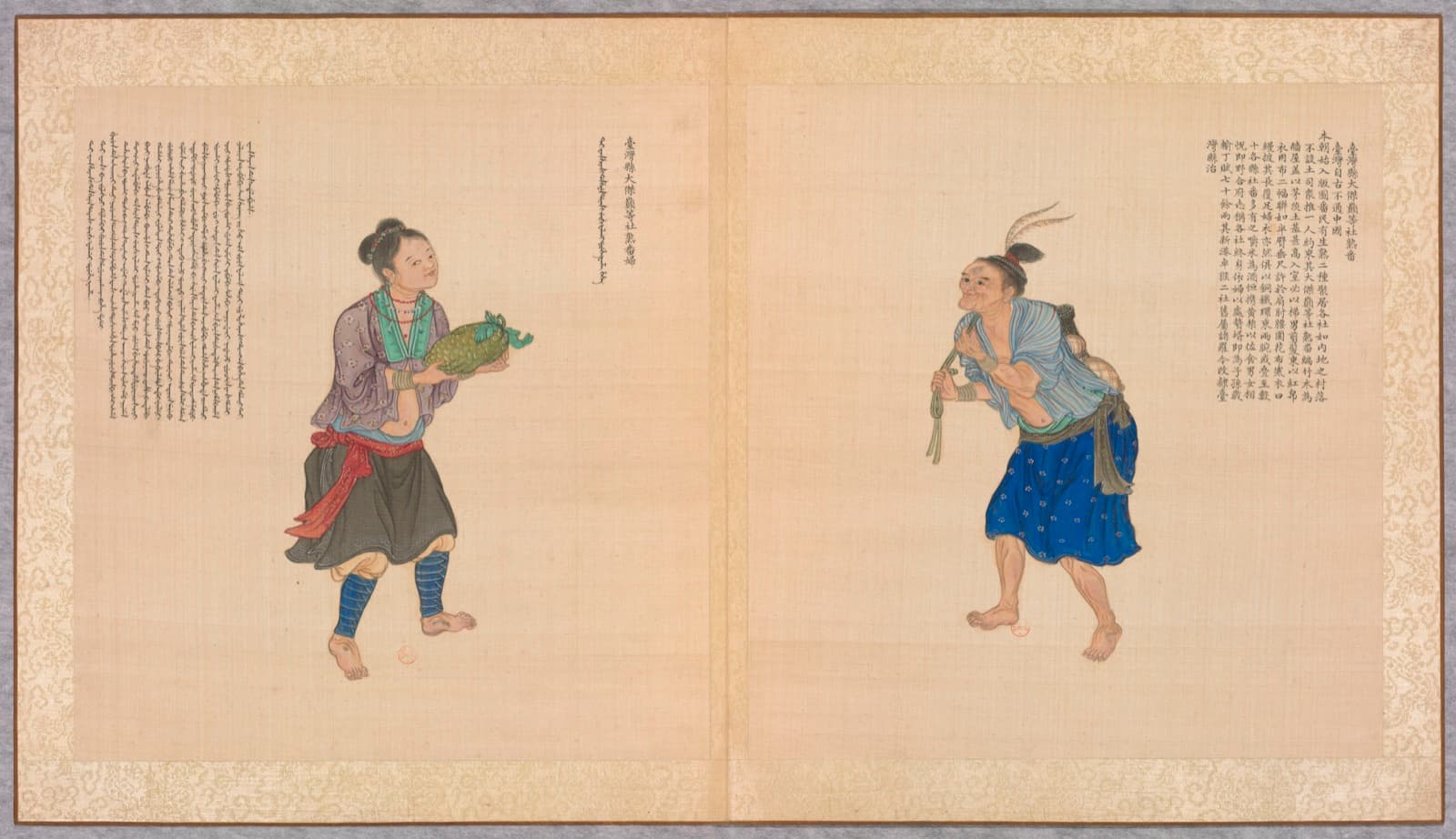
A married couple of the Dajiedian villages in Taiwan county, from the *Zhigongtu*. Qianlong ordered the album compiled, pairing the peoples of the empire and its margins one couple to a plate; Taiwan accounts for more than a dozen.
*Zhigongtu*, Bibliothèque nationale de France
Isle of Time