

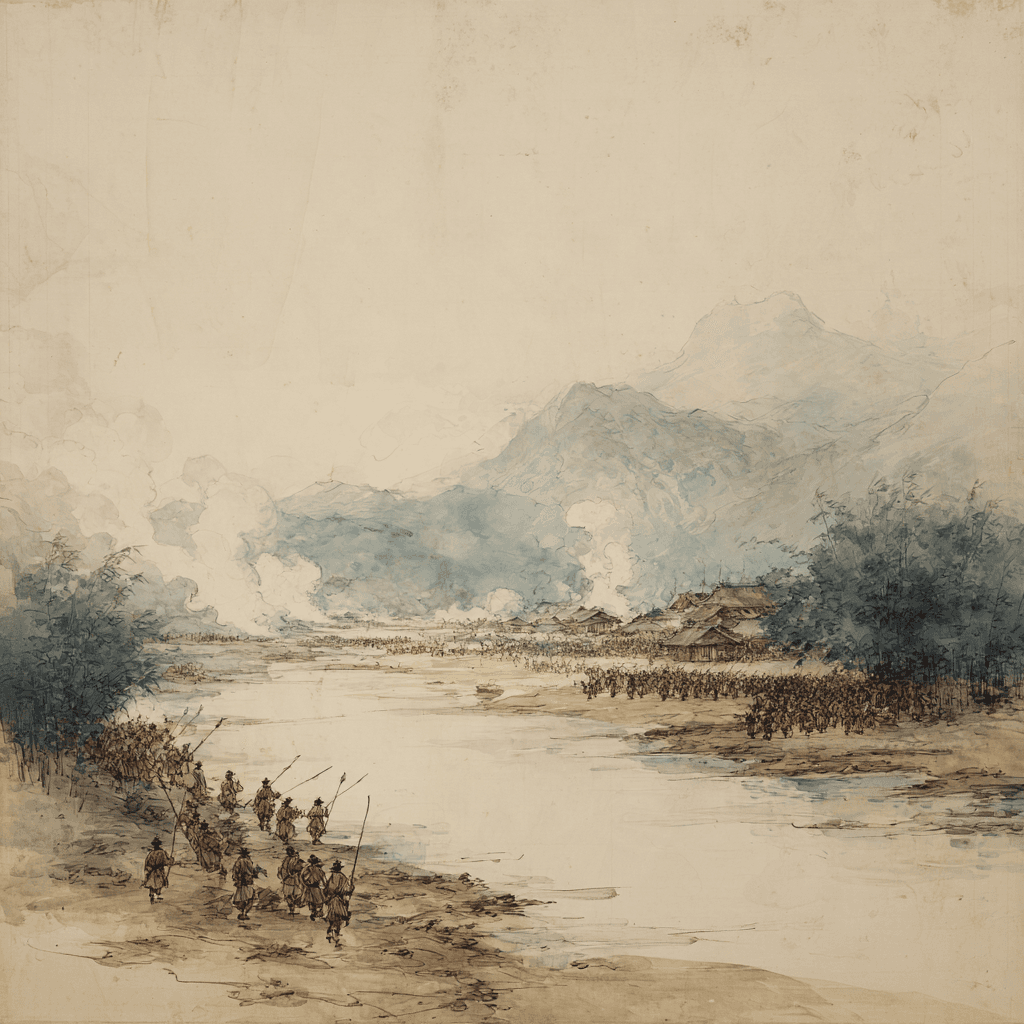
On the twelfth day of the sixth lunar month of 1721, more than twenty thousand of Zhu Yigui's followers appeared on the west bank of the Lower Tamsui River. On the other bank lay a belt of Hakka villages, their settlers mostly from Tingzhou, Zhenping, Pingyuan and Chengxiang, with a few Plains Indigenous villages scattered among them. Two months earlier, both banks had been on the same side.
In the third month of that year Du Junying raised his banner in the hills. He began with some sixty men, four Cantonese-registered, three Hokkien and the rest local to Taiwan prefecture; the following grew to tens of thousands and included Hokkien settlers from Zhangzhou and Quanzhou as well as Cantonese-registered men from Chaozhou and Hakka labourers. On the nineteenth of the fourth month Zhu Yigui rose near present-day Tianliao in Kaohsiung. The two forces routed the government troops at Chishan, and on the first of the fifth month they attacked the prefectural city together. Once it fell, the spoils had to be divided. Du Junying's camp fell out over titles and over a woman taken by force. His Hokkien commanders went over to Zhu Yigui, a fellow Hokkien, and Du Junying took the Cantonese-registered men north and later surrendered at Maoergan. The alliance had split along ancestral origin.
After the split, the Hakka villages on the east bank became Zhu Yigui's next target. Thirteen large villages and sixty-four small ones met at the Shangdi temple in Wandan and raised more than ten thousand men. They divided them into seven camps, the front, rear, left, right, centre, patrol and vanguard, chose Li Zhisan as chief headman and Hou Guande as his deputy, and set up a line of defence along the east bank. They said afterwards it was for self-protection, for fear the fighting would cross the river.
In 1895, when Japanese troops came south, the Six Units fought again, at Buyue Tower and at Huoshao village.
On the eighteenth and nineteenth of the sixth month the two sides fought across the river. In the same month the Governor-General of Fujian and Zhejiang, Gioro Manbao, and Lan Tingzhen sailed from Xiamen, joined Shi Shibiao in Penghu, and with eighteen thousand troops reached Luermen on the sixteenth of the sixth month. On the twenty-third they retook the prefectural city. On the fifth of the intercalary sixth month Zhu Yigui was captured at Gouwei village. He had been king for less than two months, and people sang: "Ming cap on his head, Qing robe on his back; Yonghe in the fifth month, Kangxi back in the sixth."
The court's reward came quickly. Seven men, Li Zhisan, Hou Guande, Qiu Yongyue, Liu Gengfu, Chen Zhanyu, Zhong Muhua and Zhong Muchun, were promoted to the rank of qianzong, with 950 taels of silver, 300 shi of rice and 100 bolts of silk, and their district was named Huaizhong, "Cherishing Loyalty." In 1722 Manbao ordered a Hall of Loyalty and Righteousness built at Xishi in the centre district, for the men who had died. The patrol camp was dropped, and the other six were renamed dui, "units," to set them apart from regular army camps. That is where the name Liudui, the Six Units, comes from. In today's townships the centre unit is Zhutian, the vanguard Wanluan, the rear Neipu, the front Linluo and Changzhi, the left Jiadong and Xinpi, the right Meinong and Gaoshu.
The arrangement was called out again. When Wu Fusheng rose in 1732, the Six Units chose Hou Xinfu as chief headman and assembled over ten thousand men from the Gangdong and Gangxi districts, and he led more than nine hundred of them across the river himself. In the Lin Shuangwen uprising of 1786 the Six Units met at the Hall of Loyalty and Righteousness, chose the provincial graduate Zeng Zhongli as headman, and picked over eight thousand men in six units to fight Zhuang Datian in the south. Afterwards the Qianlong Emperor sent the characters "Commended Loyalty" in his own hand, placed in the hall with a jade tablet bearing an imperial edict.
In 1895, when Japanese troops came south, the Six Units fought again, at Buyue Tower and at Huoshao village. This time there was no court to reward them. Taiwan had already been ceded to Japan. The jade edict tablet went missing from the hall that same year. In January 1958 the hall was renamed a shrine. On 18 October 2015 the old name was restored.
In the sixth month of 1721 the Hakka villages on the east bank of the Lower Tamsui River faced a very concrete problem. Across the water were more than twenty thousand men, the prefectural city had already fallen, and no government troops were coming to hold the river for them. Thirteen large villages and sixty-four small ones met at the Shangdi temple in Wandan because no single village could have lasted a day against that force on its own. Choosing Li Zhisan and Hou Guande as headmen and dividing into seven camps was arranged among the villages themselves. It did not come from any order from the court, which at that moment had no orders left to give in Taiwan.
After the fighting the court called this militia yimin, "righteous people," and they accepted the name, because the name came with the rank of qianzong, nine hundred and fifty taels of silver, and a Hall of Loyalty and Righteousness where the dead could be honoured every year. But the name also fixed something in place. In the official record, the east bank was righteous and the west bank was bandit. When the court faced uprisings again in 1732 and 1786 the Six Units were called out both times, and in 1786 the able-bodied men chosen numbered more than eight thousand. A militia raised for self-defence became, time after time, the most dependable body of men the court had in southern Taiwan.
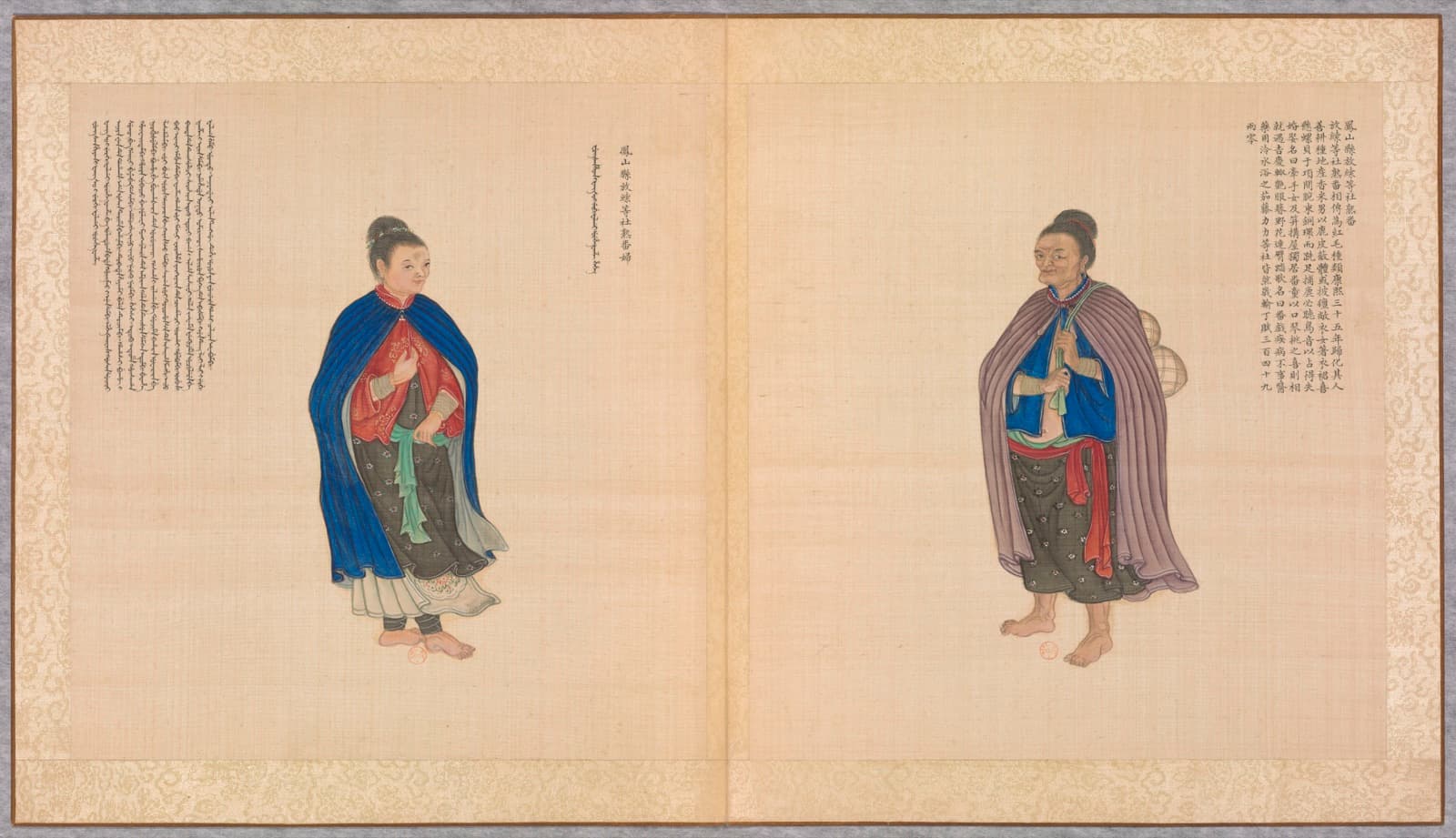
A Plains Indigenous couple of Fangsuo and neighbouring villages in Fengshan county, from the Zhigong tu commissioned under the Qianlong Emperor, around 1751. Fangsuo lay in present-day Linbian, Pingtung, on the plain south of the Lower Tamsui River, next to the left unit of the Liudui. The force that held the east bank in 1721 included Plains Indigenous men as well as Hakka settlers.
Zhigong tu, commissioned under the Qianlong Emperor; Bibliothèque nationale de France